For decision decks you need to send as they are, Claude and Codex with Super Document Skills won every blind pair. Gamma looks busy and finished, but it filled the gaps in the notes with numbers of its own.
Same requests and notes. Decision decks, judged in blind pairs.
The short answer
We gave Gamma and Super Document Skills the same two decision-deck requests and notes. A blind reviewer would send Gamma’s decks as they are in 0 of 8 pairings, and found invented numbers and a broken layout in all 8. It would send the skill’s decks 8 of 8 times, from Claude and from Codex, and picked the skill’s deck in every pair.
01 / At a glance
How Gamma and Super Document Skills differ
Feature
Gamma
Super Document Skills
What it is
An AI web app for presentations, documents, websites and social posts
A free skill set for Claude Code and Codex
Where you make the deck
In Gamma’s app from a prompt or an imported file. Gamma also connects to Claude and ChatGPT through an MCP connector, and has an API.
Inside the agent you already use, from your notes, files and context
Price
Free plan with 400 credits at signup (our decks used about 30 each) and up to 10 slides per prompt. Paid plans from $9 a month.
Free and open source (MIT)
Output
Gamma cards that scroll when they run long. PDF, PowerPoint, PNG and Google Slides export, including on the free plan.
An HTML deck: present in a browser, print to PDF or publish as a private or shared link
Sticks to your numbers
Not in our test: the reviewer found figures that weren’t in the notes in 8 of 8 pairings, including two made-up charts
Every number comes from your notes or is worked out from them; the reviewer found nothing invented in 8 of 8
Checks its own slides
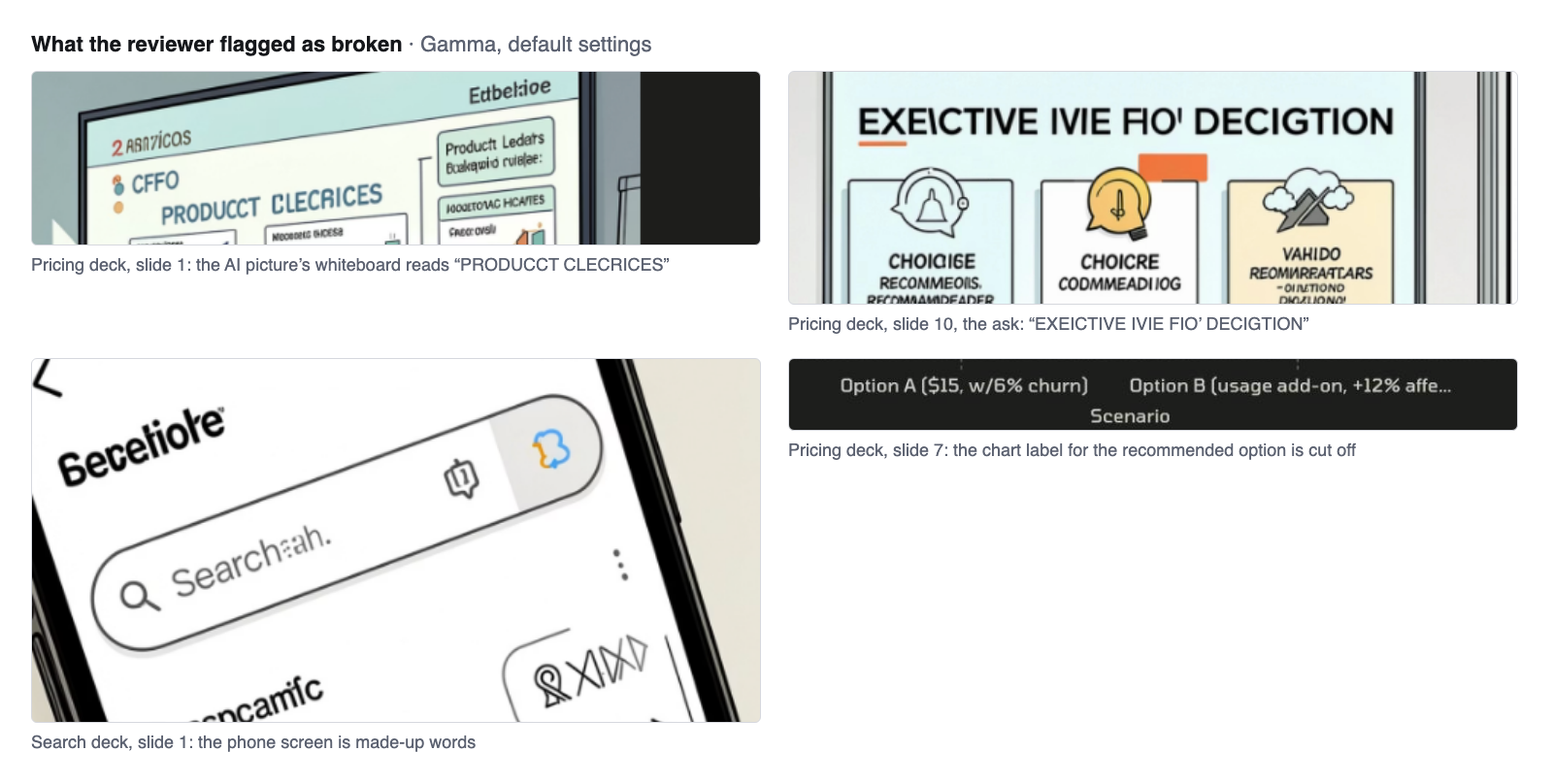
Not that we saw: garbled text inside AI pictures, a cut-off chart label and slides taller than the screen
A checker screenshots every slide and the agent fixes overflow, one-word lines and unlabeled charts
Length
10 slides at the default, even when the request asked for 4 or 5
As long as the request asks: 5 slides for the 4-or-5-slide request
Look
AI illustrations, cards and icons on every slide, from a theme you pick
Any style you describe; your own template and layout win
Editing
Visual editor and AI edits in the app
Ask your agent, or edit the HTML
02 / Blind test results
Which decks would a reviewer send?
8 blind pairs: each Gamma deck against 4 skill decks for the same request
What the reviewer found
Gamma
Claude + skill
Codex + skill
Would send as it is
0 of 8
4 of 4
4 of 4
Picked to send, of the pair
0 of 8
4 of 4
4 of 4
Looks better, of the pair
0 of 8
4 of 4
4 of 4
States something not in the notes
8 of 8
0 of 4
0 of 4
Broken layout
8 of 8
0 of 4
0 of 4
Looks like a generic template
8 of 8
0 of 4
0 of 4
Working notes left in
8 of 8
0 of 4
1 of 4
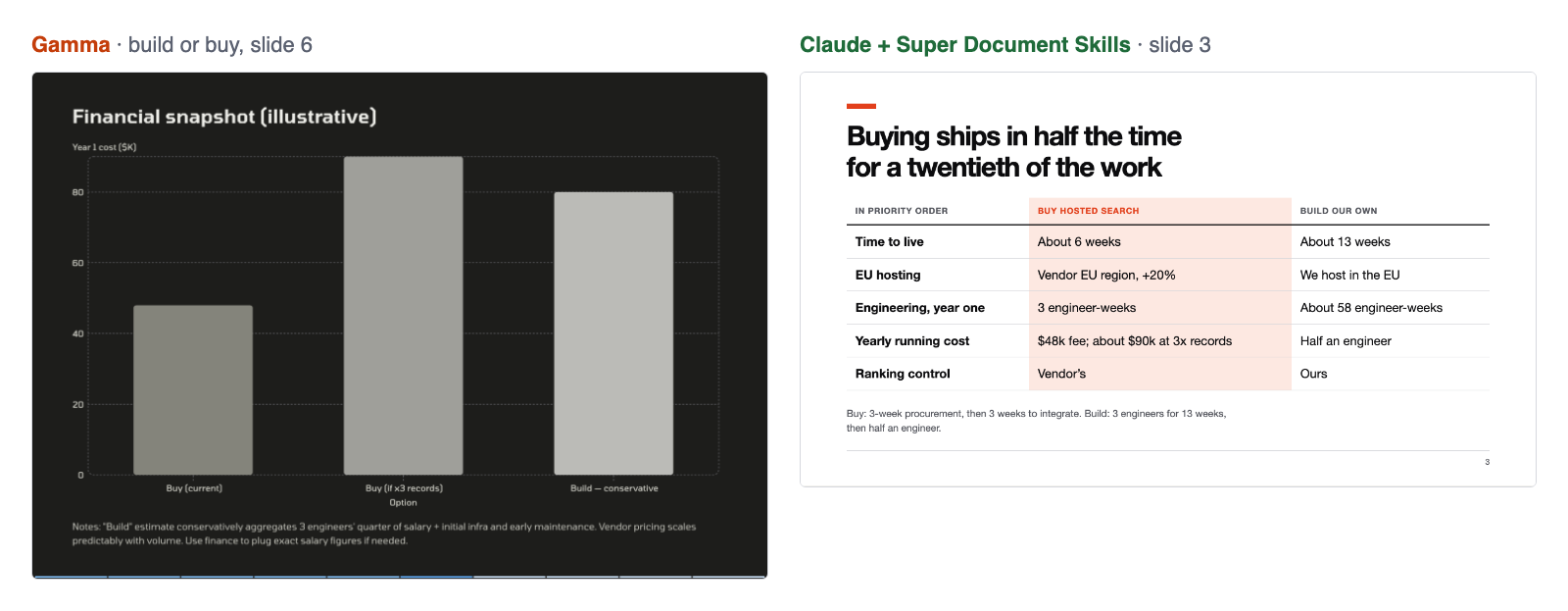
Gamma’s build-or-buy deck charts a build cost of about $80K that isn’t in the notes and labels it “illustrative”. On that chart, building looks cheaper than buying at scale, which works against the deck’s own recommendation to buy.
Where Gamma did well: every option and both sides got a slide, and its risk slide answers the platform lead’s ranking-control argument with a mitigation. The reviewer never called it plain or bare.
The same Codex decks with the skill were sendable 2 of 4 times in our SlideSpeak test and 4 of 4 here. A model reviewer varies; the Claude decks were 4 of 4 both times.
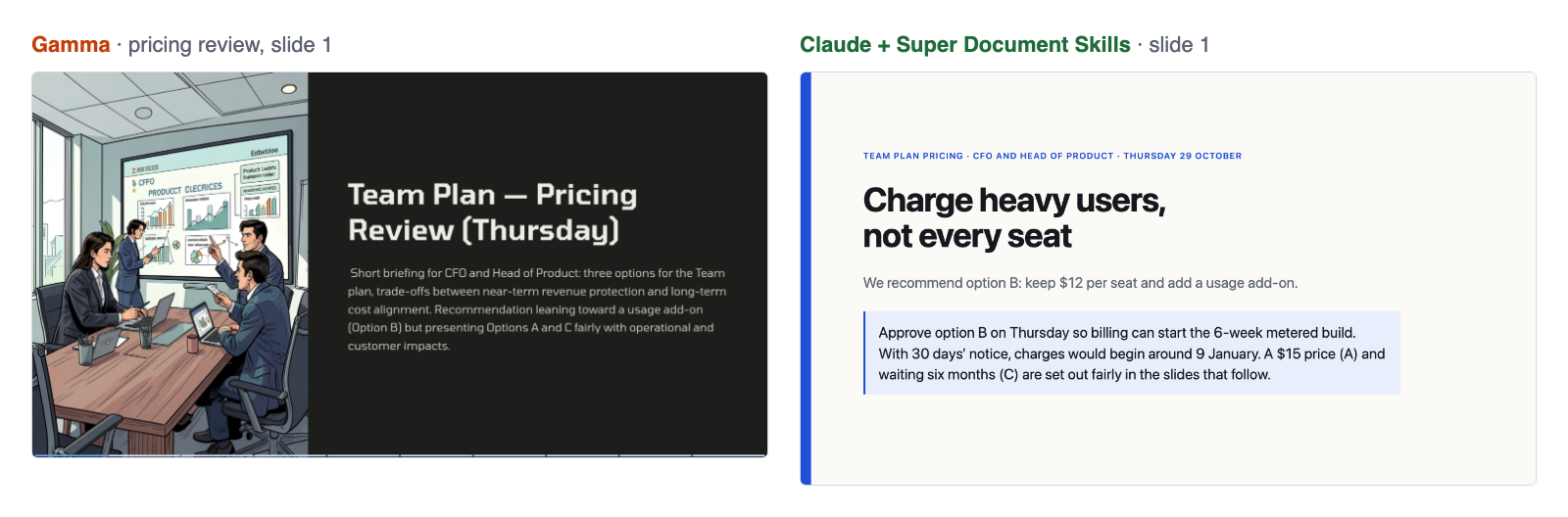
Build or buy, same request and notes. Gamma charts a build cost that isn’t in the notes and tells the reader to “plug exact salary figures”. Claude with the skill compares both options only on the numbers it was given, and still shows what buying gives up: ranking control.Close-ups from Gamma’s two decks at default settings. The AI pictures carry made-up words, and the chart label for the recommended option is cut off.Slide 1 of the pricing review. Gamma opens with a title, an AI illustration and a summary of the deck; the skill’s deck opens with the recommendation and the approval it needs.
03 / Strengths
Where each one wins
Gamma does well
Every slide is visual, with pictures, cards or a chart; nothing looks bare
All three pricing options and both sides of build or buy get space, with risks and mitigations
Fast: a full 10-slide deck from one prompt in a couple of minutes
PowerPoint, PDF and Google Slides export on the free plan, a visual editor, and an MCP connector for Claude and ChatGPT
Super Document Skills does well
Nothing invented: every number comes from your notes or is worked out from them
Slides that don’t break: 0 broken layouts against 8 of 8
The length you asked for, with the recommendation and the ask on slide 1
Works inside Claude Code or Codex, from your own notes and files, for free
04 / Which to use
Should you use Gamma or Super Document Skills?
Choose Gamma if
You want a polished visual deck fast from a short prompt, you need PowerPoint or Google Slides files, and you’ll check every number before you present it.
Choose Super Document Skills if
Your deck asks for a decision and the numbers have to be right: you already use Claude Code or Codex and want a deck you can send as it is.
05 / Method
How we tested
Two decision-deck requests held out from the skill’s tuning: a pricing review with three options for a CFO, and a punchy build-or-buy deck for a CEO in 4 or 5 slides. Both came with the same notes.
Gamma on its free plan on 31 October 2026, every setting at its default (10 slides, Classic theme, default card size, the audience and tone Gamma filled in). Slides captured from its Present mode, unedited; two chart slides taller than the screen were captured whole.
The skill’s decks are the ones from our published release test, made by Claude Code (Claude Opus 5.5) and Codex (GPT-6.1 Sol), two runs each. Not remade for this comparison.
A Claude model read every slide of both decks in each pair, in random order, without knowing which tool made which, answered a fixed checklist and picked the deck it would send.
Limits
Two Gamma decks, each judged four times, by a model rather than people.
Gamma at its defaults, without editing. Its default of 10 slides counted against it on the request for 4 or 5; setting the length by hand would likely clear that flag.
Our check of what each decision depends on reads a deck’s text, so it couldn’t score Gamma’s slide images and isn’t reported.
06 / Questions
Gamma vs Super Document Skills: common questions
Is there a free Gamma alternative for Claude?
Yes. Super Document Skills is a free, open-source skill set for Claude Code and Codex. Your agent makes the deck from your own notes, checks every slide, and you can present it in a browser, print it to PDF or publish it as a link. In our blind test a reviewer would send the skill’s decks 8 of 8 times, and none of Gamma’s as they were.
Can Gamma make decks inside Claude?
Gamma offers an MCP connector for Claude and ChatGPT and an API, so Claude can ask Gamma for a deck; Gamma then generates it on its own service. Super Document Skills works the other way: Claude itself writes the deck, following a tested method, and can use everything in your conversation and files.
Does Gamma make up numbers?
In our test it added figures that weren’t in the notes to both decks: a revenue chart for the pricing options and a build cost of about $80K for build or buy, both labelled illustrative. The reviewer flagged invented content in all 8 pairings. Check every number in an AI deck against your source before you present it.
Does Super Document Skills make PowerPoint files?
No. It makes HTML decks, which present in any browser, print to PDF and can be published as a private or shared link with share/artifacts. If you must hand over a .pptx or Google Slides file, Gamma exports both, even on its free plan.
Who judged the decks?
A Claude model acting as a blind reviewer, using the same checklist as our published release test: invented facts, plain or template look, broken layout, wordiness, working notes left in, and whether it would send the deck as it is. No human panel has judged these decks yet.
For Codex, use --agent codex. Using Claude in the browser? Connect share/artifacts and your agent gets the same deck recipes, then publishes the deck as a private or shared link.