For larger text, use “Read or print.”
Afterglow
Luminous mood art, an inspectable duration strip and spacious prompts shape a listening-session proposal.
Design study · 4 slides
Using Claude Code or Codex? Install the free presentation skill.
Source and instructions
Source notes
First-party fictional listening-session proposal. Not an event notice, actual participant study, recorded audio, waveform, spectrum or effect measurement.
Audience: community listening-circle organisers. Ask review/approve the30-minute sequence, then schedule only after authorized audio selection, facilitator confirmation and access review. None of those readiness conditions is complete; no approval secured. No date, venue, ticket offer, registration count or participants supplied.
Three proposed segments total30minutes:
A Arrive:8minutes, from0:00to0:08. Settle in and introduce the session.
B Listen:12minutes, from0:08to0:20. Focused listening to audio that still needs to be selected and authorized.
C Reflect:10minutes, from0:20to0:30. Discuss observations. This is reflection, not a third audio track.
These are planned durations, not measured attendance or outcomes. Duration geometry must encode8:12:10at every viewport; labels may sit outside the proportional strip. No sound-level, health, accessibility-compliance or emotional-benefit claims.
Reflection prompts supplied: What did you notice? What changed on a second hearing? What would you describe without naming a feeling? Prompts are optional discussion questions, not evidence that a second playback happened or fits in12minutes. Do not add tracks, composers, artists, repeats or playback lengths.
Readiness items all pending: authorized audio selected; facilitator confirmed; access review completed. Access needs/format are not supplied, so do not claim a quiet room, captions, step-free venue or specific accommodation is secured. No fee, budget or funding figures supplied.
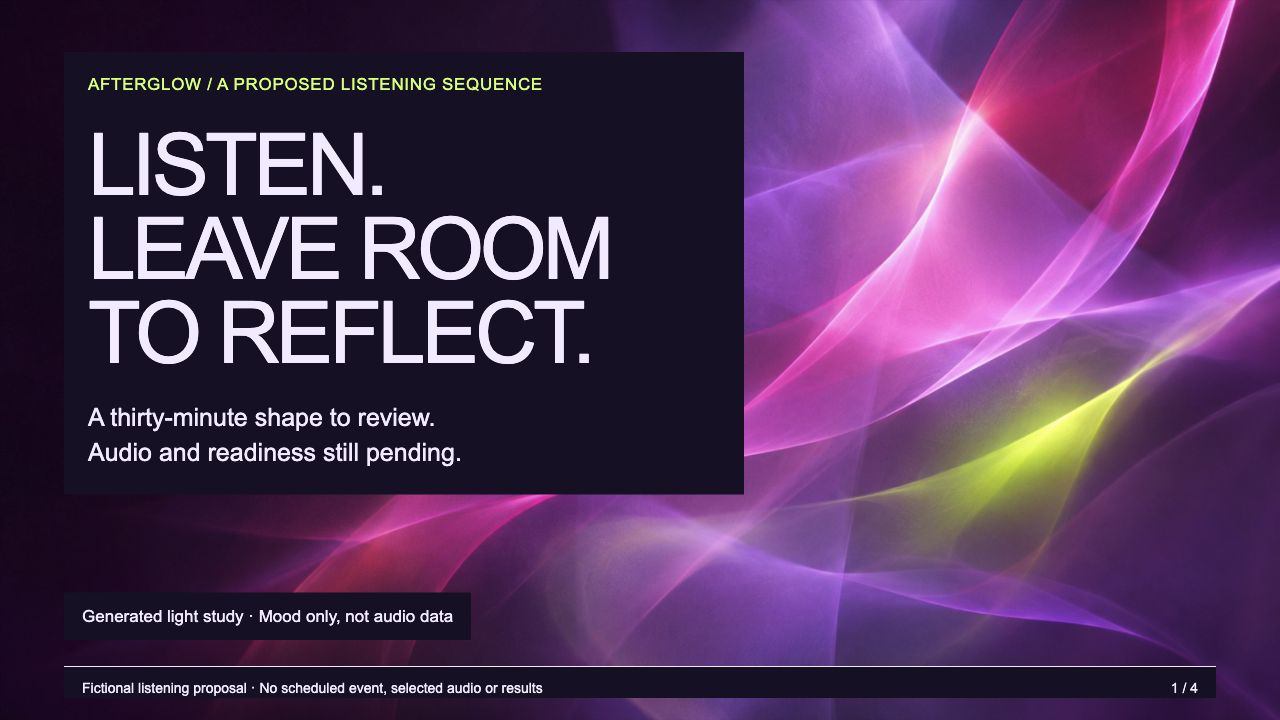
Original generated abstract light image may establish mood only, with an explicit label. It is not a concert photo, real venue, physical light installation, actual waveform or frequency data. Exact times, segment roles and readiness remain native selectable content.
Design instructions
Afterglow: luminous programme storytelling with midnight plum #170e2b, pale text #f5eeff, rose #e290c5, acid lime #d6ff7d and lavender surfaces. Pair an original abstract-light mood image with a solid dark reading panel, large open sans-serif headlines, a proportional duration strip, labelled segment ranges and spacious numbered reflection prompts. Keep decorative light separate from timing or audio data: never imply a waveform, spectrum, measured effect or actual venue. Generate original mood art when a suitable image tool is available and imagery helps; if optional generation is unavailable or fails, use a native restrained plum-to-lavender gradient and preserve the complete programme. Keep the actual duration geometry proportional at every width, move labels outside small segments, retain the total and distinguish reflection from playback. Keep authorization, facilitator and access readiness explicit; never invent tracks, repeats, outcomes or confirmed accommodations. Adapt the sequence and slide count to the supplied programme rather than a fixed event-pitch template.

Use my supplied content and the format I requested. Keep its facts, numbers, denominators, uncertainty and conclusion. Do not inherit the example deck’s story, figures or recommendation. The visual direction guides design; the audience and argument determine the slide sequence.

Check the tools available in this session. When an image would improve the presentation and a suitable generation tool is available, generate an original image or use an asset I am authorized to supply. If optional generation is unavailable or fails, continue with a complete image-free composition. Reclaim the space, leave no placeholders, and do not ask me to enable a tool or delay the deck for optional imagery. Mention a failure in the handoff rather than on audience-facing slides. If I explicitly require a particular image, preserve that requirement and explain any unmet dependency.

Keep text and evidence selectable. For HTML, use one self-contained static document with embedded CSS, compressed data images and licensed embedded fonts when needed; do not add scripts, forms, remote calls or authored slide controls. Preserve font licenses and asset provenance. Label conceptual or generated imagery when it could be mistaken for real product, customer or event evidence. Never invent a product screenshot to prove a feature.

Render every slide and inspect the actual result before handing it over. Check crop, contrast, type hierarchy, labels, overflow and source fidelity. Use at least 4.5:1 contrast for body text and 3:1 for large text. Check the destination’s file/data-image limits before any separately authorized publication. If visual checking is unavailable, say so in the handoff.About this design study
Four slides preserve a first-party fictional thirty-minute sequence, optional reflection prompts and unresolved audio, facilitator and access readiness. This is an authored fictional proposal. The original generated light image is mood artwork, not a waveform, spectrum, actual venue, installed artwork or measured listening outcome.