For larger text, use “Read or print.”
Atelier
Conceptual objects, expressive chapter type, an honest inventory and a quiet budget spread.
Design study · 5 slides
Using Claude Code or Codex? Install the free presentation skill.
Source and instructions
Source notes
FIRST-PARTY FICTIONAL TEST BRIEF. The museum, exhibition, object counts, budget and plans are invented for a presentation example; no real collection or loan is represented.

Make a five-slide museum board proposal for Common Ground Museum's exhibition "Made Again": how everyday objects are made, used and repaired. Ask for approval of an $84,000 budget envelope, with fabrication held until the loan and accessibility reviews are complete.
- Target: a six-week exhibition in autumn 2027. Exact opening and closing dates are not set.
- Three proposed chapters: Material, Use, Repair.
- 24 objects proposed: 10 owned objects confirmed; 8 potential loans requested but not secured; 6 replicas to commission.
- Budget envelope: fabrication $32,000; interpretation $18,000; loan logistics $14,000; access $10,000; contingency $10,000. Total $84,000.
- Planned interpretation/access: large-print labels and audio description. These are proposed, not delivered.
- Two family workshops are proposed; facilitators are not yet booked.
- No attendance forecast or measured visitor-learning outcome is available. A voluntary exit question is planned; no responses have been collected.
- Loan and accessibility reviews must be complete before fabrication. Do not present the requested budget approval as granted.
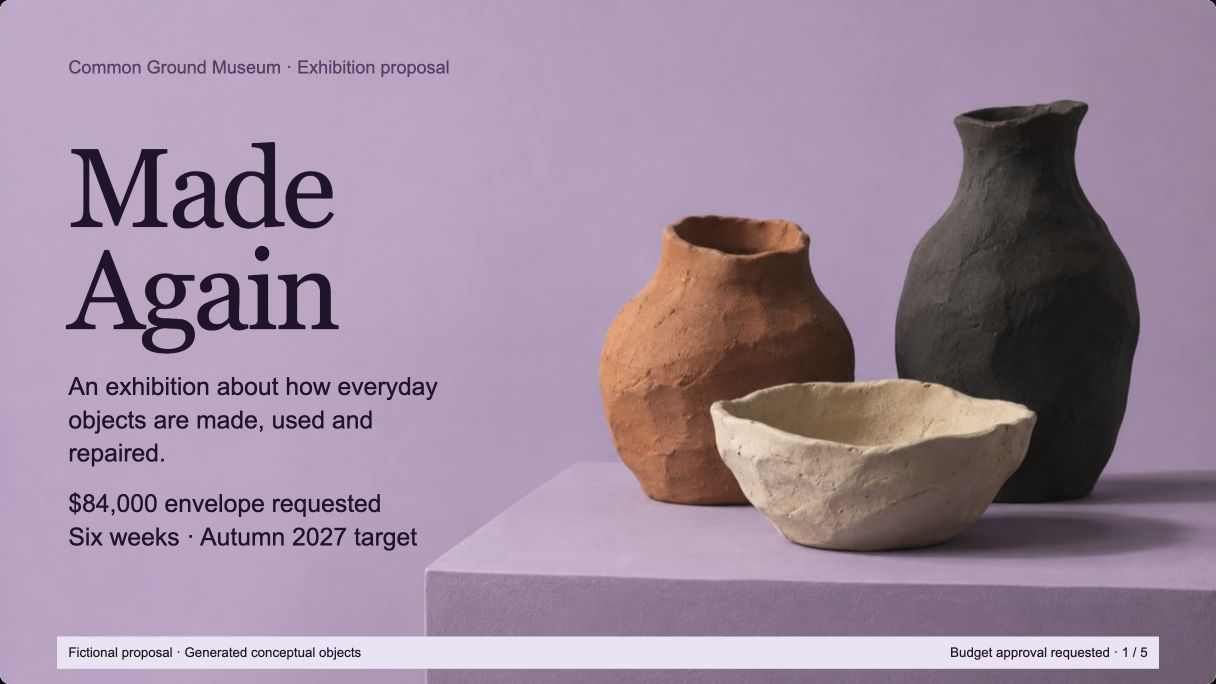
A generated still life of anonymous ceramic objects can illustrate the visual direction. It must be identified as conceptual and must not pretend to show confirmed collection objects or actual loan items.
Design instructions
Create a cultural exhibition or concept proposal in the Atelier direction. Carry the supplied curatorial idea into a clear story, then distinguish confirmed objects, requested loans, replicas and other proposed content. Keep the budget envelope, approval status, access plans, dependencies and unmeasured audience outcomes honest. Do not turn a desired object into a secured loan, a concept render into a real collection photograph, or a planned learning question into a measured visitor result. Let the material determine the chapters and slide count.

Use soft lavender (#eee7f6), dark plum ink (#241330), violet (#65347c), near-white (#fdfbff) and a restrained clay accent (#994b2d). Pair large Georgia display type with a readable system sans-serif for evidence. Let objects and words share the stage: generous negative space around a conceptual still life, large chapter words with short interpretive text, an open inventory with status labels and a quiet budget spread. Keep the visual rhythm closer to an exhibition proposal than a dashboard of cards. Use a restrained lavender gradient only as atmosphere, never to encode quantitative values.

Use authorized photographs of real works when supplied. When generation is available and useful, create original anonymous conceptual objects rather than imitating or claiming a real collection item; label the illustration accordingly. If optional images are unavailable or generation fails, preserve the identity with expressive chapter typography, open inventory marks and a gentle lavender surface. Recompose the whole slide instead of leaving an empty artwork frame. Preserve selectable captions, object status and factual evidence.

Use my supplied content and the format I requested. Keep its facts, numbers, denominators, uncertainty and conclusion. Do not inherit the example deck’s story, figures or recommendation. The visual direction guides design; the audience and argument determine the slide sequence.

Check the tools available in this session. When an image would improve the presentation and a suitable generation tool is available, generate an original image or use an asset I am authorized to supply. If optional generation is unavailable or fails, continue with a complete image-free composition. Reclaim the space, leave no placeholders, and do not ask me to enable a tool or delay the deck for optional imagery. Mention a failure in the handoff rather than on audience-facing slides. If I explicitly require a particular image, preserve that requirement and explain any unmet dependency.

Keep text and evidence selectable. For HTML, use one self-contained static document with embedded CSS, compressed data images and licensed embedded fonts when needed; do not add scripts, forms, remote calls or authored slide controls. Preserve font licenses and asset provenance. Label conceptual or generated imagery when it could be mistaken for real product, customer or event evidence. Never invent a product screenshot to prove a feature.

Render every slide and inspect the actual result before handing it over. Check crop, contrast, type hierarchy, labels, overflow and source fidelity. Use at least 4.5:1 contrast for body text and 3:1 for large text. Check the destination’s file/data-image limits before any separately authorized publication. If visual checking is unavailable, say so in the handoff.About this design study
Five slides present a first-party fictional museum proposal, separating confirmed objects, requested loans, replicas and review gates. This is an authored study from a first-party fictional brief. The ceramics are original generated conceptual objects, not actual collection objects or loan items.