For larger text, use “Read or print.”
Cabinet
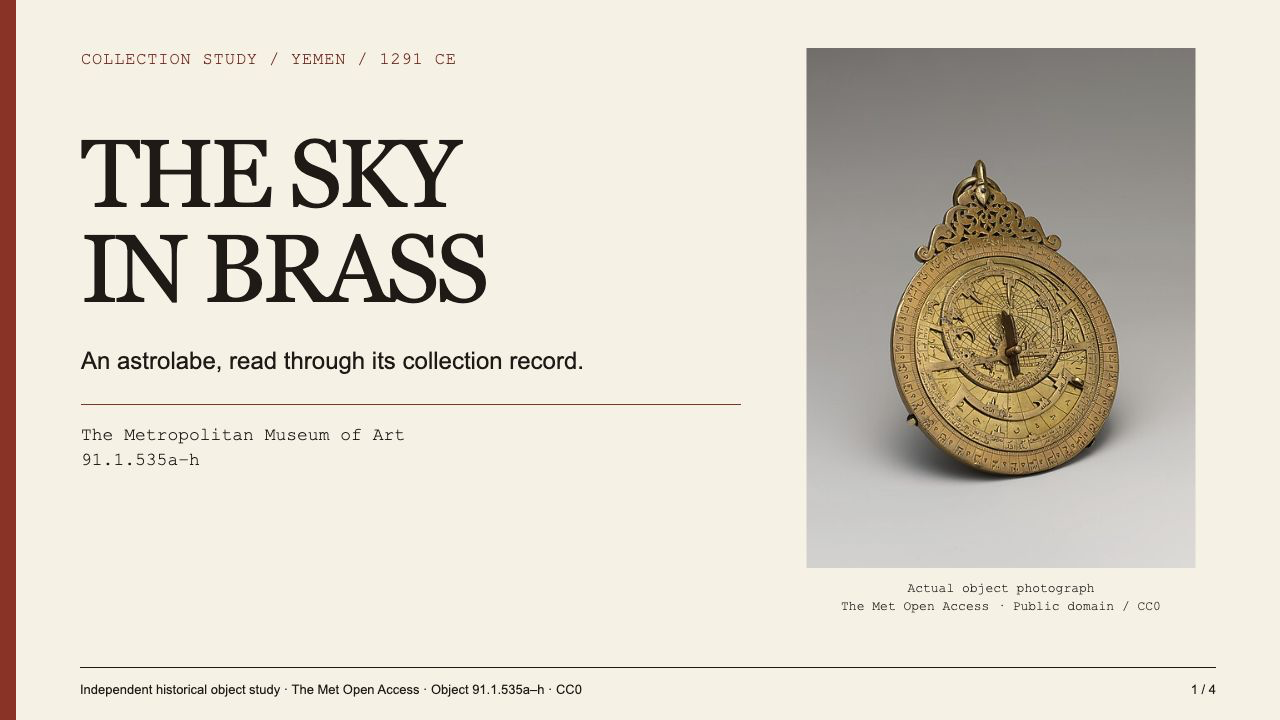
An authorized object photograph, catalogue rail, accession labels and proportional diameter markers keep the record beside the image.
Design study · 4 slides
Using Claude Code or Codex? Install the free presentation skill.
Source and instructions
Source notes
SOURCE-LINKED HISTORICAL OBJECT STUDY. Authoredsummaryofpubliccollectionrecords, notfictionalobjects, museumcuration/endorsement oractualexhibition/loanplanning.
Primary record: https://www.metmuseum.org/art/collection/search/444408
PublicAPI snapshot met-record.json from https://collectionapi.metmuseum.org/public/collection/v1/objects/444408 checked2026-11-03,objectID444408,isPublicDomaintrue.
Use thisMetobject, notthe differentSmithsonianEnglishastrolabe.
Full recordedmaker: ‘Umar ibn Yusuf ibn ‘Umar ibn ‘Ali ibn Rasul al-Muzaffari. Fullobjecttitle: Astrolabe of ‘Umar ibn Yusuf ibn ‘Umar ibn ‘Ali ibn Rasul al-Muzaffari.
Recorddate: dated690AH/1291CE. MadeinYemen. Material: brass;castandhammered,pierced,chased,inlaidwithsilver. Objectnumber91.1.535a–h. Creditline: EdwardC.MooreCollection,BequestofEdwardC.Moore,1891.
The museum'sdescriptionstatesinscriptionattributiontoRasulidprince‘UmaribnYusuf beforehisrule1295–96. No actualinscriptiontranscriptionisprovidedbythisstudy; do notpretendwecanreaditfromthepackagedphoto. The educationalnarrative canpairscientificpurposewithmetalwork, notofferanoperationalnavigationprocedure.
Component-specificmetricmeasurements inrecord:
Case(a): maximumwidth19.4cm,diameter15.6cm,depth0.6cm.
Net(c): diameter12.7cm. Plates(d–g): diameter12.7cm.
Do notapplycasemeasurementstoeachpartorlabel19.4asanunsourcedheight. Nativecirclemarkerscompare15.6and12.7diametersononeconsistentdisplayscale; notactualpartdrawingsorphysical1:1screensize. No inventedcompleteownershipchain, precision/calibrationclaims, currentdisplaystatus/tickets/availability/loans.
Image download: officialpublicweb-largephoto https://images.metmuseum.org/CRDImages/is/web-large/DP170386.jpg . Preserveunmodifieddownloadedbytes; actualobjectphotograph, notAIgenerated. No inventedphotographer.
Rights: recordmarksPublicDomain/isPublicDomaintrue. OpenAccesspolicy https://www.metmuseum.org/hubs/open-access releasespublicdomainimages/basicdata underCC0. CreditTheMetOpenAccess andobjectnumber; preservethefullrecordcreditlineinthestudy/source.
Reuseinstructionsmustpreferauthorizedrealobjectimageswhenevidence; generatedconceptcannotstandinforcollectionproof. Optionalimageryunavailable/failedfallbacknativecataloguerecord/type/measurementmarkerswithnomissingimageplaceholder.
Design instructions
Cabinet: an archival object catalogue with ivory #f8f3e8, dark umber #211b16 and oxblood #9d2f28. Use a narrow red catalogue rail, large normal-weight Georgia titles, monospaced accession labels, complete uncropped object photographs and component-specific measurement plates. Let the actual object remain separate from native explanatory markers. Scale comparable diameters with one unit per viewport and label markers as schematics, not part drawings or a physical screen ruler. Keep maker attribution, dates, material techniques, accession number, credit line and primary record beside the image; do not invent provenance, calibration or current display status. Adapt the story to supplied records rather than copying the astrolabe. Prefer an authorized photograph for object evidence. If imagery is optional and unavailable or fails, remove the photo slot and build a complete typographic record with native measurement markers. If generation is available, optional conceptual context must be labelled and kept distinct from a real collection object; never replace documentary evidence with a generated replica. An explicitly required missing source image remains a dependency. Preserve source rights and credits without implying museum endorsement.

Use my supplied content and the format I requested. Keep its facts, numbers, denominators, uncertainty and conclusion. Do not inherit the example deck’s story, figures or recommendation. The visual direction guides design; the audience and argument determine the slide sequence.

Check the tools available in this session. When an image would improve the presentation and a suitable generation tool is available, generate an original image or use an asset I am authorized to supply. If optional generation is unavailable or fails, continue with a complete image-free composition. Reclaim the space, leave no placeholders, and do not ask me to enable a tool or delay the deck for optional imagery. Mention a failure in the handoff rather than on audience-facing slides. If I explicitly require a particular image, preserve that requirement and explain any unmet dependency.

Keep text and evidence selectable. For HTML, use one self-contained static document with embedded CSS, compressed data images and licensed embedded fonts when needed; do not add scripts, forms, remote calls or authored slide controls. Preserve font licenses and asset provenance. Label conceptual or generated imagery when it could be mistaken for real product, customer or event evidence. Never invent a product screenshot to prove a feature.

Render every slide and inspect the actual result before handing it over. Check crop, contrast, type hierarchy, labels, overflow and source fidelity. Use at least 4.5:1 contrast for body text and 3:1 for large text. Check the destination’s file/data-image limits before any separately authorized publication. If visual checking is unavailable, say so in the handoff.About this design study
Four slides use The Met object 444408: its maker attribution, date, materials, component-specific measurements, accession number and full credit line. This is an independently authored historical object study using The Met Open Access record and public-domain photograph, not fictional objects, a museum-authored or endorsed presentation, an exhibition notice or an unedited recipe evaluation.