For larger text, use “Read or print.”
Chord
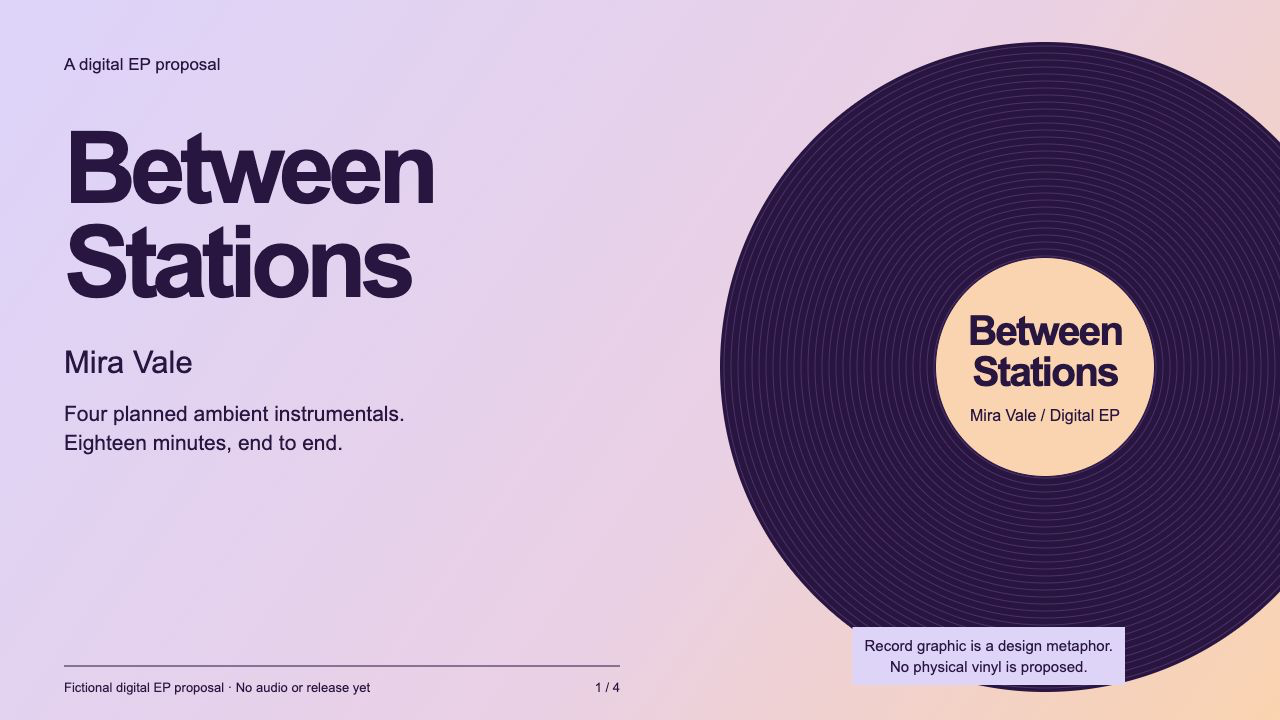
An off-center native record form and lilac-to-peach gradient carry through track lists, budget stacks and a completion sequence.
Design study · 4 slides
Using Claude Code or Codex? Install the free presentation skill.
Source and instructions
Source notes
FROZEN FICTIONAL SOURCE BRIEF · CHORD
Authored for a local presentation style study. No actual musician, audio, listeners or release.
Audience: a small independent-label review group. Job: approve completion funding for a proposed digital EP.
Fictional artist: Mira Vale. Proposed EP: Between Stations. Four planned tracks: Platform Light4:00; Blue Hour5:30; Last Connection3:30; Home Signal5:00. Total18:00. Genre direction: ambient instrumentals. Track names and durations are plans, not measured audio.
Release format: digital EP; no physical vinyl manufacture proposed. A native record graphic is a design metaphor only. No playable audio exists for this study, no waveform/amplitude/frequency claim.
Completion budget request:$1,800; mixing$900, mastering$500, artwork$400. No revenue forecast, audience result or contracted supplier quote.
Proposed sequence: finish mixes, approve masters, package release. No dates or release commitment. Rights checks and final artwork approval remain outstanding.
Ask: approve the$1,800 completion budget conditional on resolving rights and approving final artwork before publication. No approval yet.
Visual direction: lilac/plum record-sleeve typography and large off-center concentric record forms. A soft lavender-to-peach gradient supplies atmosphere; linear track strips show the exact planned durations at one scale, not audio data. Optional generated sleeve art could support another brief, but this native example intentionally needs no image tool. If generation is available for optional artwork, label it conceptual and preserve readable type; otherwise continue with complete native gradients, rings and track strips.
Design instructions
Chord: a record-sleeve visual language in plum #30164c, lavender #e3d9fb, peach #ffd6b6 and violet #7142a8. Use oversized tight Arial display, an off-center concentric native record form, a quiet lilac-to-peach gradient, spare track rows and duration-proportional strips. Carry the sleeve character into budget stacks and a completion sequence without converting every slide into a cover. Keep native atmosphere separate from evidence: rings are not a manufacture promise, duration strips are not audio waveforms, and release plans are not listener results. Adapt compositions and arguments to supplied content; do not inherit this artist, tracks or budget. Optional image generation may create clearly conceptual original sleeve artwork when it improves the actual brief and an authorized tool is available. If generation is unavailable or fails, continue with a complete native composition using gradients, rings and typographic track lists, reclaiming the image space with no placeholder. Keep all text and factual evidence native/selectable; preserve costs, exact durations, conditions and missing dates.

Use my supplied content and the format I requested. Keep its facts, numbers, denominators, uncertainty and conclusion. Do not inherit the example deck’s story, figures or recommendation. The visual direction guides design; the audience and argument determine the slide sequence.

Check the tools available in this session. When an image would improve the presentation and a suitable generation tool is available, generate an original image or use an asset I am authorized to supply. If optional generation is unavailable or fails, continue with a complete image-free composition. Reclaim the space, leave no placeholders, and do not ask me to enable a tool or delay the deck for optional imagery. Mention a failure in the handoff rather than on audience-facing slides. If I explicitly require a particular image, preserve that requirement and explain any unmet dependency.

Keep text and evidence selectable. For HTML, use one self-contained static document with embedded CSS, compressed data images and licensed embedded fonts when needed; do not add scripts, forms, remote calls or authored slide controls. Preserve font licenses and asset provenance. Label conceptual or generated imagery when it could be mistaken for real product, customer or event evidence. Never invent a product screenshot to prove a feature.

Render every slide and inspect the actual result before handing it over. Check crop, contrast, type hierarchy, labels, overflow and source fidelity. Use at least 4.5:1 contrast for body text and 3:1 for large text. Check the destination’s file/data-image limits before any separately authorized publication. If visual checking is unavailable, say so in the handoff.About this design study
Four slides carry a fictional digital EP proposal with four planned tracks totaling 18 minutes, an 1800-dollar completion request and rights/artwork conditions. Independently authored fictional digital EP proposal with native CSS graphics. No playable audio, physical vinyl manufacture, measured audience result or unedited released-recipe evaluation is implied.