For larger text, use “Read or print.”
Constellation
Stable native nodes, adjacency records and one explicitly removed edge distinguish a connected graph from two remaining sets.
Design study · 4 slides
Using Claude Code or Codex? Install the free presentation skill.
Source and instructions
Source notes
CONSTELLATION / Frozen abstract graph lesson
Purpose: explain connectedness in one abstract undirected, unweighted graph. This is not actual network traffic, an infrastructure diagram, a resilience test or a measured operational result.
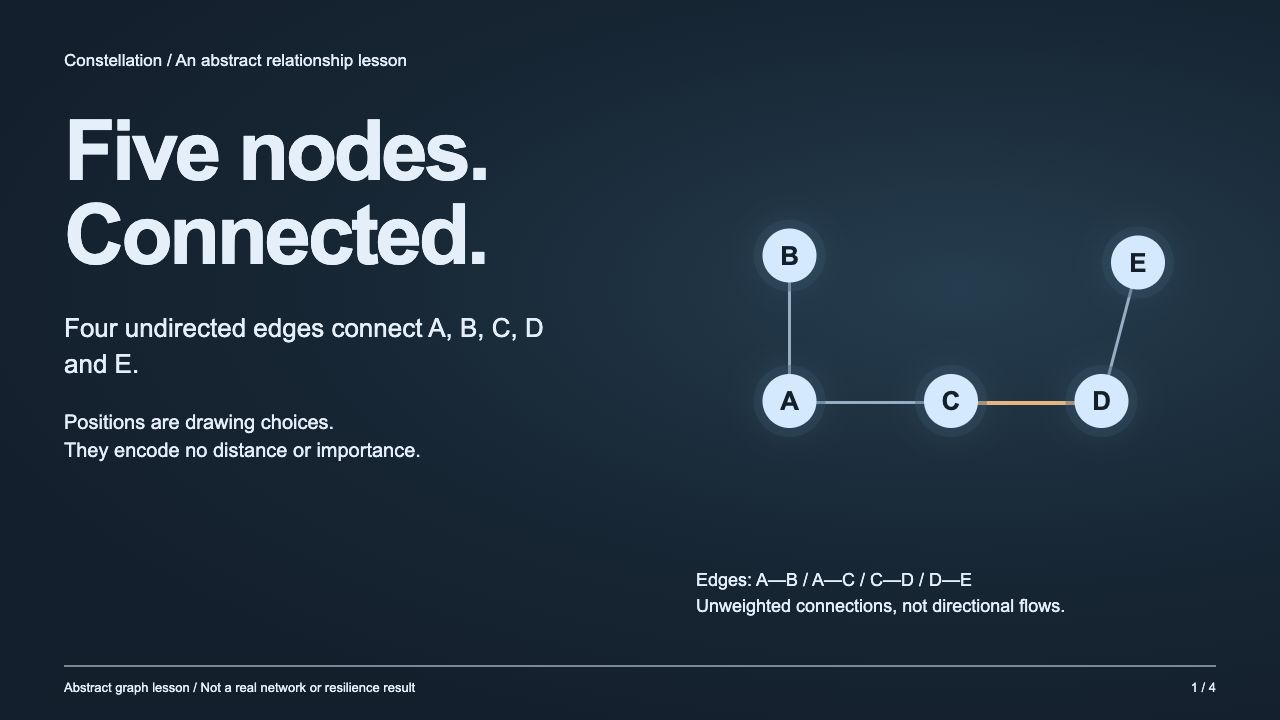
Five labelled nodes A,B,C,D,E. Exactly four undirected edges: A-B, A-C, C-D, D-E. Edges indicate connection only, no direction, distance, capacity, frequency or weight. Node positions are a drawing choice and encode no physical or measured quantity.
Adjacency lists: A has B,C; B has A; C has A,D; D has C,E; E has D. Every node can reach every other through edges, so the given graph is one connected set. Node degrees2,1,2,2,1 sum8, twice the four-edge count; this optional calculation does not establish importance.
Remove exactly edge C-D, leaving A-B,A-C,D-E. The resulting graph has two connected sets: A,B,C and D,E. There is no remaining edge path between these sets. The nodes and all other edges remain unchanged.
Restore edge C-D and all five nodes form one connected set again. In this specific graph C-D is a bridge because removing it increases the number of connected sets. This observation does not guarantee robustness, identify a real critical asset or establish impact, probability or recovery time in an actual system.
Keep node names, edge endpoints and state labels stable across the lesson. Show an absent edge with a dashed break and explicit removed label, not color alone. Native diagrams and text need no images.
Four-slide independently authored abstract computing lesson, not a released-recipe evaluation or a recommendation about real network architecture.
Design instructions
Constellation: a relationship-graph language with a petrol-to-deep-navy radial gradient #24475a to #102333, pale blue live nodes #d7edff, muted connection lines #9bb8cb and apricot edge emphasis #efba88. Use spacious glowing node fields, stable labels, adjacency rows and a single controlled edge change; carry the same node positions and edge identities across all states. Lines in an undirected unweighted graph encode connection only, never direction, importance, distance, capacity or measured flow. Draw absent links as explicit dashed breaks with a removed label, and identify resulting sets with names as well as outlines. Verify every adjacency and reachable set against the supplied edge list; do not invent edges to make a composition balanced. Restore the changed edge for the concluding comparison when the source supports it. Keep native labels on high-contrast opaque nodes and captions readable on the gradient. Reflow diagrams and records on phones while preserving identities and visible edges. The complete native graph and gradient require no images. Omit optional generated atmosphere if unavailable and continue with the graph, labels and records; required documentary network evidence remains a dependency. Never translate an abstract bridge example into a real resilience, criticality or operational-impact claim without evidence.

Use my supplied content and the format I requested. Keep its facts, numbers, denominators, uncertainty and conclusion. Do not inherit the example deck’s story, figures or recommendation. The visual direction guides design; the audience and argument determine the slide sequence.

Check the tools available in this session. When an image would improve the presentation and a suitable generation tool is available, generate an original image or use an asset I am authorized to supply. If optional generation is unavailable or fails, continue with a complete image-free composition. Reclaim the space, leave no placeholders, and do not ask me to enable a tool or delay the deck for optional imagery. Mention a failure in the handoff rather than on audience-facing slides. If I explicitly require a particular image, preserve that requirement and explain any unmet dependency.

Keep text and evidence selectable. For HTML, use one self-contained static document with embedded CSS, compressed data images and licensed embedded fonts when needed; do not add scripts, forms, remote calls or authored slide controls. Preserve font licenses and asset provenance. Label conceptual or generated imagery when it could be mistaken for real product, customer or event evidence. Never invent a product screenshot to prove a feature.

Render every slide and inspect the actual result before handing it over. Check crop, contrast, type hierarchy, labels, overflow and source fidelity. Use at least 4.5:1 contrast for body text and 3:1 for large text. Check the destination’s file/data-image limits before any separately authorized publication. If visual checking is unavailable, say so in the handoff.About this design study
Four teaching slides use five abstract nodes and four undirected, unweighted edges, preserving the exact adjacency and the bounded effect of removing and restoring one edge. Independently authored abstract graph lesson using native diagrams and gradients. It is not actual network traffic, an infrastructure audit, a resilience test, a critical-asset assessment or a measured operational result.