For larger text, use “Read or print.”
Cyanotype
Botanical imagery and book-like typography for a seed-library proposal.
Design study · 5 slides
Using Claude Code or Codex? Install the free presentation skill.
Source and instructions
Source notes
First-party fictional brief. No actual archive, grant, botanical specimen or measured conservation result.
Audience: the board of the fictional Common Ground seed library. Ask: approve a $3,600 documentation pilot lasting six weeks. This has not been approved or funded.
The current inventory has180 packet records.120 records have a packet photograph;60 do not. Records and photographs are documentation, not evidence of seed viability or taxonomic identification.
145 records are cleared for public access.35 still require permission review. Do not claim the pilot will secure those permissions or make all180 public.
Pilot targets: photograph the remaining60 packets, check the labels on all180 records, and review the35 permissions. Publish only records cleared for public access. These are proposed targets, not completed outputs.
Available volunteer capacity: two volunteers, each three hours per week for six weeks. Derived total36 volunteer hours. This capacity is not a measured task-completion rate.
Budget request: scanner and lightbox$1,400; cataloguing contractor$1,200; open-session materials$600; contingency$400. Total$3,600. No funding has been secured.
No germination tests, verified species identification, seed storage improvement or future viability claims are included. No exact start date or guaranteed completion rate is supplied.
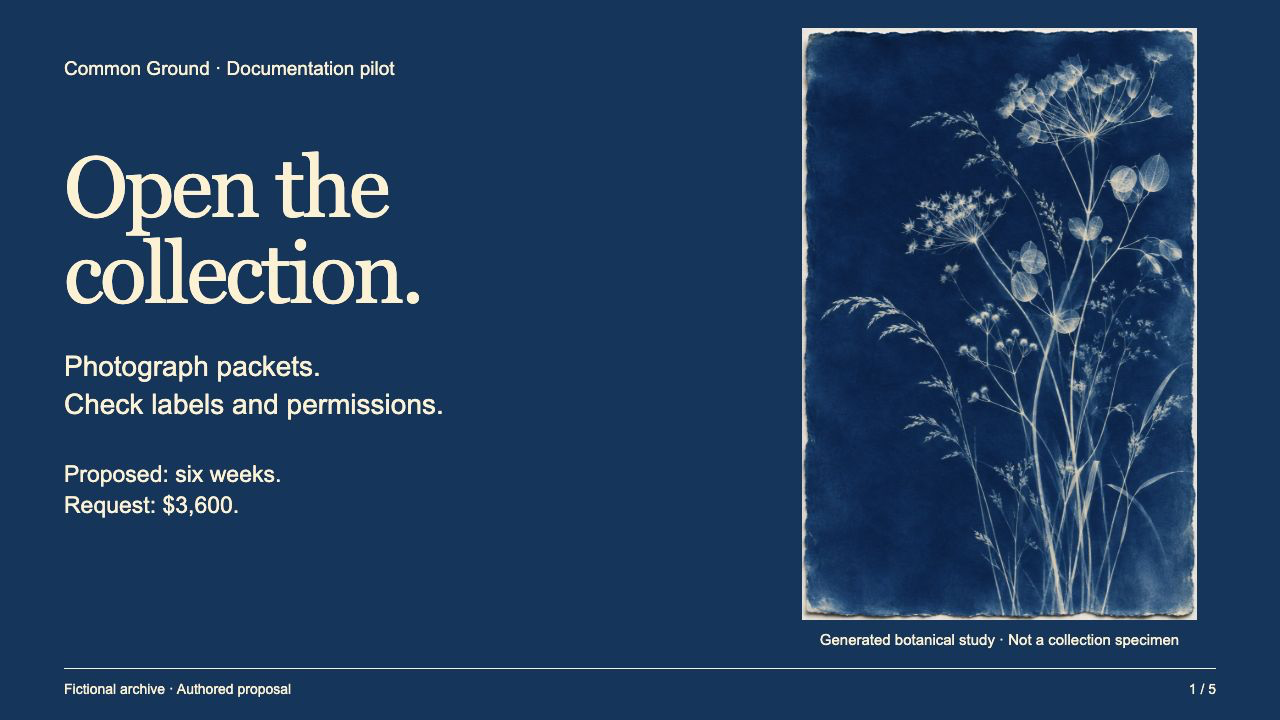
Visual: cyanotype-inspired botanical plate. Any generated plant image is conceptual design imagery, not an actual specimen in this collection. Do not label a botanical species or present it as scientific identification.
Design instructions
Create a deck in the Cyanotype direction: a botanical-print or archival-plate visual language for a collection, research proposal or cultural programme. Use my material as the source. Separate inventory, documentation, access permissions and evidence about the objects themselves; a record or photograph does not establish authenticity, identification, condition or future performance. Keep proposed work, available capacity and measured output distinct.

Use deep Prussian blue (#083e68), pale paper (#eff4e7), chalk ivory (#fff2d8) and restrained blue-grey rules. Pair expressive Georgia bookplate headlines and large serif inventory numerals with readable Arial or Helvetica annotations. Let a tactile plate and quiet negative space carry the identity. Use open annotation columns, sparse ruled inventories, a carefully cropped detail and a funding spread; do not turn every slide into a card grid. Change the composition with the slide's job rather than repeat the example's sequence. Keep numbers and qualifications in selectable text.

If image generation is available and a plate improves the story, generate an original cyanotype-inspired contact print relevant to my subject, with delicate pale forms on textured blue paper and no embedded text or invented archival marks. Treat it as conceptual imagery unless I supply an authorized real object image. Never invent a species label, accession number or specimen identity. Put a visible conceptual-image caption where the image could be mistaken for collection evidence. If imagery is unavailable or fails, use a complete typographic collection sheet: enlarge the inventory numerals, open the annotation columns and reclaim the plate area. Leave no empty image frame, substitute fake specimen or delay for optional imagery.

Keep body text on calm, high-contrast blue or paper surfaces. Let the plate breathe; do not put dense labels over fine botanical detail. Reflow the plate and evidence into a clear vertical reading order on narrow screens. Use the supplied facts and argument to choose slide count and structure; do not reuse this example's archive, record counts, budget or recommendation.

Use my supplied content and the format I requested. Keep its facts, numbers, denominators, uncertainty and conclusion. Do not inherit the example deck’s story, figures or recommendation. The visual direction guides design; the audience and argument determine the slide sequence.

Check the tools available in this session. When an image would improve the presentation and a suitable generation tool is available, generate an original image or use an asset I am authorized to supply. If optional generation is unavailable or fails, continue with a complete image-free composition. Reclaim the space, leave no placeholders, and do not ask me to enable a tool or delay the deck for optional imagery. Mention a failure in the handoff rather than on audience-facing slides. If I explicitly require a particular image, preserve that requirement and explain any unmet dependency.

Keep text and evidence selectable. For HTML, use one self-contained static document with embedded CSS, compressed data images and licensed embedded fonts when needed; do not add scripts, forms, remote calls or authored slide controls. Preserve font licenses and asset provenance. Label conceptual or generated imagery when it could be mistaken for real product, customer or event evidence. Never invent a product screenshot to prove a feature.

Render every slide and inspect the actual result before handing it over. Check crop, contrast, type hierarchy, labels, overflow and source fidelity. Use at least 4.5:1 contrast for body text and 3:1 for large text. Check the destination’s file/data-image limits before any separately authorized publication. If visual checking is unavailable, say so in the handoff.About this design study
Five slides turn a first-party fictional seed-library brief into a bounded documentation pilot, keeping permission review and untested viability explicit. This is an authored study from a first-party fictional brief. The original generated botanical plate is conceptual design imagery, not an archive specimen or verified species identification.