For larger text, use “Read or print.”
Delta
Native stock blocks, floating movement bars and running-balance connectors keep a material reconciliation separate from unreported finished output.
Design study · 4 slides
Using Claude Code or Codex? Install the free presentation skill.
Source and instructions
Source notes
DELTA / Frozen fictional inventory-review brief
Purpose: explain one fictional workshop's material movements and request a count review before another order is planned. No actual workshop, inventory audit or purchase approval is represented.
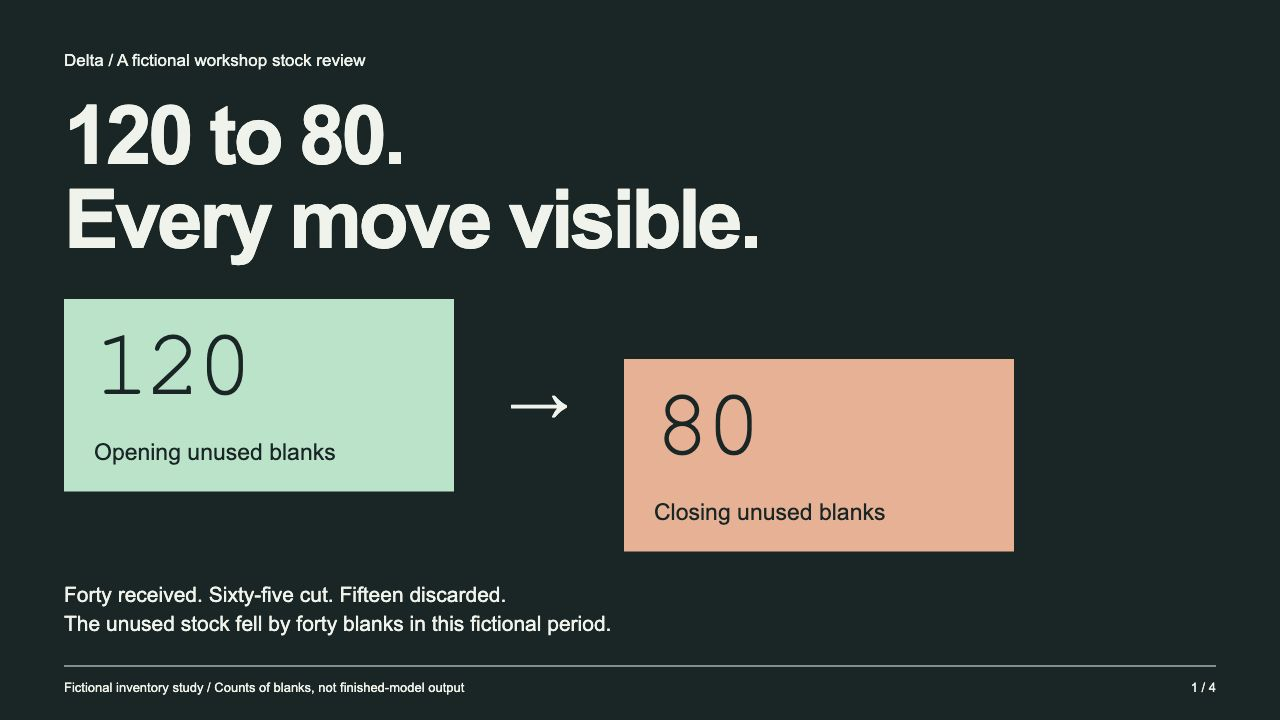
Opening stock:120 unused cardboard blanks. Then40 blanks were received;65 blanks were cut for model-making;15 blanks were discarded. Closing unused stock:80 blanks. These are disjoint movements of unused blank stock during the one fictional period, not alternate categories of one snapshot.
Running balances:120 opening;160 after receipt;95 after cutting;80 after discard. Net change in unused stock: minus40. Formula120+40-65-15=80. All figures are counts of blanks; no weight, currency, rate, date or period length is supplied.
The65 cut blanks are not a count of finished models, successful products, sales or remaining usable cut pieces. Reasons for discard and finished-model output are not supplied. No waste-reduction result, financial cost, causal explanation or physical inspection is established.
A waterfall may show positive receipt40 and negative movements65/15 against a common zero baseline, with each floating bar spanning the correct before/after balance. Opening and closing stock bars start at zero. Include signs, movement names and source counts, not color alone.
Ask: review the closing count and remaining material needs before planning a further order. No order quantity, supplier, price, purchase date or purchase approval is given.
Four-slide independently authored fictional operations study, not a released-recipe evaluation output.
Design instructions
Delta: a stock-movement waterfall language in graphite green #172b2a, paper #f2f5ed, mint #bce8cf and peach #efb79c. Start with opening and closing values on offset stock blocks, reveal every movement on a true waterfall, then carry the stepped rhythm through known-versus-unknown evidence and the next review sequence. Use a common zero-referenced count scale: totals start at zero, floating movements span their actual before/after balances and connectors trace the running balance. Give every bar an explicit signed value, name and unit; positive and negative colors are supporting cues. Calculate and check every intermediate total. Preserve the difference between a stock movement and an output or outcome; missing counts and reasons are not zero or an invented cause. On phones keep essential chart text readable in one bounded, visibly hinted, focusable pan window with real keyboard access to both ends; never make the whole page overflow. The complete native composition needs no imagery. If optional imagery is unavailable, continue with the stock blocks, chart and evidence steps; keep specifically required documentary inventory evidence as a dependency. Adapt to supplied units and material, not these workshop counts. Do not imply a purchase, inspection, environmental result or financial benefit from an illustrative reconciliation.

Use my supplied content and the format I requested. Keep its facts, numbers, denominators, uncertainty and conclusion. Do not inherit the example deck’s story, figures or recommendation. The visual direction guides design; the audience and argument determine the slide sequence.

Check the tools available in this session. When an image would improve the presentation and a suitable generation tool is available, generate an original image or use an asset I am authorized to supply. If optional generation is unavailable or fails, continue with a complete image-free composition. Reclaim the space, leave no placeholders, and do not ask me to enable a tool or delay the deck for optional imagery. Mention a failure in the handoff rather than on audience-facing slides. If I explicitly require a particular image, preserve that requirement and explain any unmet dependency.

Keep text and evidence selectable. For HTML, use one self-contained static document with embedded CSS, compressed data images and licensed embedded fonts when needed; do not add scripts, forms, remote calls or authored slide controls. Preserve font licenses and asset provenance. Label conceptual or generated imagery when it could be mistaken for real product, customer or event evidence. Never invent a product screenshot to prove a feature.

Render every slide and inspect the actual result before handing it over. Check crop, contrast, type hierarchy, labels, overflow and source fidelity. Use at least 4.5:1 contrast for body text and 3:1 for large text. Check the destination’s file/data-image limits before any separately authorized publication. If visual checking is unavailable, say so in the handoff.About this design study
Four slides follow a fictional workshop from 120 opening unused blanks through 40 received, 65 cut and 15 discarded to 80 closing blanks, then request a count review. Independently authored fictional operations study using native charts and typography. It is not an actual stock audit, model-output count, financial result, physical inspection, waste-reduction study or purchase approval.