For larger text, use “Read or print.”
Dial
Native circular sectors, equal-whole focus rings and elapsed-minute boundary plates keep one program inspectable before content approval.
Design study · 4 slides
Using Claude Code or Codex? Install the free presentation skill.
Source and instructions
Source notes
DIAL / Frozen fictional projection-program brief
Purpose: propose a content sequence for one 24-minute gallery projection loop, asking for content-sequence approval only. Not an actual event schedule or start time.
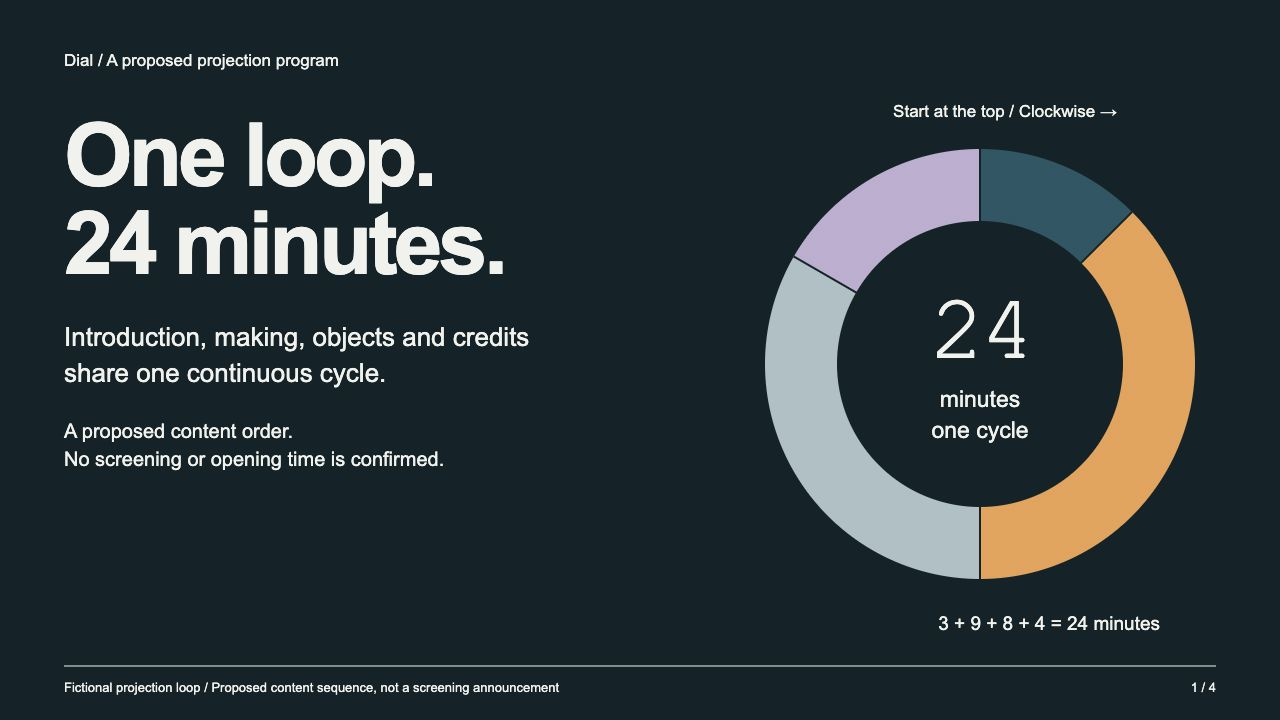
The four consecutive proposed segments, clockwise from the top of the cycle: Introduction3minutes; Making9minutes; Objects8minutes; Credits4minutes. Total24minutes.
Elapsed-minute boundaries:0,3,12,20,24. A circle represents one24-minute cycle;0and24are the same cycle boundary. At equalangularscale360degrees/24=15degrees perminute: segmentangles45,135,120,60degrees. Cumulativeboundaryanglesclockwisefromtop:0,45,180,300,360degrees.
The ring's segments encode duration, not audience preference, actual viewing behavior, performance, budget or the physical sizes of objects. Starttop/clockwisedirection must be explicit. An equal-size set of rings may compare each duration share at the same whole24-minute scale; there are no different hidden denominators.
Rights, playback equipment, power and access arrangements remain unconfirmed. No venue, opening date, clock start time, audience capacity or actual screening result is supplied.
Ask: approve the proposed content sequence only. This is not permission to screen, an opening announcement, confirmed rights clearance or operational readiness.
Four-slide independently authored fictional program-planning visual study, not an evaluation output of a released recipe.
Design instructions
Dial: a radial-program language with deep petrol #10282f, paper #f3f4ef, teal #2f6270, apricot #ecaa64, pale slate #b7c8cc and lilac #c6b7d6. Use a large clockwise cycle as the main canvas, monospace duration figures, equal-whole focus rings and an elapsed-boundary plate. Carry the circular outline into the final content-only approval checklist, while making clear that decorative checklist dots encode no duration. Every quantitative ring uses an explicitly labelled common whole, top origin, clockwise direction and source-derived sector angles; preserve actual source order, duration and units. Compute boundary positions from elapsed fractions; zero and the full duration meet at one cycle boundary. Keep text on opaque surfaces, compact center labels on explicit lines and essential names in a readable native legend. Use ink separators between adjacent sectors and contrast-safe darker color variants for focus arcs against a pale remainder; preserve the exact underlying angles. Reflow ring comparisons vertically on phones without shrinking labels. Do not use circle area, hidden denominators or decorative glow to imply unsupported quantities, preference or measured outcomes. The complete native CSS composition needs no images; omit optional generated atmosphere when unavailable, reclaiming its space. Required documentary screening evidence remains a dependency. Preserve the distinction between approving content order and confirming rights, equipment, access or permission to screen.

Use my supplied content and the format I requested. Keep its facts, numbers, denominators, uncertainty and conclusion. Do not inherit the example deck’s story, figures or recommendation. The visual direction guides design; the audience and argument determine the slide sequence.

Check the tools available in this session. When an image would improve the presentation and a suitable generation tool is available, generate an original image or use an asset I am authorized to supply. If optional generation is unavailable or fails, continue with a complete image-free composition. Reclaim the space, leave no placeholders, and do not ask me to enable a tool or delay the deck for optional imagery. Mention a failure in the handoff rather than on audience-facing slides. If I explicitly require a particular image, preserve that requirement and explain any unmet dependency.

Keep text and evidence selectable. For HTML, use one self-contained static document with embedded CSS, compressed data images and licensed embedded fonts when needed; do not add scripts, forms, remote calls or authored slide controls. Preserve font licenses and asset provenance. Label conceptual or generated imagery when it could be mistaken for real product, customer or event evidence. Never invent a product screenshot to prove a feature.

Render every slide and inspect the actual result before handing it over. Check crop, contrast, type hierarchy, labels, overflow and source fidelity. Use at least 4.5:1 contrast for body text and 3:1 for large text. Check the destination’s file/data-image limits before any separately authorized publication. If visual checking is unavailable, say so in the handoff.About this design study
Four slides carry a fictional twenty-four-minute projection program with three, nine, eight and four-minute segments, while screening rights and operating readiness remain unconfirmed. Independently authored fictional program brief using native quantitative rings. It is not an opening announcement, audience or performance result, permission to screen, rights clearance or confirmed operational schedule.