For larger text, use “Read or print.”
Dispatch
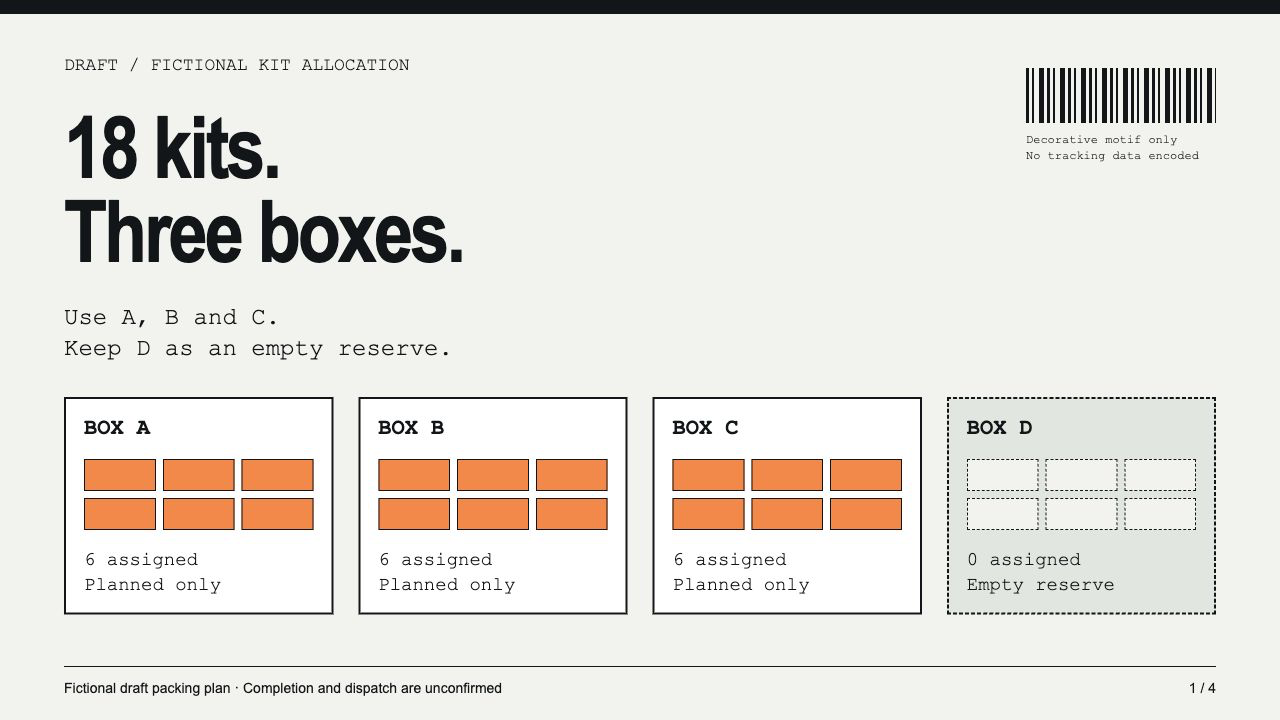
Counted kit slots, bold label typography and a draft manifest separate available capacity from completed packing.
Design study · 4 slides
Using Claude Code or Codex? Install the free presentation skill.
Source and instructions
Source notes
First-party fictional kit-packing proposal, not real stock, a shipment, an order, a customer or a shipping label.
Planning snapshot:18kits are available;4boxes are available; each box can hold6kits. Total available box capacity24kit slots, derived4×6. Capacity is not an actualpacked/shipped count.
Draft allocation: BoxA6kits,BoxB6kits,BoxC6kits,BoxD0kits. Use3boxes for18kits and keep BoxD as an empty reserve. Six capacity slots are unused. Do not imply six kits are lost/missing or that more kits were purchased.
This is a packing plan only. No kits have been confirmed packed, sealed, dispatched or delivered. No recipient, carrier, address, tracking number, deadline, shipping cost or actual barcode is supplied.
Use native counted slot diagrams:6equal slots perbox. Planned occupied slots marked assigned, reserve slots labelled unused capacity. Never show the allocation as an observed packing result.
The handoff is confirm the allocation, then pack and count before any dispatch. Approval and completion are not supplied. Do not claim the request has already been approved.
A decorative barcode-like line motif is allowed as visual language only, not machine-readable order/tracking information, and must not encode a URL or private data.
No product dimensions, weight, safe-load certification, damage-rate claim or environmental-benefit claim.
Design instructions
Dispatch: operational manifest language with paper #f4f5f0, near-black #10171a, orange #ff8b4c and pale-grey #e5e9e4. Use large utilitarian headlines, monospaced identifiers, ruled quantity tables, counted box slots, dashed reserve outlines and explicit draft/completion states. Keep inventory, capacity, planned allocation and actual completion separate; preserve quantities and units, verify totals and reserve counts, and never turn a proposal into a shipment confirmation. Bar geometry must remain proportional at every width; reflow box grids without hiding identifiers or counts. Any barcode-like line motif is decorative only and must not encode or imply tracking data. The complete direction uses native typography and diagrams. If generation is available, an optional original packaging-context image may sit away from evidence and be labelled conceptual; if imagery is unavailable or fails, omit that slot and continue with the full native composition. Do not invent carrier, address, order, cost or delivery claims.

Use my supplied content and the format I requested. Keep its facts, numbers, denominators, uncertainty and conclusion. Do not inherit the example deck’s story, figures or recommendation. The visual direction guides design; the audience and argument determine the slide sequence.

Check the tools available in this session. When an image would improve the presentation and a suitable generation tool is available, generate an original image or use an asset I am authorized to supply. If optional generation is unavailable or fails, continue with a complete image-free composition. Reclaim the space, leave no placeholders, and do not ask me to enable a tool or delay the deck for optional imagery. Mention a failure in the handoff rather than on audience-facing slides. If I explicitly require a particular image, preserve that requirement and explain any unmet dependency.

Keep text and evidence selectable. For HTML, use one self-contained static document with embedded CSS, compressed data images and licensed embedded fonts when needed; do not add scripts, forms, remote calls or authored slide controls. Preserve font licenses and asset provenance. Label conceptual or generated imagery when it could be mistaken for real product, customer or event evidence. Never invent a product screenshot to prove a feature.

Render every slide and inspect the actual result before handing it over. Check crop, contrast, type hierarchy, labels, overflow and source fidelity. Use at least 4.5:1 contrast for body text and 3:1 for large text. Check the destination’s file/data-image limits before any separately authorized publication. If visual checking is unavailable, say so in the handoff.About this design study
Four slides present a first-party fictional eighteen-kit allocation, with three planned boxes, one empty reserve and unconfirmed completion. This is an authored fictional planning study, not actual stock, an order, a completed shipment or a usable shipping label. Its barcode-like motif is decorative and encodes no tracking data.