For larger text, use “Read or print.”
Feast
An editorial food-photo opening leads into numbered courses, exact seating symbols and a conditional budget request.
Design study · 4 slides
Using Claude Code or Codex? Install the free presentation skill.
Source and instructions
Source notes
FROZEN FICTIONAL SOURCE BRIEF · FEAST
Authored for a local presentation style study; no real event, venue, organizer or financial result.
Audience: the committee of a fictional neighborhood hall. Job: decide whether to authorize planning, not public ticket sales.
Proposal name: One Long Table. A one-evening community supper for 48 guests, with six tables of eight seats. The seating arrangement is a count schematic only, not a venue floor plan, occupancy approval or accessibility assessment.
Proposed menu: roasted tomato and white bean starter; lemon-herb roast vegetables with barley main; baked pears with oat crumble dessert. Menu is a concept. No dietary or allergen certification.
Proposed ticket price: $25 per guest. Full-attendance ticket income:48×25=$1,200. Budget ceiling:$900, split food$540, hall$240, materials$120. Full-attendance difference:$300 before any unlisted costs; not guaranteed profit. At36paid seats, ticket income$900 matches listed budget. No tickets sold or costs contracted.
Ask: authorize planning up to a$900 ceiling, conditional on checking venue access and food requirements before any ticket sale. Date, supplier quotes, venue access and food requirements unresolved; no approval yet. No claim of demand, profit or inclusion compliance.
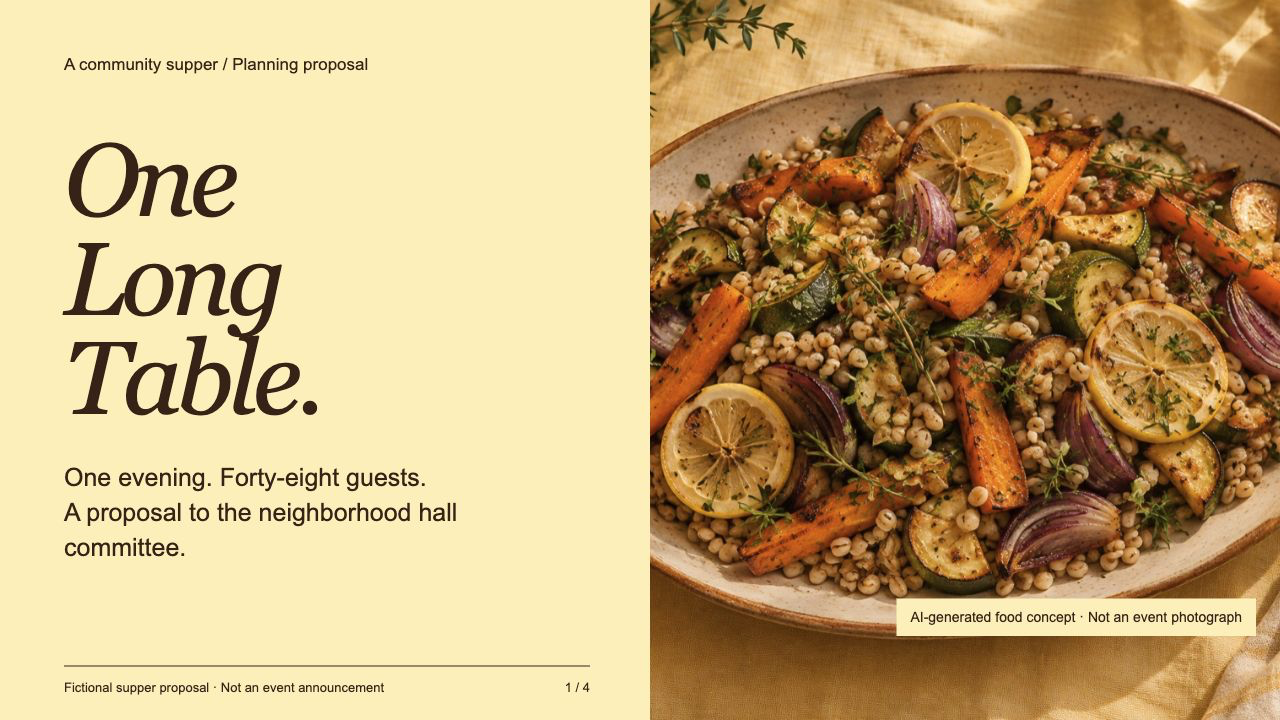
Optional image: a generated culinary concept photo of the proposed roast vegetables, not an event photograph, proof of dietary suitability or exact serving size. Keep generated provenance visible. If image generation is unavailable, omit the image and build a complete menu-led typographic opening.
Design instructions
Feast: a convivial menu-led presentation in butter #fff0bd, warm brown #422417, tomato #a32e1a and leaf #365b38. Use oversized italic Georgia display, plain Arial body text, a food-photo diptych on the opening, generous numbered course rows, and exact native seat-count schematics or menu structures when they explain the supplied proposal. Alternate the photograph with clear menu and planning pages; avoid repeating a generic card grid. Keep financial scenarios conditional and separate capacity diagrams from venue approvals. Use supplied facts and build the story for its audience; do not copy this supper or its numbers. With an available image-generation tool, create an original editorial food concept that supports the actual menu, compress/embed it and label its conceptual status. With no optional image capability or a failed generation, omit the image and its credit, expand the title/menu across the opening, and continue without a placeholder. Images never establish serving counts, dietary suitability or actual attendance. Preserve unknown requirements and evidence provenance.

Use my supplied content and the format I requested. Keep its facts, numbers, denominators, uncertainty and conclusion. Do not inherit the example deck’s story, figures or recommendation. The visual direction guides design; the audience and argument determine the slide sequence.

Check the tools available in this session. When an image would improve the presentation and a suitable generation tool is available, generate an original image or use an asset I am authorized to supply. If optional generation is unavailable or fails, continue with a complete image-free composition. Reclaim the space, leave no placeholders, and do not ask me to enable a tool or delay the deck for optional imagery. Mention a failure in the handoff rather than on audience-facing slides. If I explicitly require a particular image, preserve that requirement and explain any unmet dependency.

Keep text and evidence selectable. For HTML, use one self-contained static document with embedded CSS, compressed data images and licensed embedded fonts when needed; do not add scripts, forms, remote calls or authored slide controls. Preserve font licenses and asset provenance. Label conceptual or generated imagery when it could be mistaken for real product, customer or event evidence. Never invent a product screenshot to prove a feature.

Render every slide and inspect the actual result before handing it over. Check crop, contrast, type hierarchy, labels, overflow and source fidelity. Use at least 4.5:1 contrast for body text and 3:1 for large text. Check the destination’s file/data-image limits before any separately authorized publication. If visual checking is unavailable, say so in the handoff.About this design study
Four slides carry a fictional 48-guest supper planning proposal, three-course menu, six eight-seat tables and conditional 900-dollar planning ceiling. Independently authored fictional supper proposal with an AI-generated culinary concept image. It is not a real event announcement, dietary assurance, measured attendance result or unedited released-recipe evaluation.