For larger text, use “Read or print.”
Fieldnote
Real Caveat lettering, paper receipts, counted branches and selective highlights keep missing fields distinct from missing records.
Design study · 4 slides
Using Claude Code or Codex? Install the free presentation skill.
Source and instructions
Source notes
First-party fictional paperwork teaching example, no real receipts, purchases, customers or financial advice.
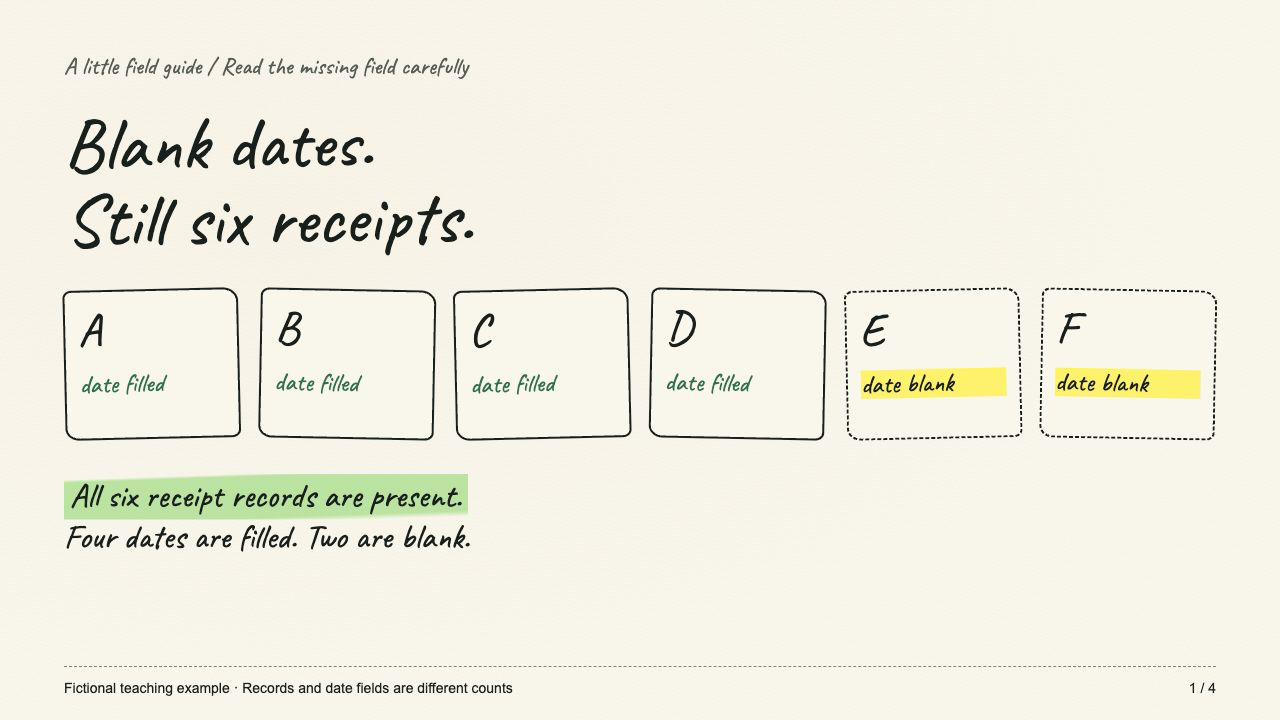
Six receipt records A,B,C,D,E,F are present in the toy batch. A,B,C,D have a date field filled; E,F have a blank date field. The actual dates are not supplied; do not invent them.
Two blank dates do not mean two missing receipt records. All six records exist. No reason for the missing dates is supplied. No count of purchases outside this toy batch is supplied or inferable.
The statement Two receipts are missing is unsupported in this example; label it unsupported if showing it for contrast. A supported statement is Two of the six receipt records have no date filled in.
Use equal record tokens for the six records; separate presence of a record from completeness of one field. Four green known-date labels and two yellow blank-date labels may support the count, but text labels must carry meaning too.
The next action in this teaching example is ask for the missing dates and retain all six records; do not fill dates by guessing or delete a record because its date is absent. Do not make legal retention, bookkeeping-compliance, transaction authenticity or purchase-frequency claims.
Closing takeaway: describe the missing field precisely; preserve the distinction between missing information and missing records.
Use the user's saved field-guide appearance: warm paper, Caveat handwriting, ink diagrams, selective yellow/green highlights. Embed the packaged font and full SIL Open Font License; no external assets or remote font calls.
Design instructions
Fieldnote: the saved hand-drawn field-guide appearance with warm paper #faf7ee, ink #19221d, green #237c53, yellow #fff16a and pale-green highlights. Use real Caveat handwriting (normal400; the example aliases it Notebook), embed the licensed font and retain its complete SIL Open Font License. Preserve meaningful headings and large readable lettering, restrained rotations, irregular ink borders, circled step numbers and selective highlights. Build explanations from counted tokens, branching questions and a concrete source-grounded example. Keep missing fields distinct from missing records, name denominators, and preserve unknown causes. Reflow sequences downward on phones but preserve parallel branches as branches. Optional generated imagery may add context only when a suitable tool is available; native paper diagrams are the complete default and require no raster. If generation is unavailable or fails, continue with complete native diagrams and no placeholders. Do not substitute a generated picture for evidence or claim a rounded system font reproduces the bundled handwritten type. Use your supplied content, not the example’s receipt story.

Use my supplied content and the format I requested. Keep its facts, numbers, denominators, uncertainty and conclusion. Do not inherit the example deck’s story, figures or recommendation. The visual direction guides design; the audience and argument determine the slide sequence.

Check the tools available in this session. When an image would improve the presentation and a suitable generation tool is available, generate an original image or use an asset I am authorized to supply. If optional generation is unavailable or fails, continue with a complete image-free composition. Reclaim the space, leave no placeholders, and do not ask me to enable a tool or delay the deck for optional imagery. Mention a failure in the handoff rather than on audience-facing slides. If I explicitly require a particular image, preserve that requirement and explain any unmet dependency.

Keep text and evidence selectable. For HTML, use one self-contained static document with embedded CSS, compressed data images and licensed embedded fonts when needed; do not add scripts, forms, remote calls or authored slide controls. Preserve font licenses and asset provenance. Label conceptual or generated imagery when it could be mistaken for real product, customer or event evidence. Never invent a product screenshot to prove a feature.

Render every slide and inspect the actual result before handing it over. Check crop, contrast, type hierarchy, labels, overflow and source fidelity. Use at least 4.5:1 contrast for body text and 3:1 for large text. Check the destination’s file/data-image limits before any separately authorized publication. If visual checking is unavailable, say so in the handoff.About this design study
Four slides follow a first-party fictional six-record batch, preserving four filled date fields, two blanks and the unknown reason. This is an authored teaching study with fictional records, not real receipts, a transaction-authenticity claim, bookkeeping advice or evidence about purchases outside the example.