For larger text, use “Read or print.”
Halftone
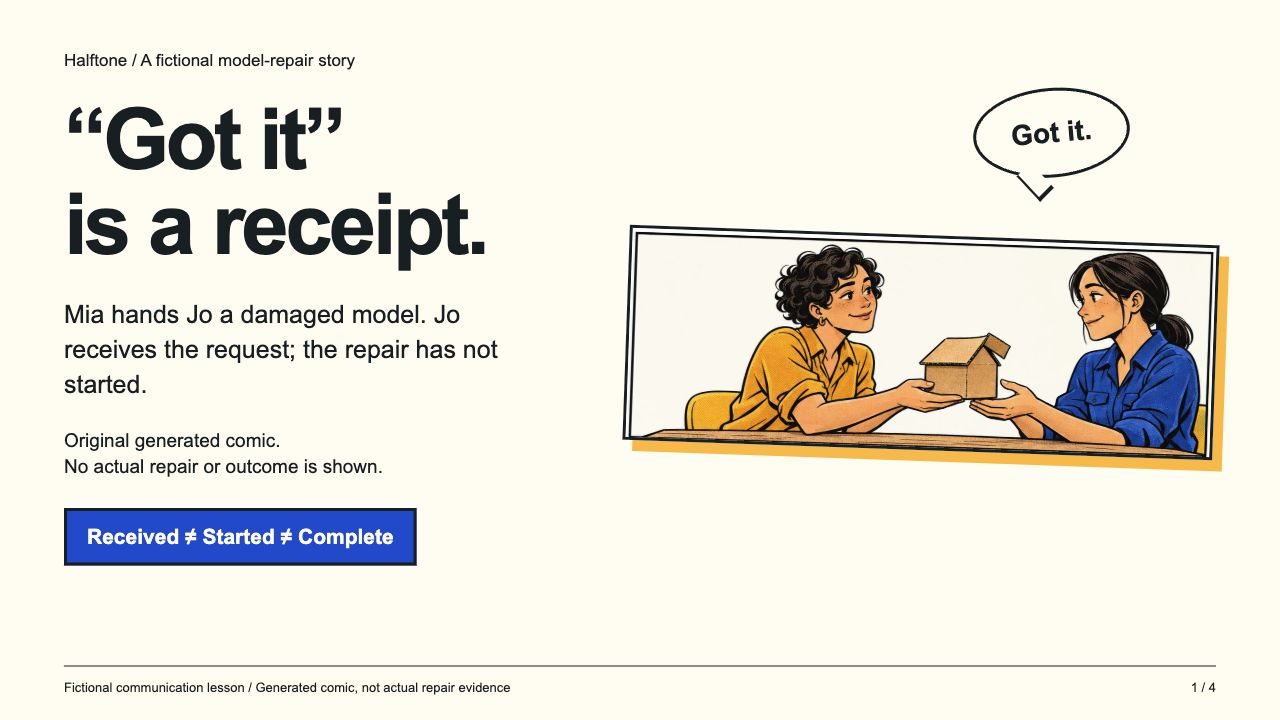
An original generated comic plate, bold panel frames and selectable speech balloons separate receiving a request from starting and completing work.
Design study · 4 slides
Using Claude Code or Codex? Install the free presentation skill.
Source and instructions
Source notes
HALFTONE / Frozen fictional communication lesson
Purpose: teach how to name a work state in a reply using a small fictional model-repair story. Not an actual customer account, repair instruction, protocol trace or effectiveness study.
Mia gives Jo a damaged cardboard model and asks: "Please repair this model." Jo replies: "Got it." At this first illustrated moment Jo has received the request, but the repair has not started.
At the next illustrated moment Jo is repairing the same model. Work is in progress and is not complete.
At the last illustrated moment the repair is complete in this fictional story. No actual repaired object, measured outcome, time taken, guarantee or test is supplied.
Three explicit work states in order: Request received; Repair in progress; Repair complete. A receipt does not by itself establish a start or completion.
Three clearer example replies, mapped to those states: "I received your request."; "The repair is underway."; "The repair is complete."
Original generated comic imagery may illustrate the scene, but all dialogue/state labels must be real selectable text. Comic images establish no real work, model construction accuracy, actual people's identity or process evidence.
Four-slide independently authored fictional visual lesson. There is no claim that using these exact words improves communication in a measured study.
Design instructions
Halftone: a comic-sequence language with warm white #fffdf3, ink #172328, cobalt #1f57d6 and mango #ffbe45. Use bold panel borders, restrained dot texture, oversized short statements, numbered moments and native speech balloons whose words remain selectable. Carry the same actors and object through a clear state sequence; pair every picture with an explicit state and keep the conclusion tied to the known evidence. Adapt the lesson rather than copying these names, dialogue or repair scenario. If generation is available and optional story art helps, generate a consistent panel plate without baked-in text, disclose fictional/generated imagery and keep the prompt/assets. Crop the same plate honestly; pictures must not be presented as actual process or customer evidence. Without generation or supplied images, retain a complete native panel-and-balloon composition with named actors, labelled object/status schematics and the same readable state progression. Leave no blank image box; schematics are not repair instructions. Specifically required documentary process evidence stays a dependency. Separate receiving a request, starting work and completing work; never infer later states from an acknowledgement alone. Reflow panels vertically on phones while retaining moment numbers and speech order; do not claim measured effectiveness without a study.

Use my supplied content and the format I requested. Keep its facts, numbers, denominators, uncertainty and conclusion. Do not inherit the example deck’s story, figures or recommendation. The visual direction guides design; the audience and argument determine the slide sequence.

Check the tools available in this session. When an image would improve the presentation and a suitable generation tool is available, generate an original image or use an asset I am authorized to supply. If optional generation is unavailable or fails, continue with a complete image-free composition. Reclaim the space, leave no placeholders, and do not ask me to enable a tool or delay the deck for optional imagery. Mention a failure in the handoff rather than on audience-facing slides. If I explicitly require a particular image, preserve that requirement and explain any unmet dependency.

Keep text and evidence selectable. For HTML, use one self-contained static document with embedded CSS, compressed data images and licensed embedded fonts when needed; do not add scripts, forms, remote calls or authored slide controls. Preserve font licenses and asset provenance. Label conceptual or generated imagery when it could be mistaken for real product, customer or event evidence. Never invent a product screenshot to prove a feature.

Render every slide and inspect the actual result before handing it over. Check crop, contrast, type hierarchy, labels, overflow and source fidelity. Use at least 4.5:1 contrast for body text and 3:1 for large text. Check the destination’s file/data-image limits before any separately authorized publication. If visual checking is unavailable, say so in the handoff.About this design study
Four teaching slides follow a fictional cardboard-model repair story, preserving the three work states and avoiding any claim about actual repairs or measured communication outcomes. Independently authored fictional visual lesson using an original generated comic. It is not a customer account, documentary process record, actual repair, instruction or measured effectiveness study.