For larger text, use “Read or print.”
Ledger
Open cost comparisons, quality evidence and a recommendation that keeps unknowns visible.
Design study · 5 slides
Using Claude Code or Codex? Install the free presentation skill.
Source and instructions
Source notes
FICTIONAL SOURCE NOTES — author reference.

Please convert the memo below into a decision deck for the executive committee. Formal tone.

--- Recommendation on after-hours phone support ---
We outsource after-hours phone support (6pm to 8am and weekends) to Callhaven at $38 per handled call: 2,900 calls a month, about $110k a month.
Option 1: bring after-hours in-house. 14 hires across 3 shifts, fully loaded about $96k a month after a 4-month ramp, plus about $120k one-time for hiring and training.
Option 2: renew Callhaven for 2 years at $34 a call (their offer), about $99k a month at current volume.
Option 3: renew for 1 year at $36 a call while we pilot in-house support on weekends only.
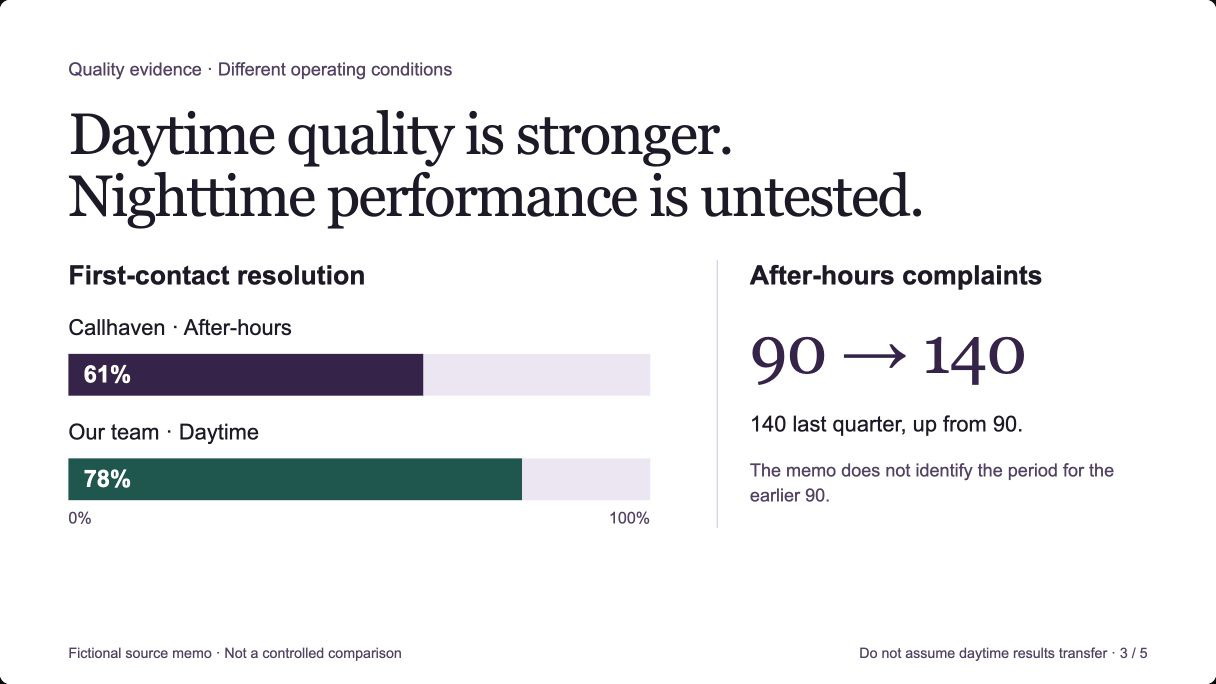
Quality: Callhaven's first-contact resolution is 61%, against 78% for our daytime team. Complaints about after-hours support: 140 last quarter, up from 90.
Caveat: call volume has grown 12% a year. Option 2's cost rises with volume, while Option 1's is mostly fixed until we need another shift. We have not modelled the break-even beyond year 1.
Recommendation: Option 3, because it keeps cost close to today's while we test whether in-house quality holds at night.
Decision needed by November 30; the Callhaven contract ends December 31.
Design instructions
Build an executive decision deck in the Ledger direction from my supplied memo. Keep the memo’s recommendation and its reasons, even if another option has a lower headline cost. Compare alternatives on the same dimensions, with units, time periods, ramp assumptions and one-time costs kept separate. Mark missing costs and unmodelled break-even points as unknown rather than calculating an unsupported total. Label any derived arithmetic and its assumptions. Separate current measured quality from an untested expectation. End with the actual decision and deadlines supplied in the source.

Use a clean financial ledger as the compositional idea: near-white (#ffffff), deep plum (#3f2755), quiet lilac (#eee9f4), dark ink (#211a2b) and restrained teal (#006358). Pair Georgia headlines with a readable system sans-serif for evidence. Use a wide open comparison table with aligned numerals, a source-grounded chart where it helps, a generous recommendation spread and a sparse decision timeline. Keep evidence rows open and scannable; do not wrap every number in a card. Let the argument determine the order and slide count.

Use chart axes honestly and identify populations, timeframes and measured versus estimated values. A relevant authorized image can supply context, but it must not replace financial or quality evidence. If images would add only decoration, deliver a complete image-free deck with strong typography, comparisons and clear caveats.

Use my supplied content and the format I requested. Keep its facts, numbers, denominators, uncertainty and conclusion. Do not inherit the example deck’s story, figures or recommendation. The visual direction guides design; the audience and argument determine the slide sequence.

Check the tools available in this session. When an image would improve the presentation and a suitable generation tool is available, generate an original image or use an asset I am authorized to supply. If optional generation is unavailable or fails, continue with a complete image-free composition. Reclaim the space, leave no placeholders, and do not ask me to enable a tool or delay the deck for optional imagery. Mention a failure in the handoff rather than on audience-facing slides. If I explicitly require a particular image, preserve that requirement and explain any unmet dependency.

Keep text and evidence selectable. For HTML, use one self-contained static document with embedded CSS, compressed data images and licensed embedded fonts when needed; do not add scripts, forms, remote calls or authored slide controls. Preserve font licenses and asset provenance. Label conceptual or generated imagery when it could be mistaken for real product, customer or event evidence. Never invent a product screenshot to prove a feature.

Render every slide and inspect the actual result before handing it over. Check crop, contrast, type hierarchy, labels, overflow and source fidelity. Use at least 4.5:1 contrast for body text and 3:1 for large text. Check the destination’s file/data-image limits before any separately authorized publication. If visual checking is unavailable, say so in the handoff.About this design study
Five slides preserve the fictional support memo’s recommendation, alternatives, quality evidence, assumptions and decision deadline. This is an authored rework of our memo-to-committee-deck example, refined through review. It uses fictional source notes and system fonts. It is not an unedited recipe test output.