For larger text, use “Read or print.”
Marquee
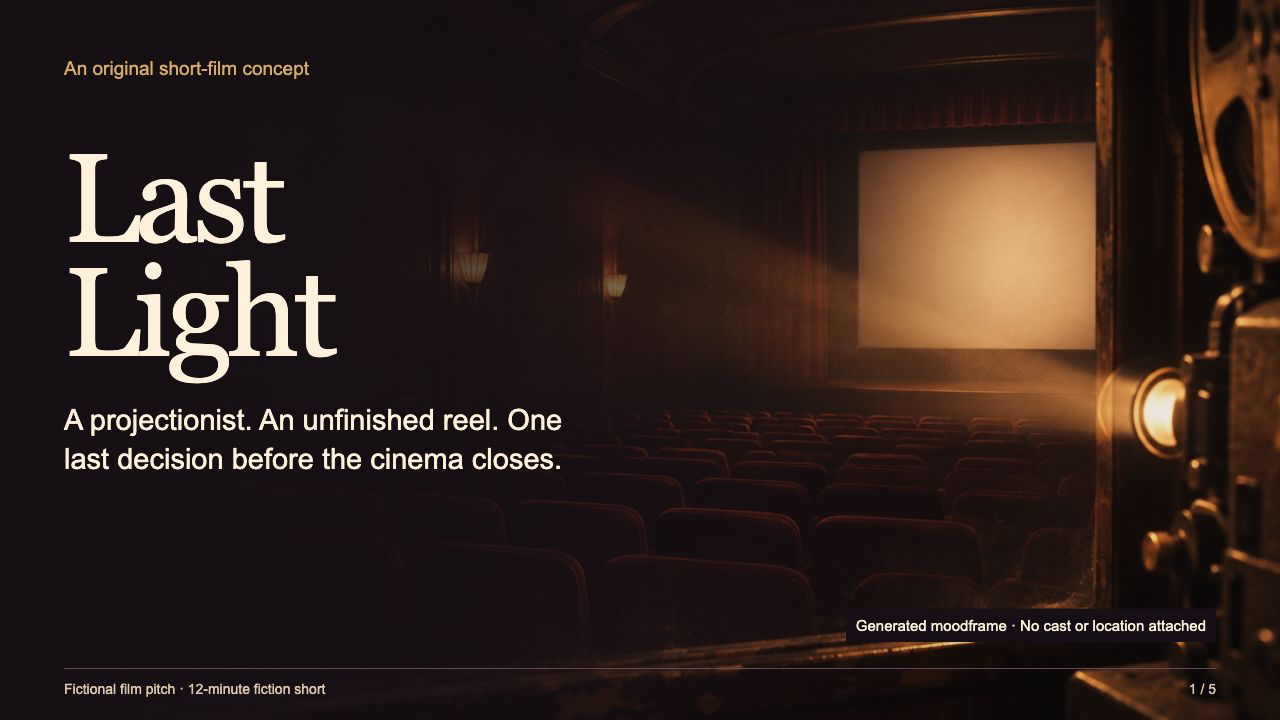
An original cinema moodframe, quiet ivory titles and a pitch that keeps funding and attachments explicit.
Design study · 5 slides
Using Claude Code or Codex? Install the free presentation skill.
Source and instructions
Source notes
First-party fictional brief. No real film, cast, cinema, funding or distribution agreement.
Audience: potential backers of an original short-film concept called Last Light. Ask: fund an$18,000 production plan for a12-minute fiction short. No funding is secured.
Logline: A night-shift projectionist must decide whether to screen an unfinished reel left by her father before the old cinema closes.
One proposed location: a neighborhood cinema, not yet permitted. Three planned shoot nights. Two speaking roles, with no cast attached. Planned crew of eight, not hired.
Budget: production$7,200; location$3,000; post-production$4,800; contingency$3,000. Total$18,000. Post-production includes a music-license allowance, but no music rights are cleared.
Proposed six-week sequence after funding: pre-production in weeks1–2; three shoot nights in week3; post-production in weeks4–6. This is a proposed schedule, not a committed release date.
The original screenplay is in draft. No distribution is secured. Do not invent audience traction, festival selection, awards, commercial returns or confirmed cast/crew/locations.
Visual direction: quiet, nocturnal, amber projection light and deep burgundy. A generated cinema frame is a mood reference for the concept, not a real location scout, an attached performer, existing production still or footage from the film.
Design instructions
Create a deck in the Marquee direction: a cinematic pitch with a strong visual premise, an exact logline or central idea, a bounded production scope and a concrete ask. Use my supplied story and facts. Keep a draft, proposed schedule, funding request and secured commitment distinct. Never invent cast, rights, locations, audience traction, festival selection, commercial returns or distribution.

Use near-black plum (#180e16), deep burgundy (#4c1f30), warm ivory (#fff2df) and restrained amber (#e4b36b). Pair large Georgia titles with clear Arial or Helvetica evidence. A full-bleed moodframe may lead, held behind a directional dark gradient so the selectable headline and premise remain readable. Follow with an open logline spread, a sparse production-scope frame, honest budget bars and a schedule whose widths represent the stated durations. Do not force business evidence into a filmstrip or put every slide over a photograph. Vary image scale and information density while retaining one quiet nocturnal palette.

When image generation is available and a moodframe helps, create an original cinematic concept image that fits my material. Avoid text, film branding and recognizable real performers or locations unless I supply authorized assets. State visibly when a frame is generated or conceptual; it is not a location scout, attached cast, production still or existing footage. If optional image generation is unavailable or fails, build a complete image-free deck with the title, logline, budget and schedule on solid plum or burgundy, using a restrained amber light gradient only where it helps the composition. Reclaim the image area and leave no empty screen, fake still or request to enable an optional tool.

Use a dark text backing or scrim strong enough to preserve contrast across the image crop. Keep all figures, qualifiers and labels selectable, with chart text outside marks where that is clearer. Reflow the premise and evidence vertically on narrow screens, preserving the meaning of any schedule durations. Let my content determine slide count and sequence; do not copy the example's title, plot, crew, budget or production plan.

Use my supplied content and the format I requested. Keep its facts, numbers, denominators, uncertainty and conclusion. Do not inherit the example deck’s story, figures or recommendation. The visual direction guides design; the audience and argument determine the slide sequence.

Check the tools available in this session. When an image would improve the presentation and a suitable generation tool is available, generate an original image or use an asset I am authorized to supply. If optional generation is unavailable or fails, continue with a complete image-free composition. Reclaim the space, leave no placeholders, and do not ask me to enable a tool or delay the deck for optional imagery. Mention a failure in the handoff rather than on audience-facing slides. If I explicitly require a particular image, preserve that requirement and explain any unmet dependency.

Keep text and evidence selectable. For HTML, use one self-contained static document with embedded CSS, compressed data images and licensed embedded fonts when needed; do not add scripts, forms, remote calls or authored slide controls. Preserve font licenses and asset provenance. Label conceptual or generated imagery when it could be mistaken for real product, customer or event evidence. Never invent a product screenshot to prove a feature.

Render every slide and inspect the actual result before handing it over. Check crop, contrast, type hierarchy, labels, overflow and source fidelity. Use at least 4.5:1 contrast for body text and 3:1 for large text. Check the destination’s file/data-image limits before any separately authorized publication. If visual checking is unavailable, say so in the handoff.About this design study
Five slides present a first-party fictional short-film concept, its logline, proposed production scope, budget and schedule after funding. This is an authored study from a first-party fictional brief. The original generated cinema image is a conceptual moodframe, not a real location, attached cast, production still or footage.