For larger text, use “Read or print.”
Orbit
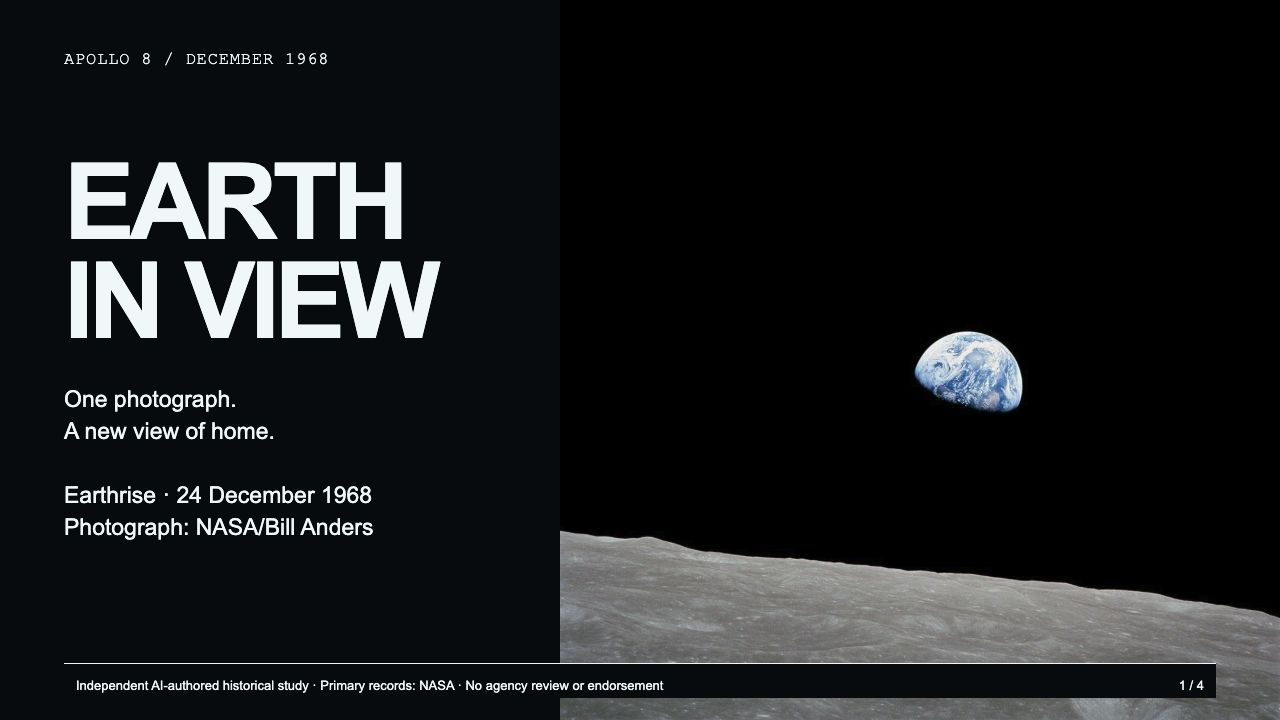
The Earthrise photograph, geometric headlines and a dated sequence alternate dark image plates with pale factual interiors.
Design study · 4 slides
Using Claude Code or Codex? Install the free presentation skill.
Source and instructions
Source notes
SOURCE-LINKED HISTORICAL STUDY. Authored with AI from the public records below, not a fictional company brief or a NASA-authored/reviewed presentation.
Primary factual sources checked2026-11-03:
https://www.nasa.gov/mission/apollo-8/
https://science.nasa.gov/resource/apollo-8s-iconic-earthrise/
Facts selected: Apollo8 crew Frank Borman, James Lovell Jr., William Anders. Launch21December1968; lunar orbit24December1968; splashdown27December1968. Apollo8 carried the first humans to orbit the Moon. The Earthrise photograph was made aboardApollo8 by Bill(William)Anders on24December1968. Do not call it the first imageofEarthfromtheMoon, implya lunar landing, invent exactclocktimes/orbitaldistances/durations, or addunsourced missionresults.
Use date markers for21/24/27December, not a drawn flightpath. Any schematic is an authored explanatory diagram, not spacecraft navigation or a scaled trajectory.
Image source record andcredit: Apollo8's IconicEarthrise, NASA/BillAnders. The downloadedNASA-deliveredwebJPEG is an archivalphoto, not generated imagery, not an originalcamera negative; the downloadedbytes are preserved. No NASAlogo/astronautportrait used.
Image URL: https://assets.science.nasa.gov/dynamicimage/assets/science/psd/solar/2023/09/a/as08-14-2383-1.jpg
Media policy checked: https://www.nasa.gov/nasa-brand-center/images-and-media/
Treat this as an independently authored historicalsummary usingNASA source material. Credit the original photograph without attributing the AI-authored presentation to NASA or implying endorsement, review or agencyresponsibilityforgeneratedtext. No wholesalearticletext or longquotes.
The reusable visual direction must work with other suppliedcontent. If an archivalimage is explicitlyrequired andunavailable, explainthatdependency; do notreplaceit withanunlabelledAIreconstruction. Optional generatedcontext maybelabelledconceptual andkeptawayfromhistoricalevidence. Imagefreefallback isnative date/evidence typography.
Design instructions
Orbit: a photographic science plate with near-black #02070b, ice paper #eaf1f1, restrained teal #075d6b and white. Use large geometric Arial headlines, monospaced record labels, uncropped authorized archival photography, open crew-name rows and a date sequence. Alternate black image plates with pale factual interiors; the photograph needs room rather than a text overlay. Keep calendar lines distinct from flight paths, preserve exact dates and names, and cite primary records beside factual evidence. For other supplied content, build its own chronology and evidence story. Prefer an authorized real image when the image is historical evidence. When an optional image is unavailable or fails, continue with a complete native composition of dates, names and evidence typography; remove the image slot and rebalance. If image generation is available, optional labelled conceptual context may support other topics, but must never impersonate an archival photograph. Explicitly required missing evidence remains a dependency. Preserve credit, usage conditions and independent authorship; do not use agency logos or imply endorsement.

Use my supplied content and the format I requested. Keep its facts, numbers, denominators, uncertainty and conclusion. Do not inherit the example deck’s story, figures or recommendation. The visual direction guides design; the audience and argument determine the slide sequence.

Check the tools available in this session. When an image would improve the presentation and a suitable generation tool is available, generate an original image or use an asset I am authorized to supply. If optional generation is unavailable or fails, continue with a complete image-free composition. Reclaim the space, leave no placeholders, and do not ask me to enable a tool or delay the deck for optional imagery. Mention a failure in the handoff rather than on audience-facing slides. If I explicitly require a particular image, preserve that requirement and explain any unmet dependency.

Keep text and evidence selectable. For HTML, use one self-contained static document with embedded CSS, compressed data images and licensed embedded fonts when needed; do not add scripts, forms, remote calls or authored slide controls. Preserve font licenses and asset provenance. Label conceptual or generated imagery when it could be mistaken for real product, customer or event evidence. Never invent a product screenshot to prove a feature.

Render every slide and inspect the actual result before handing it over. Check crop, contrast, type hierarchy, labels, overflow and source fidelity. Use at least 4.5:1 contrast for body text and 3:1 for large text. Check the destination’s file/data-image limits before any separately authorized publication. If visual checking is unavailable, say so in the handoff.About this design study
Four slides use primary Apollo 8 and Earthrise records, preserving crew names, dates, photograph credit and the distinction between chronology and a flight path. This is an independently authored historical study using NASA source material and a credited archival photograph, with AI-authored summary text. It is not a fictional mission, an unedited recipe evaluation, or a NASA-authored, reviewed or endorsed presentation.