For larger text, use “Read or print.”
Prism
A lavender object cutout over a radial gradient, oversized targets and a bounded form-study request.
Design study · 5 slides
Using Claude Code or Codex? Install the free presentation skill.
Source and instructions
Source notes
First-party fictional product-form study brief. No manufactured product, functioning prototype, engineering validation or commercial launch.
Audience: a design-review committee. Working concept: Arc Light, a compact portable task-light form to move between a desk and a shelf. These are design intentions, not measured portability or performance claims.
Ask: approve a$12,000 form study, proposed to last eight weeks. No funding is approved.
Planned outputs: three appearance models and16 facilitated handling sessions. None of the models is built; participants are not recruited. Targets are not completed results or a guaranteed completion rate.
Proposed sequence: weeks1–2sketches and mockups; weeks3–5appearance models; weeks6–8handling sessions. No exact dates or committed completion date are supplied. Do not invent hiring, recruitment, manufacturing partners or a production schedule.
Budget request: design work$5,000; model materials and printing$4,000; sessions$2,000; reserve$1,000. Total$12,000.
No dimensions, battery life, brightness, thermal testing, drop resistance or certification is supplied. Electrical engineering and manufacturing validation are outside this form study. No material specification is selected; a frosted translucent appearance is visual exploration only.
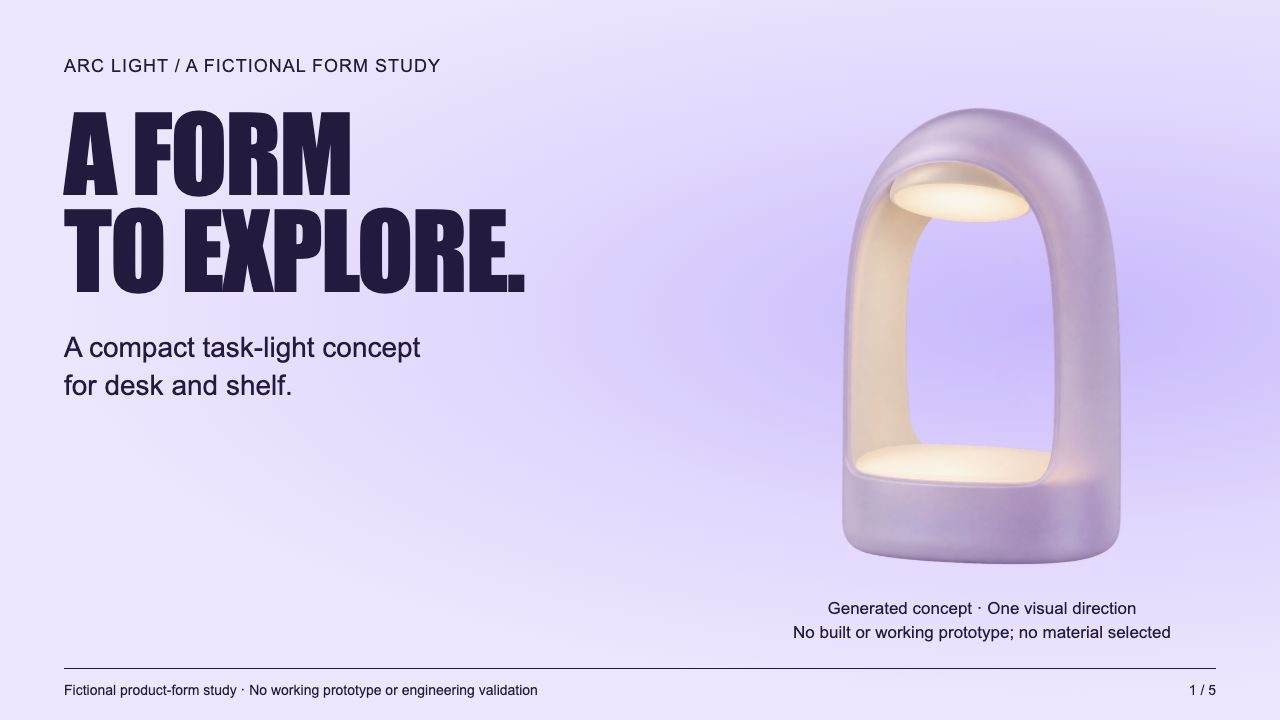
A generated product-form image is one conceptual visual direction, not a built model, working lamp, material selection or proof of engineering feasibility. Do not show three different models as though they exist. Preserve a visible conceptual-image label.
Design instructions
Prism: industrial form-study direction with pale lilac #efe9ff, violet #4f3cce, lime #e7f591 and dark plum #291d48. Use oversized condensed display type, one transparent concept-object cutout over a controlled radial gradient, large planned-output numerals, proportional phase bands and a bounded budget. If image generation is available, create one original appearance concept with genuine alpha; preserve transparency during packaging and label it conceptual. Do not present the render as a working prototype, selected material, measured performance or engineered product. Without generation, use an intentional typographic cover and native phase geometry, omitting the object slot entirely. Keep real specifications separate from visual exploration, targets separate from results, and engineering exclusions beside the request. Never invent extra views, models, test findings or manufacturing readiness.

Use my supplied content and the format I requested. Keep its facts, numbers, denominators, uncertainty and conclusion. Do not inherit the example deck’s story, figures or recommendation. The visual direction guides design; the audience and argument determine the slide sequence.

Check the tools available in this session. When an image would improve the presentation and a suitable generation tool is available, generate an original image or use an asset I am authorized to supply. If optional generation is unavailable or fails, continue with a complete image-free composition. Reclaim the space, leave no placeholders, and do not ask me to enable a tool or delay the deck for optional imagery. Mention a failure in the handoff rather than on audience-facing slides. If I explicitly require a particular image, preserve that requirement and explain any unmet dependency.

Keep text and evidence selectable. For HTML, use one self-contained static document with embedded CSS, compressed data images and licensed embedded fonts when needed; do not add scripts, forms, remote calls or authored slide controls. Preserve font licenses and asset provenance. Label conceptual or generated imagery when it could be mistaken for real product, customer or event evidence. Never invent a product screenshot to prove a feature.

Render every slide and inspect the actual result before handing it over. Check crop, contrast, type hierarchy, labels, overflow and source fidelity. Use at least 4.5:1 contrast for body text and 3:1 for large text. Check the destination’s file/data-image limits before any separately authorized publication. If visual checking is unavailable, say so in the handoff.About this design study
Five slides present a first-party fictional product-form study, separating proposed models and handling sessions from engineering validation and production. This is an authored fictional study. The original generated appearance concept is one visual direction, not a built or working prototype, selected material or tested product.