For larger text, use “Read or print.”
Profile
An original fictional portrait, numbered questions and selectable quotations keep an imagined interview attached to its source and attribution.
Design study · 4 slides
Using Claude Code or Codex? Install the free presentation skill.
Source and instructions
Source notes
PROFILE / Frozen first-party imagined interview
Purpose: demonstrate an editorial portrait/interview treatment for a concept community newsletter. The conversation below is first-party fictional text, not a transcript, real person, customer testimonial, endorsement or measured outcome.
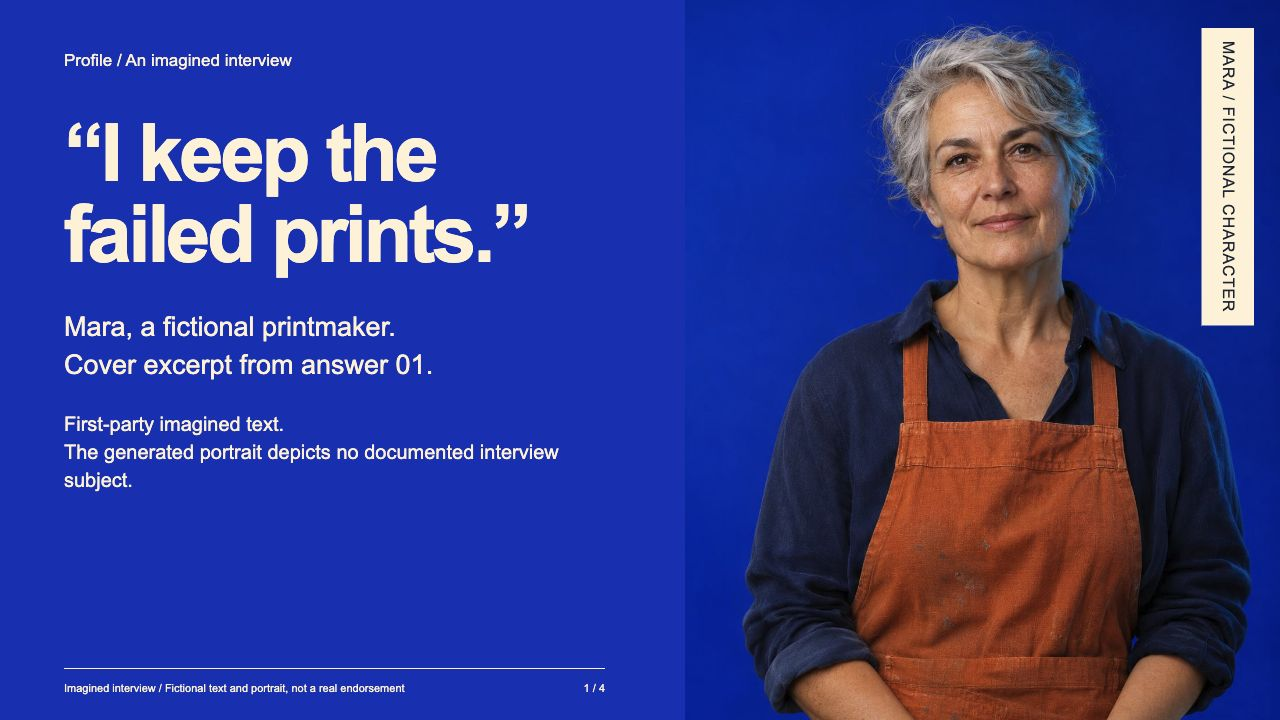
Character: Mara, an imagined printmaker. No real surname, age, employer, biography, career dates, client, award or real interview is supplied. An original generated portrait may illustrate this fictional character; it does not depict a documented interview subject.
Question1: What do you keep?
Answer1 (verbatim): I keep the failed prints. They show me what I changed.
Question2: What do you look for?
Answer2 (verbatim): A page needs somewhere quiet for the eye to rest.
Question3: When do you stop?
Answer3 (verbatim): I stop when the next change would make the print less clear.
Keep every displayed full answer verbatim. A clearly marked cover excerpt may use the exact first sentence of answer1: I keep the failed prints. Do not present an editorial paraphrase as an exact quotation. Questions stay attached to their own answers.
The imagined answers express a fictional voice. They establish no actual practice, reader outcome, causal benefit, professional endorsement or research finding. No publication or consent from a real subject is represented.
All speech must remain selectable native text. If optional imagery is unavailable, a complete typographic nameplate/profile treatment retains all three questions and answers and the fictional attribution, without an empty portrait slot.
Four-slide independently authored editorial design study, not a released-recipe evaluation output.
Design instructions
Profile: an editorial portrait/interview language in cobalt #153cbd, warm live type #fff3db, ink #182739 and apricot nameplates #e8a66d. Use a large portrait beside an exact, clearly marked excerpt; carry the subject identifier, question numbers, native serif quotations and a concise source record through the sequence. Keep each source question attached to its exact answer. Do not turn a paraphrase into a quotation, invent a biography, combine speakers or create testimonials or endorsements. Use actual authorized portraits and transcripts for real people, with the supplied attribution and consent limits. If optional generation is available for a clearly fictional character, generate an original labelled portrait and retain the prompt/assets; do not imply a documented interview subject. Keep all speech selectable, outside the bitmap. Without generation or supplied imagery, use a complete typographic nameplate/profile composition, reclaiming portrait space while retaining every question, answer and source label. Leave no empty portrait slot. Specifically required documentary subject photography or a real interview remains a dependency. Reflow portraits and quotes on phones without shrinking the words or cutting off meaningful faces; keep imagined voice separate from actual practice, research results or causal benefits.

Use my supplied content and the format I requested. Keep its facts, numbers, denominators, uncertainty and conclusion. Do not inherit the example deck’s story, figures or recommendation. The visual direction guides design; the audience and argument determine the slide sequence.

Check the tools available in this session. When an image would improve the presentation and a suitable generation tool is available, generate an original image or use an asset I am authorized to supply. If optional generation is unavailable or fails, continue with a complete image-free composition. Reclaim the space, leave no placeholders, and do not ask me to enable a tool or delay the deck for optional imagery. Mention a failure in the handoff rather than on audience-facing slides. If I explicitly require a particular image, preserve that requirement and explain any unmet dependency.

Keep text and evidence selectable. For HTML, use one self-contained static document with embedded CSS, compressed data images and licensed embedded fonts when needed; do not add scripts, forms, remote calls or authored slide controls. Preserve font licenses and asset provenance. Label conceptual or generated imagery when it could be mistaken for real product, customer or event evidence. Never invent a product screenshot to prove a feature.

Render every slide and inspect the actual result before handing it over. Check crop, contrast, type hierarchy, labels, overflow and source fidelity. Use at least 4.5:1 contrast for body text and 3:1 for large text. Check the destination’s file/data-image limits before any separately authorized publication. If visual checking is unavailable, say so in the handoff.About this design study
Four editorial slides preserve three first-party fictional questions and answers, an exact cover excerpt and a clearly labelled invented printmaker. Independently authored imagined interview using original fictional text and a generated portrait. It is not a real person or interview, customer testimonial, endorsement, biography, consent record or measured reader outcome.