For larger text, use “Read or print.”
Receipt
Aligned planning receipts separate fixed and per-person costs, then compare attendance scenarios with unknown charges kept visible.
Design study · 4 slides
Using Claude Code or Codex? Install the free presentation skill.
Source and instructions
Source notes
FROZEN FICTIONAL WORKSHOP PLANNING BRIEF · RECEIPT
Audience: the committee of a fictional community studio. Purpose: decide whether to authorize planning for one printmaking taster, not sell tickets or approve a real invoice.
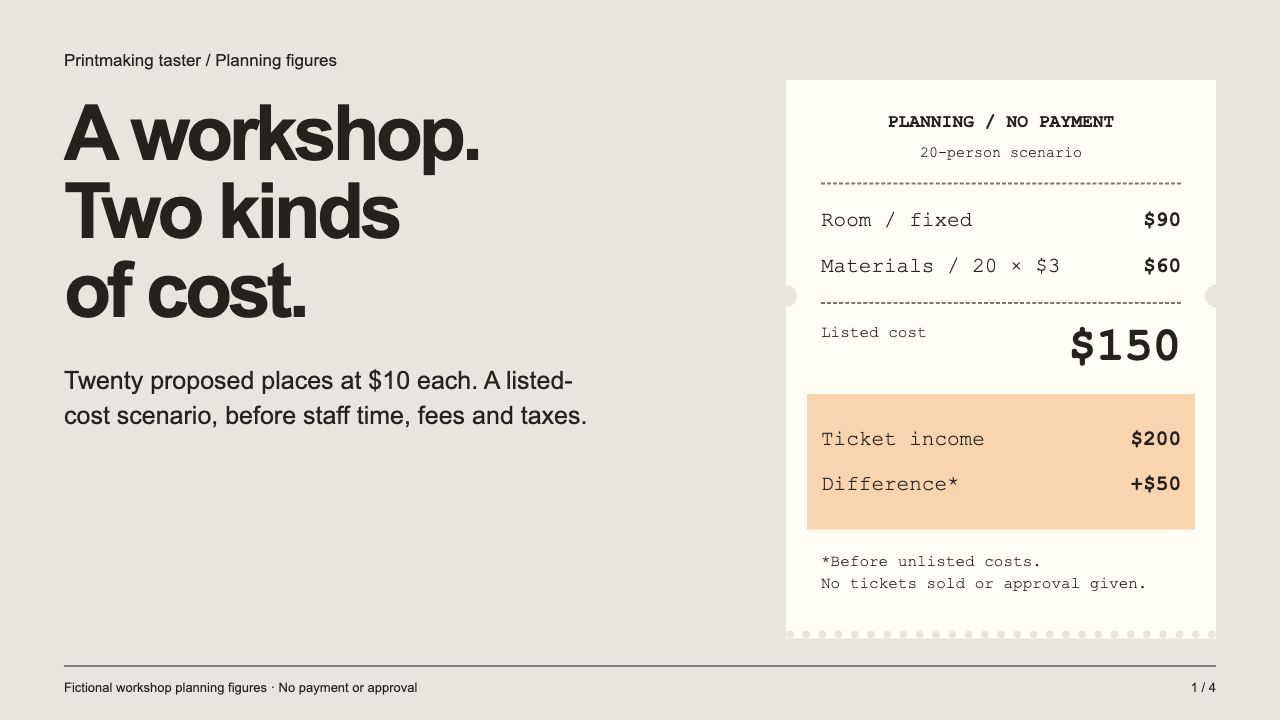
Proposed capacity:20participants; proposed price:$10per paidplace. Listed room cost:$90fixed per session. Materials:$3per participant. Cost for nparticipants:90+3n dollars. These are planning figures, not quotes or contracted costs.
At20paidplaces:income$200,listedcost$150,scenario difference$50 before unlistedcosts. At10paidplaces:income$100,listedcost$120,scenario difference−$20 beforeunlistedcosts. At13paidplaces:income$130,listedcost$129,difference$1;13 is the first whole paidplacecount that covers these listedcosts. This is not an all-cost breakeven or guaranteed profit. Do not subtract a20-person materials total in a10-person scenario.
Staff time, payment fees and taxes have no supplied amounts; they remain unknown, not zero. Session date and supplierquotes unresolved. No tickets sold, costs contracted or approval given.
Ask: authorize planning to the listed$150cost for20people, conditional on checking the unknown stafftime/paymentfees/taxes before ticket sales. Do not imply this authorizes any unlisted cost.
Visualdirection: narrow planning receipts, monospace aligned monetary lines, perforated stubs and paired attendance scenarios. Everyreceipt states planning/no payment; avoid fabricating transaction IDs, tax rates, legal accounting claims or customer purchases. Native typographic diagrams; no image is needed. Optionalimages may add context but cannot prove costs, sales orattendance.
Design instructions
Receipt: a planning-paper visual language in warm grey #ebe8e2, white #fffdf7, dark brown #292421 and pale apricot #ffd6b5. Use one dominant narrow receipt, aligned Courier New monetary lines, perforated cost stubs and paired receipts with identical row order. Large Arial headlines lead the explanation; typography and arithmetic carry the evidence. Match variable costs to each scenario, keep fixed costs fixed, and distinguish a listed-cost difference from all-cost profit or a completed transaction. Mark planning sheets as planning, never fabricate transaction identifiers or tax rates. Adapt the cost structure and narrative to supplied figures rather than copying this workshop. Keep numbers, units, conditions and unknown charges visible and selectable. This style is complete without images. When an available image tool can add useful optional context, generate a labelled conceptual scene or use an authorized supplied asset, keeping it separate from the receipt evidence. If optional imagery is unavailable or fails, retain the complete native receipt/stub composition and continue without an empty image slot.

Use my supplied content and the format I requested. Keep its facts, numbers, denominators, uncertainty and conclusion. Do not inherit the example deck’s story, figures or recommendation. The visual direction guides design; the audience and argument determine the slide sequence.

Check the tools available in this session. When an image would improve the presentation and a suitable generation tool is available, generate an original image or use an asset I am authorized to supply. If optional generation is unavailable or fails, continue with a complete image-free composition. Reclaim the space, leave no placeholders, and do not ask me to enable a tool or delay the deck for optional imagery. Mention a failure in the handoff rather than on audience-facing slides. If I explicitly require a particular image, preserve that requirement and explain any unmet dependency.

Keep text and evidence selectable. For HTML, use one self-contained static document with embedded CSS, compressed data images and licensed embedded fonts when needed; do not add scripts, forms, remote calls or authored slide controls. Preserve font licenses and asset provenance. Label conceptual or generated imagery when it could be mistaken for real product, customer or event evidence. Never invent a product screenshot to prove a feature.

Render every slide and inspect the actual result before handing it over. Check crop, contrast, type hierarchy, labels, overflow and source fidelity. Use at least 4.5:1 contrast for body text and 3:1 for large text. Check the destination’s file/data-image limits before any separately authorized publication. If visual checking is unavailable, say so in the handoff.About this design study
Four slides carry a fictional workshop planning request, showing listed costs for ten and twenty paid places and a conditional planning ceiling. Independently authored fictional workshop planning study using native typography. Receipts are illustrative planning sheets, not real payments, supplier quotes, tax advice or guaranteed profit.