For larger text, use “Read or print.”
Relay
Athletic display titles, unique pairings and concurrent-court rows keep a tournament proposal honest.
Design study · 5 slides
Using Claude Code or Codex? Install the free presentation skill.
Source and instructions
Source notes
First-party fictional community court-tournament proposal, not a booking, registration notice, sports governing rule or actual results.
Audience: community programme committee. Ask approve1200dollars subject to securing two courts, officials and a review of access/rest requirements. None of those conditions confirmed. No funds approved.
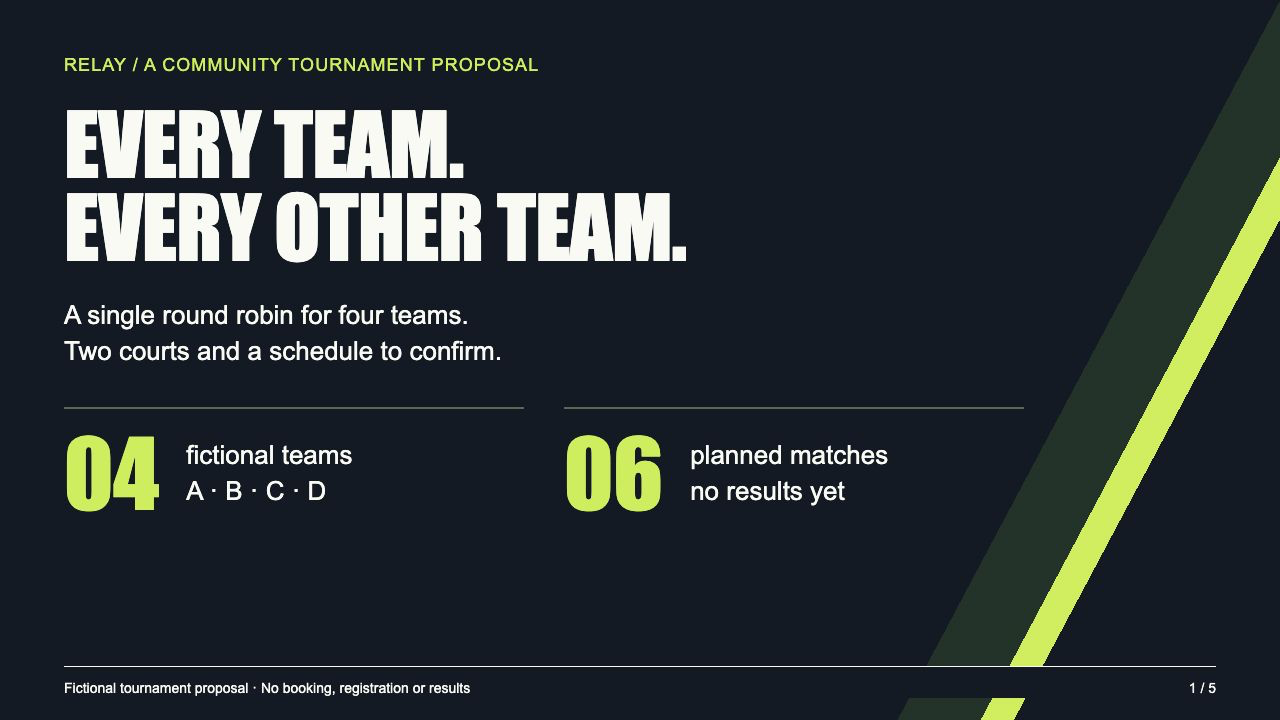
Four fictional teams A,B,C,D. Single round robin, each unordered pair plays once. Six planned matches total; three matches per team; no winners/results or participant registrations.
Three planned rounds using two courts simultaneously:
Round1 Court1 A–B; Court2 C–D.
Round2 Court1 A–C; Court2 B–D.
Round3 Court1 A–D; Court2 B–C.
Proposed start09:00. Assumed20-minute slot includes play and changeover; these are planning assumptions, not sport regulations or evidence enough recovery time. Round2 starts09:20; Round3 starts09:40. Proposed final slot ends10:00 if all start on time. Sixty-minute total derives3×20minutes with two courts; not six sequential games in60minutes. Do not promise finish time or sufficient rest. No calendar date/address/venue/operator supplied.
Budget proposal1200: courts600,equipment250,officials250,reserve100. No fee/revenue/prize/sponsorship claims or material costs beyond these categories.
Court availability, officials, rest suitability and access are unconfirmed. Weather contingency not supplied; do not invent one.
No named sport supplied. Do not imply formal match lengths, tournament certification, qualification or sport-specific rules.
Design instructions
Relay: scoreboard-led programme storytelling with midnight #121c29, acid lime #d0f05b, electric blue #3f64ed and pale text #f9fbf4. Use condensed athletic display headlines, monospaced pairing tokens, parallel-court timetable rows, strong numbered conditions and one high-contrast funding spread. Keep planned fixtures visually separate from results: never invent scores, wins, registrations, confirmed venues or official appointments. Verify unordered pair uniqueness, matches per team and the concurrency assumptions behind schedule arithmetic; preserve changeover and rest caveats. Reflow fixture rows on phones while retaining both court labels and the same time rows. Native pairings and typography are the complete default composition. If an available generation tool can add useful atmosphere, use an original clearly conceptual court-detail image away from the schedule, never a real venue or participant claim. If imagery is unavailable or fails, omit that optional slot and keep the complete native composition. Vary poster, pairing board, parallel timetable, funding and conditions layouts.

Use my supplied content and the format I requested. Keep its facts, numbers, denominators, uncertainty and conclusion. Do not inherit the example deck’s story, figures or recommendation. The visual direction guides design; the audience and argument determine the slide sequence.

Check the tools available in this session. When an image would improve the presentation and a suitable generation tool is available, generate an original image or use an asset I am authorized to supply. If optional generation is unavailable or fails, continue with a complete image-free composition. Reclaim the space, leave no placeholders, and do not ask me to enable a tool or delay the deck for optional imagery. Mention a failure in the handoff rather than on audience-facing slides. If I explicitly require a particular image, preserve that requirement and explain any unmet dependency.

Keep text and evidence selectable. For HTML, use one self-contained static document with embedded CSS, compressed data images and licensed embedded fonts when needed; do not add scripts, forms, remote calls or authored slide controls. Preserve font licenses and asset provenance. Label conceptual or generated imagery when it could be mistaken for real product, customer or event evidence. Never invent a product screenshot to prove a feature.

Render every slide and inspect the actual result before handing it over. Check crop, contrast, type hierarchy, labels, overflow and source fidelity. Use at least 4.5:1 contrast for body text and 3:1 for large text. Check the destination’s file/data-image limits before any separately authorized publication. If visual checking is unavailable, say so in the handoff.About this design study
Five slides present a first-party fictional four-team tournament plan, its pairings, conditional schedule, proposed budget and unconfirmed operating conditions. This is an authored fictional planning study, not an event notice, registration offer, confirmed venue, actual result or sport governing rule.