For larger text, use “Read or print.”
Section
An original layer concept leads into a proportioned native cross-section, a gap-free material sum and a conditional physical-sample review.
Design study · 4 slides
Using Claude Code or Codex? Install the free presentation skill.
Source and instructions
Source notes
SECTION / Frozen fictional material-panel concept brief
Purpose: present an appearance and layer arrangement for a proposed sample panel, asking for one physical sample review after materials and sample budget approval. Neither approval is supplied. Not a product specification, assembly guide or construction approval.
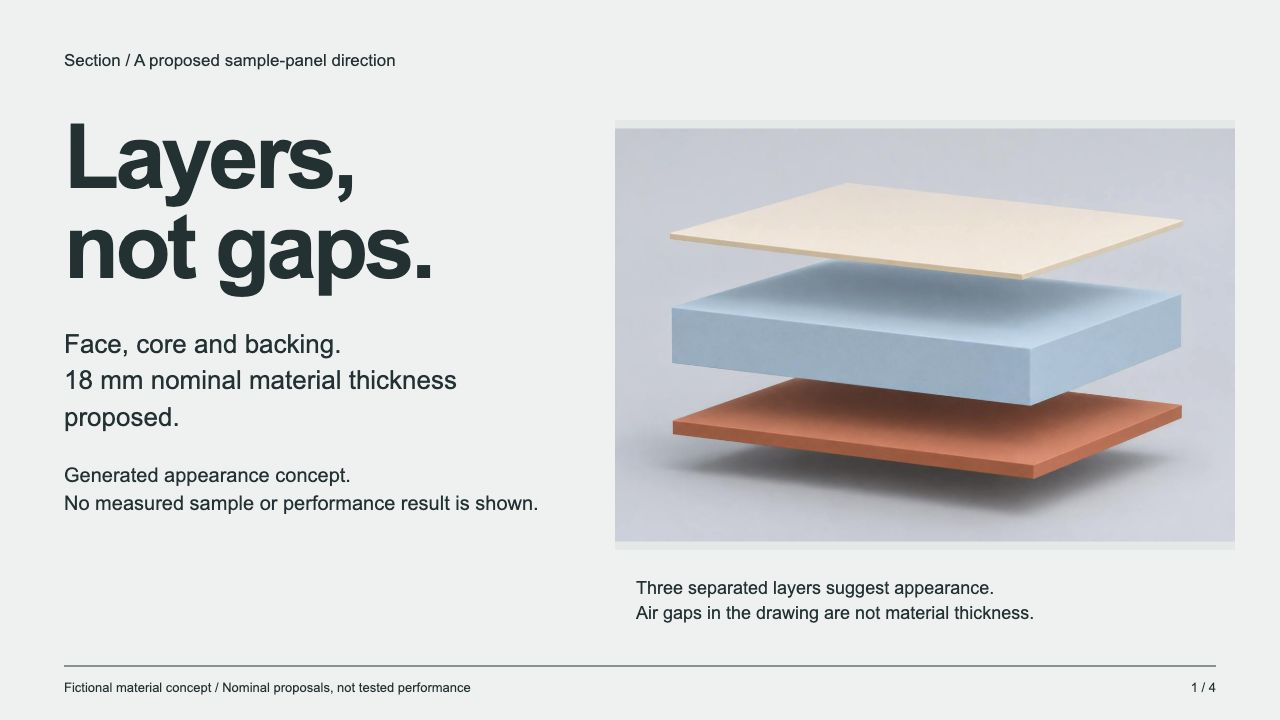
Three proposed layers in order from face to back: face layer nominal2mm; core nominal12mm; backing nominal4mm. Proposed nominal material thickness18mm=2+12+4. No tolerance or measured sample thickness is supplied. The gap between exploded parts is an illustration device and adds no material thickness.
The source names layers by role only. Face composition, core composition, backing composition, adhesive, fasteners, finish, manufacturer, costs, physical dimensions other than nominal thickness and delivery date are not supplied.
An original generated exploded appearance image may suggest three separated layers. It does not verify material identity, accurate layer thickness, fabrication, assembly, structural capacity, acoustic or thermal performance, fire rating, electrical safety or compliance. No performance tests or physical inspection are supplied.
A native flat cross-section may encode only proposed thickness at one scale:2:12:4=1:6:2. Keep a separate18mm material-thickness label; never include display gaps. Layer role labels and the words nominal/proposed stay visible.
Ask: commission one physical sample for review only after materials and sample budget are approved. Material choice, fabrication method and performance evidence remain open. No production or installation approval is requested.
Four-slide independently authored fictional material-concept study, not a released-recipe evaluation output.
Design instructions
Section: a layered-material study language in cool paper #f0f3f1, dark teal ink #24393b, ivory face #f5ead2, pale blue core #b9d1d9 and muted terracotta backing #e5b7a0. Lead with an original exploded appearance plate, then carry parallel planes, layer-role registers and a nominal-sum record through the whole sequence. Keep concept imagery separate from the native cross-section that encodes source thicknesses at one stated scale; a display gap adds no material thickness. Preserve source layer order, nominal versus measured wording, units and approval conditions. Never infer composition, tolerance, fabrication, assembly, structural or other performance from a rendering. If optional generation is available, create an original three-layer concept without baked-in labels, disclose it, compress/embed it and retain the prompt/assets. Without generation or supplied imagery, build the complete native exploded-plane composition with meaningful role labels and schematic limits; preserve every thickness and review condition without a blank image slot. Specifically required documentary sample/test evidence remains a dependency. Native exploded planes are not assembly instructions. Reflow records on phones while keeping the proportioned cross-section and readable quantities; do not replace unknown properties with zero or a performance promise.

Use my supplied content and the format I requested. Keep its facts, numbers, denominators, uncertainty and conclusion. Do not inherit the example deck’s story, figures or recommendation. The visual direction guides design; the audience and argument determine the slide sequence.

Check the tools available in this session. When an image would improve the presentation and a suitable generation tool is available, generate an original image or use an asset I am authorized to supply. If optional generation is unavailable or fails, continue with a complete image-free composition. Reclaim the space, leave no placeholders, and do not ask me to enable a tool or delay the deck for optional imagery. Mention a failure in the handoff rather than on audience-facing slides. If I explicitly require a particular image, preserve that requirement and explain any unmet dependency.

Keep text and evidence selectable. For HTML, use one self-contained static document with embedded CSS, compressed data images and licensed embedded fonts when needed; do not add scripts, forms, remote calls or authored slide controls. Preserve font licenses and asset provenance. Label conceptual or generated imagery when it could be mistaken for real product, customer or event evidence. Never invent a product screenshot to prove a feature.

Render every slide and inspect the actual result before handing it over. Check crop, contrast, type hierarchy, labels, overflow and source fidelity. Use at least 4.5:1 contrast for body text and 3:1 for large text. Check the destination’s file/data-image limits before any separately authorized publication. If visual checking is unavailable, say so in the handoff.About this design study
Four slides carry a fictional three-layer panel proposal with nominal two, twelve and four-millimetre layers, while composition, fabrication and performance remain open. Independently authored fictional material-concept study using one original generated appearance image. It is not a measured sample, material specification, assembly guide, fabrication or performance test, safety or compliance result, production approval or installation instruction.