For larger text, use “Read or print.”
Shoreline
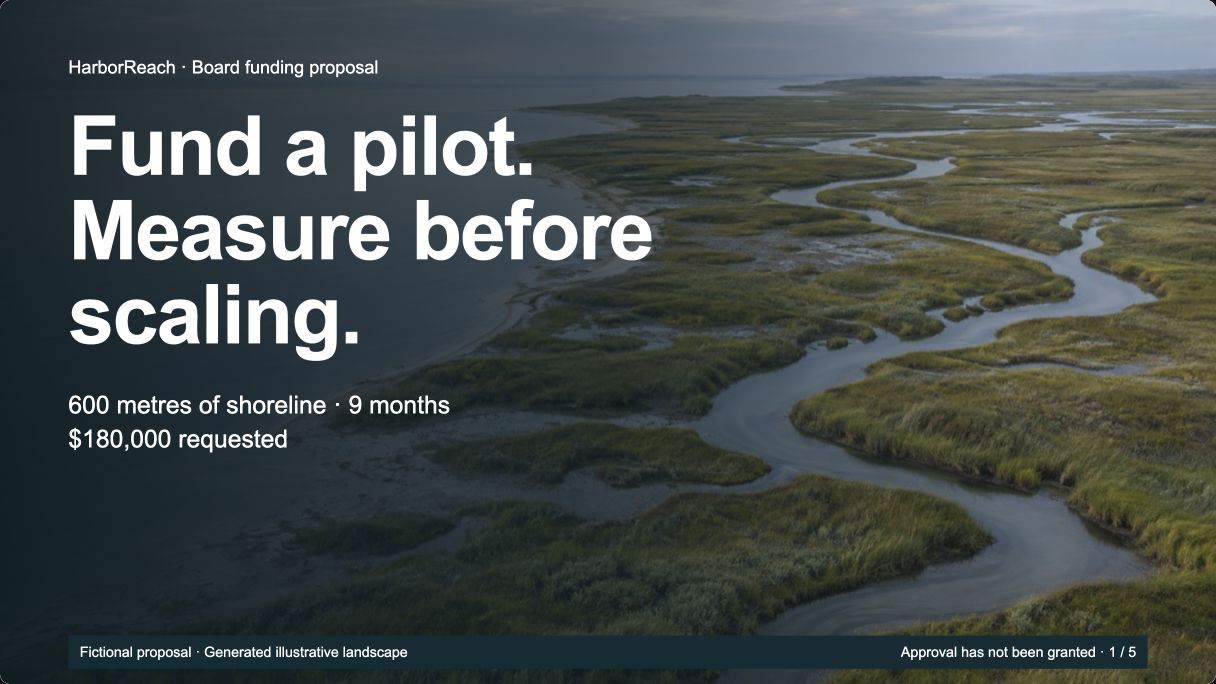
A coastal landscape sets the context while budget, permissions and unproven outcomes remain explicit.
Design study · 5 slides
Using Claude Code or Codex? Install the free presentation skill.
Source and instructions
Source notes
FIRST-PARTY FICTIONAL TEST BRIEF. All organisations, locations, figures and proposals below are invented for a presentation example; they are not real conservation findings.

Make a five-slide board funding brief for HarborReach's proposed North Inlet coastal-restoration pilot. The recommendation is to approve a bounded pilot before committing to a full programme.
- Proposed pilot: 600 metres of shoreline, 9 months, total $180,000.
- Allocation: baseline survey $40,000; planting $90,000; monitoring $35,000; contingency $15,000.
- Work sequence: baseline survey in months 1–2; planting in months 3–5, subject to the permit; monitoring visits in months 6, 8 and 9.
- The permit has not been secured. No baseline survey has yet been completed.
- We have not demonstrated flood protection, carbon benefits or ecological improvement. Do not imply those outcomes or use an illustration as site evidence.
- The monitoring results will inform whether to scale. Scale criteria have not yet been agreed.
- Alternative 1: wait and monitor for 9 months, at an estimated $25,000; no planting.
- Alternative 2: the proposed $180,000 pilot over 9 months.
- Alternative 3: a full programme has an early $900,000 estimate; its scope and delivery duration are not final.
- The board is being asked to approve the $180,000 pilot, subject to the permit before planting. Do not imply approval has happened.
Use a generated coastal image only as illustrative context, not as a photograph of North Inlet or evidence of restoration success.
Design instructions
Create an environmental or place-based proposal in the Shoreline direction. Begin with the audience’s actual decision and distinguish proposed scope, baseline evidence, intended outcomes and outcomes not yet demonstrated. Keep permissions, funding status, timing, budget assumptions and scale criteria visible. Compare alternatives fairly when supplied, noting differences in scope and duration rather than presenting unlike totals as equivalent. Never infer ecological improvement, carbon benefit or protection from a landscape image.

Use deep estuary blue (#11323c), off-white (#f4f7f5), muted water blue (#507782), olive (#626f3b) and a light tidal tint (#dce8e7). Use a readable system sans-serif with large, calm, left-aligned headlines. Give a relevant original or authorized landscape a meaningful role: a full-bleed cover with a deliberate dark reading zone, then a contextual strip or side crop alongside selectable evidence. Use open scope labels, honest proportional budget marks and a sequence of work with explicit dependency gates. Do not create a fake geographic map or imply site measurements from a conceptual aerial image.

If a suitable image-generation tool is available and contextual imagery improves the proposal, generate a landscape illustration with no fabricated measurement labels or before/after claim. Identify it as illustrative when it could be mistaken for the actual place. If optional imagery is unavailable or fails, build the same complete argument using strong type, a restrained water-blue gradient and source-grounded diagrams or budget evidence. Reclaim image areas; never leave empty panels.

Use my supplied content and the format I requested. Keep its facts, numbers, denominators, uncertainty and conclusion. Do not inherit the example deck’s story, figures or recommendation. The visual direction guides design; the audience and argument determine the slide sequence.

Check the tools available in this session. When an image would improve the presentation and a suitable generation tool is available, generate an original image or use an asset I am authorized to supply. If optional generation is unavailable or fails, continue with a complete image-free composition. Reclaim the space, leave no placeholders, and do not ask me to enable a tool or delay the deck for optional imagery. Mention a failure in the handoff rather than on audience-facing slides. If I explicitly require a particular image, preserve that requirement and explain any unmet dependency.

Keep text and evidence selectable. For HTML, use one self-contained static document with embedded CSS, compressed data images and licensed embedded fonts when needed; do not add scripts, forms, remote calls or authored slide controls. Preserve font licenses and asset provenance. Label conceptual or generated imagery when it could be mistaken for real product, customer or event evidence. Never invent a product screenshot to prove a feature.

Render every slide and inspect the actual result before handing it over. Check crop, contrast, type hierarchy, labels, overflow and source fidelity. Use at least 4.5:1 contrast for body text and 3:1 for large text. Check the destination’s file/data-image limits before any separately authorized publication. If visual checking is unavailable, say so in the handoff.About this design study
Five slides turn a first-party fictional conservation brief into a bounded board funding proposal. This is an authored study from a first-party fictional brief. The landscape is an original generated illustration, not North Inlet or evidence of ecological improvement.