For larger text, use “Read or print.”
Storyboard
Numbered concept frames, framing notes and duration bands make a proposed visual sequence inspectable before production.
Design study · 4 slides
Using Claude Code or Codex? Install the free presentation skill.
Source and instructions
Source notes
FROZEN FICTIONAL FILM PLANNING BRIEF · STORYBOARD
Audience: the review group for a fictional short-film exercise. Purpose: approve a visual sequence for further storyboard development, not a shoot, budget or publication.
Working title: Morning, held. Proposed duration:30seconds, four planned shots.
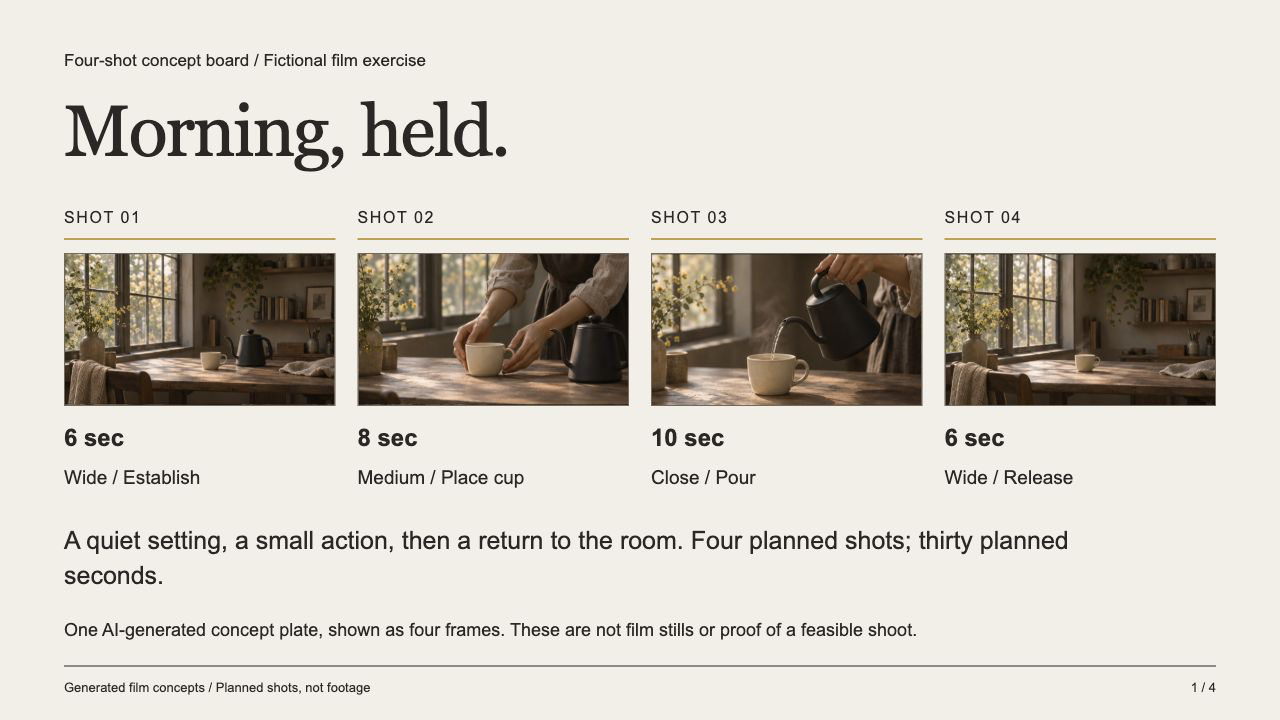
Shot01:6seconds, wide view of a quiet worktable by a window, a ceramic cup and a kettle. Establish the setting.
Shot02:8seconds, medium view of hands placing the ceramic cup on the table. Begin the action.
Shot03:10seconds, close view of water pouring from the kettle into the cup. Continue the action.
Shot04:6seconds, wider view of the cup resting by the window. Release the action and end on the setting.
Planned durations total6+8+10+6=30seconds. Grouping: establish6seconds, action18seconds(shots02+03), release6seconds. These are planned holds, not measured footage or demonstrated viewing/engagement performance.
A single original AI-generated four-panel concept plate may illustrate the four shots. Each quarter is a concept frame, not actual footage or a continuity/production feasibility guarantee. Do not fabricate an actual actor, location, director, camera/lens metadata, completed film or soundtrack. Sound plan, performer, location and production arrangements are unresolved. No shoot or publication approved.
Four-slide narrative: complete shot board; duration-proportional cut plan; close-up concept with planned10-second hold and unresolved sound; ask approve the visual sequence for further development, with production still open.
If optional image generation is unavailable, make a complete native four-shot board with shot numbers, framing descriptions and timing strips. No blank photo slots. Explicitly required documentary footage would remain a dependency.
Design instructions
Storyboard: a cinematic planning language in warm paper #f3f1eb, charcoal #302d28, quiet gold #c9a85c and grey #ded9cf. Use numbered shot frames, short framing descriptions, proportional timing bands and one featured concept frame. Georgia display and plain Arial production notes should support the planned sequence rather than mimic a camera interface. Make shot order, action and duration the evidence; show open production questions next to the approval scope. Do not infer footage, lenses, soundtrack, continuity or engagement results from generated boards. Adapt the sequence to supplied content rather than copying this cup scene. When an authorized image tool is available, generate original concept frames, preserve their provenance, compress/embed them and label them as concepts. Without optional generation or supplied imagery, build a complete native shot board from framing/action descriptions and timing strips, reclaiming photo space without placeholders. Keep all counts, timing, decisions and caveats native/selectable. Explicitly required documentary footage remains a dependency; never replace it with generated proof.

Use my supplied content and the format I requested. Keep its facts, numbers, denominators, uncertainty and conclusion. Do not inherit the example deck’s story, figures or recommendation. The visual direction guides design; the audience and argument determine the slide sequence.

Check the tools available in this session. When an image would improve the presentation and a suitable generation tool is available, generate an original image or use an asset I am authorized to supply. If optional generation is unavailable or fails, continue with a complete image-free composition. Reclaim the space, leave no placeholders, and do not ask me to enable a tool or delay the deck for optional imagery. Mention a failure in the handoff rather than on audience-facing slides. If I explicitly require a particular image, preserve that requirement and explain any unmet dependency.

Keep text and evidence selectable. For HTML, use one self-contained static document with embedded CSS, compressed data images and licensed embedded fonts when needed; do not add scripts, forms, remote calls or authored slide controls. Preserve font licenses and asset provenance. Label conceptual or generated imagery when it could be mistaken for real product, customer or event evidence. Never invent a product screenshot to prove a feature.

Render every slide and inspect the actual result before handing it over. Check crop, contrast, type hierarchy, labels, overflow and source fidelity. Use at least 4.5:1 contrast for body text and 3:1 for large text. Check the destination’s file/data-image limits before any separately authorized publication. If visual checking is unavailable, say so in the handoff.About this design study
Four slides carry a fictional four-shot, thirty-second film concept, preserving planned durations and unresolved production questions. Independently authored fictional shot-planning study using one original AI-generated concept plate. The frames are not footage, camera metadata, continuity proof or an approved shoot or publication.