For larger text, use “Read or print.”
Stream
Native ribbons trace one inventory through split and merged statuses, with a separate subset plate and explicit conservation equation.
Design study · 4 slides
Using Claude Code or Codex? Install the free presentation skill.
Source and instructions
Source notes
FROZEN FICTIONAL BOOK-TRIAGE CASE · STREAM
Audience: a fictional community book-room team. Purpose: explain a status update without counting the same inventory twice. This is a toy case, not a real donation campaign or impact report.
There are exactly80books in this case, counted at intake. No new arrivals and no removals between the two status snapshots below. Statuses in each snapshot are mutually exclusive.
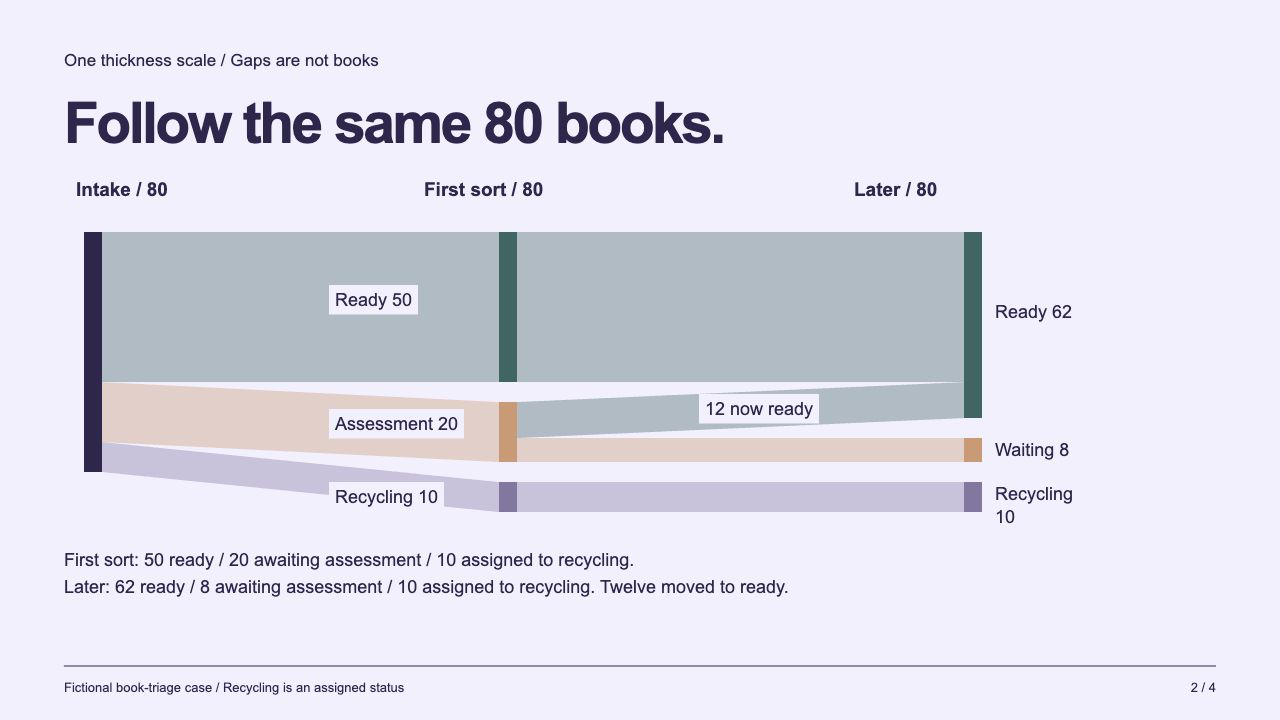
First sort:50ready for reuse,20awaiting repair assessment,10assigned to recycling. Total80.
Later snapshot:12of the20assessment books are now ready for reuse;8remain awaiting assessment. The original50ready remain ready, and the10assigned to recycling retain that status. Final statuses:62ready,8awaiting assessment,10assigned to recycling. Total80. Recycling is an assigned status, not a claim that collection or disposal occurred.
The ready count increased by12books. This is a transfer of status among the same80books, not12new arrivals or a total of160books. No measured repair labor, cost, timeframe, reader benefit, unique donors or environmental impact is supplied. Do not invent them.
Diagram requirement: ribbon thickness uses one common height scale per diagram. Initial80books split50/20/10; assessment20splits12ready+8waiting; finalready62combines50+12. Label every count and keep both snapshots inspectable. Spacing gaps are not books. Native CSS ribbons/stacked bands only, not generated charts. Necessary narrow-reading pan must be bounded, keyboard-focusable and visibly hinted, with all counts available in ordinary text.
Four slides: same80books with changed status; complete intake-to-snapshots flow; assessment subset20→12+8; final conservation62+8+10=80 and remaining unknowns. Next update after the8outstanding assessments; no date or promise that all8will be reusable.
Optional generated contextual imagery may decorate another brief when available, but must not replace actual counts/flow evidence. Without it, continue with complete native ribbons and labels.
Design instructions
Stream: a conserved-flow visual language in pale lavender #f5f2ff, plum #372b58, teal #42726d, apricot #d5a17e and muted violet #8e82ab. Use proportional native branching and merging ribbons to trace the same inventory through status snapshots. Keep one common thickness scale per diagram, state totals at each stage and give a changed subset its own simpler plate. Labels and ordinary-text counts must remain visible; spacing gaps never encode extra items. If a wide diagram is necessary on phones, use a bounded focusable reader with a visible associated sideways-reading hint and preserve the counts in ordinary text. Adapt the flow and sequence to supplied evidence rather than inheriting these books or statuses. Distinguish a status transfer from new arrivals, mutually exclusive counts from cumulative activity, and assignment from completed action. Keep source uncertainty and avoid invented impact. Flow evidence stays native and selectable. Optional image generation may add clearly conceptual context when available; if unavailable or failed, continue with the complete ribbon/count composition without an empty image slot. Never replace data ribbons with a generated diagram.

Use my supplied content and the format I requested. Keep its facts, numbers, denominators, uncertainty and conclusion. Do not inherit the example deck’s story, figures or recommendation. The visual direction guides design; the audience and argument determine the slide sequence.

Check the tools available in this session. When an image would improve the presentation and a suitable generation tool is available, generate an original image or use an asset I am authorized to supply. If optional generation is unavailable or fails, continue with a complete image-free composition. Reclaim the space, leave no placeholders, and do not ask me to enable a tool or delay the deck for optional imagery. Mention a failure in the handoff rather than on audience-facing slides. If I explicitly require a particular image, preserve that requirement and explain any unmet dependency.

Keep text and evidence selectable. For HTML, use one self-contained static document with embedded CSS, compressed data images and licensed embedded fonts when needed; do not add scripts, forms, remote calls or authored slide controls. Preserve font licenses and asset provenance. Label conceptual or generated imagery when it could be mistaken for real product, customer or event evidence. Never invent a product screenshot to prove a feature.

Render every slide and inspect the actual result before handing it over. Check crop, contrast, type hierarchy, labels, overflow and source fidelity. Use at least 4.5:1 contrast for body text and 3:1 for large text. Check the destination’s file/data-image limits before any separately authorized publication. If visual checking is unavailable, say so in the handoff.About this design study
Four slides follow the same eighty fictional books through two status snapshots, including twelve moving from assessment to ready. Independently authored fictional book-triage case using native CSS flow diagrams. Counts are illustrative, recycling is an assigned status, and no real campaign, completed disposal or measured impact is implied.