For larger text, use “Read or print.”
Switchboard
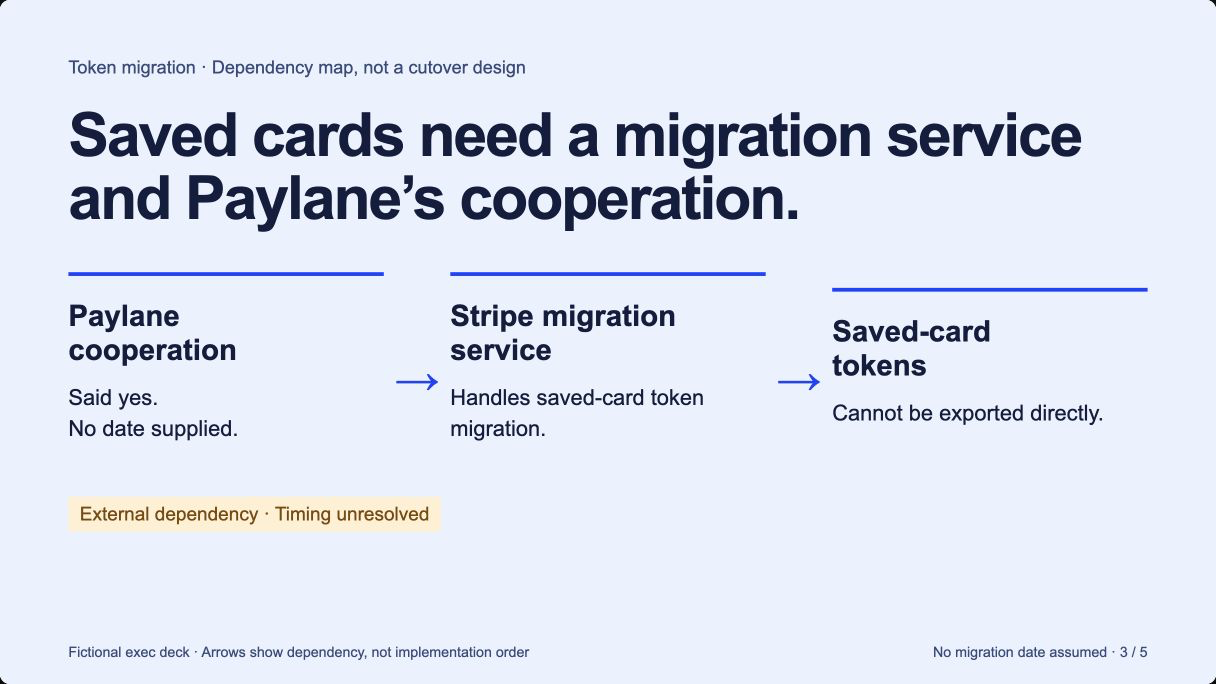
Dependency lanes and explicit unresolved design boundaries turn an approved decision into an engineering discussion.
Design study · 5 slides
Using Claude Code or Codex? Install the free presentation skill.
Source and instructions
Source notes
FICTIONAL SOURCE NOTES — author reference.

my VP approved this last week. now i need a version of the same deck for the engineering kickoff with the payments team. same facts, but they need different things from it. here's the text of the exec deck:

Slide 1: Move card payments from Paylane to Stripe by the end of Q2. Approved October 21.
Slide 2: Paylane fees cost us $412k last year. At Stripe's quoted rate the same volume would have cost $298k, a $114k saving.
Slide 3: Paylane had 3 outages in the last 6 months, 9 hours in total, about $60k in lost checkouts (finance estimate).
Slide 4: Options considered: stay and renegotiate (Paylane offered 8% off), move to Stripe, or move to Adyen (a 6-month integration). Chosen: Stripe.
Slide 5: Risks: saved card tokens can't be exported directly. Stripe's migration service handles it but needs Paylane's cooperation; Paylane said yes but gave no date. Subscription renewals will be in flight during the switch.
Slide 6: Approved: 2 engineers for Q1 and Q2, and a $25k migration fee.

My notes: the engineers care about the token migration, how we run both providers in parallel, and what the cutover looks like. We haven't designed the parallel run yet. Their tech lead asked whether we can drop the old webhook handler; nobody has answered that yet.
Design instructions
Create an engineering kickoff deck in the Switchboard direction from an approved decision and my team’s notes. Retain the decision, constraints, resources, timing and business rationale, then shift the emphasis to dependencies, unanswered technical questions and decisions the engineers still need to make. Preserve the difference between approved scope, an external dependency, a risk and a design that does not yet exist. Never invent a cutover plan, rollback procedure, owner, date, migration guarantee or webhook decision. Label a proposal explicitly if my request asks for one; otherwise expose the open question and its consequence without answering it.

Use white (#ffffff), cobalt (#2354f4), dark blue ink (#122145), pale blue (#eef3ff) and accessible amber (#875000). Use a precise system sans-serif with large action headlines and readable evidence. Give the deck the logic of a switchboard: open dependency lanes, connectors with explicit meanings, a deliberately unresolved design boundary and a sparse resource/timing frame. Use solid versus dashed lines only with a visible legend; color alone must not carry approval or uncertainty. Vary composition as the story moves from mandate to evidence to dependencies to questions.

Diagram only relationships supported by the source. A dependency map is not proof of an implemented architecture, and an illustrative screenshot is not evidence that a migration works. Use actual authorized product images only when they help; keep a strong image-free version for technical reasoning. Let the material determine the slide count and layout, rather than repeat this example’s sequence.

Use my supplied content and the format I requested. Keep its facts, numbers, denominators, uncertainty and conclusion. Do not inherit the example deck’s story, figures or recommendation. The visual direction guides design; the audience and argument determine the slide sequence.

Check the tools available in this session. When an image would improve the presentation and a suitable generation tool is available, generate an original image or use an asset I am authorized to supply. If optional generation is unavailable or fails, continue with a complete image-free composition. Reclaim the space, leave no placeholders, and do not ask me to enable a tool or delay the deck for optional imagery. Mention a failure in the handoff rather than on audience-facing slides. If I explicitly require a particular image, preserve that requirement and explain any unmet dependency.

Keep text and evidence selectable. For HTML, use one self-contained static document with embedded CSS, compressed data images and licensed embedded fonts when needed; do not add scripts, forms, remote calls or authored slide controls. Preserve font licenses and asset provenance. Label conceptual or generated imagery when it could be mistaken for real product, customer or event evidence. Never invent a product screenshot to prove a feature.

Render every slide and inspect the actual result before handing it over. Check crop, contrast, type hierarchy, labels, overflow and source fidelity. Use at least 4.5:1 contrast for body text and 3:1 for large text. Check the destination’s file/data-image limits before any separately authorized publication. If visual checking is unavailable, say so in the handoff.About this design study
Five slides preserve the fictional approved payments decision and highlight token migration, parallel-run design and the unanswered webhook question. This is an authored rework of our payments-kickoff-recut example, refined through review. It uses fictional source notes and system fonts. It is not an unedited recipe test output.