For larger text, use “Read or print.”
Viewfinder
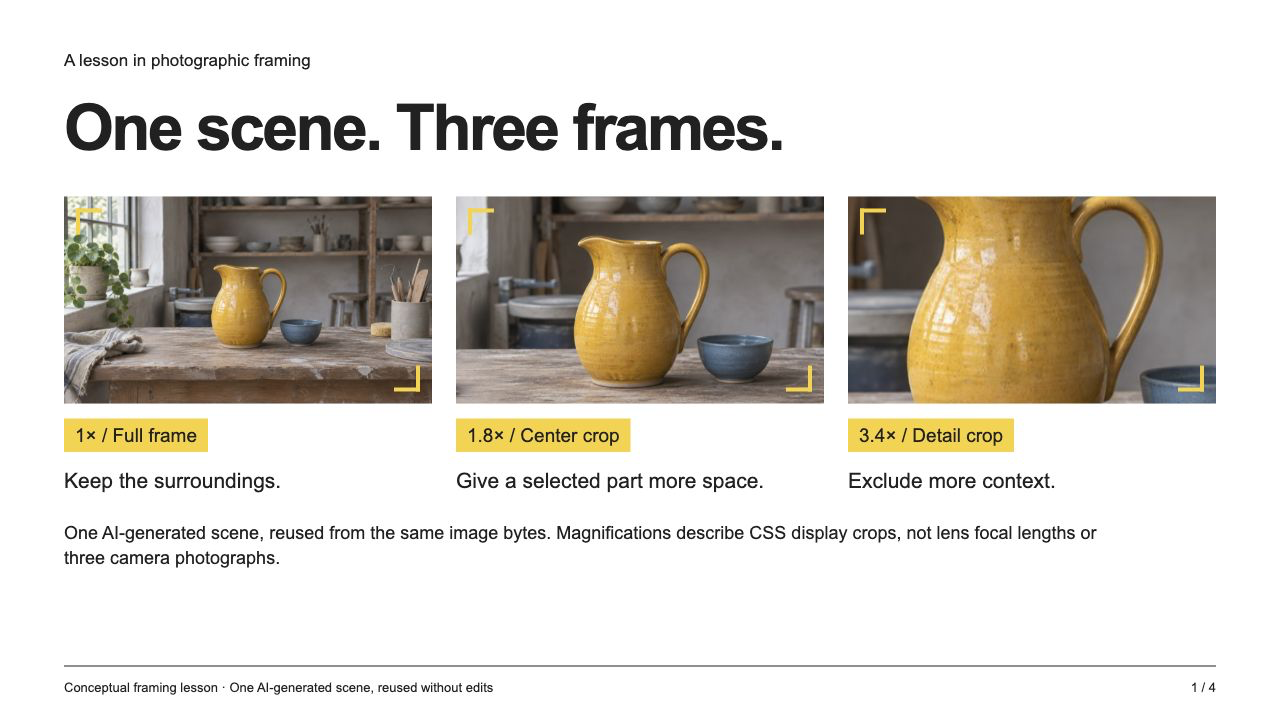
One generated scene is reused across labelled full, centered and detail crops, with the full frame kept visible for context.
Design study · 4 slides
Using Claude Code or Codex? Install the free presentation skill.
Source and instructions
Source notes
FROZEN PHOTOGRAPHY LESSON BRIEF · VIEWFINDER
Authored conceptual lesson, not documentary photography, a real artist interview, or a measured engagement study.
Audience: people composing photo-led presentations. Outcome: choose a useful crop without implying the crop contains the full context or adds evidence.
One original generated still-life image of a yellow ceramic pitcher and blue bowl on a workbench beside a window, with shelves and tools in the background. The generated scene is an illustration, not an actual workshop record. No identification of an artist, place, date, brand or material certification.
Compare three centered views made from the SAME original image: full frame,1.8×display zoom and3.4×display zoom. These are CSS crop magnifications, not lens focal lengths, optical zoom claims or three camera photographs. Preserve actualpixels; do not use generated variants as before/after evidence.
Wide framing retains more visible surroundings. Tighter framing gives a selected part more space and excludes context. A detail view may help show texture but cannot reveal excluded context or establish an object's history or quality. Crop labels must say what they are; the full image should remain inspectable in the lesson.
Four slides: three-crop comparison cover; full-image context; magnified detail with side-by-side full-image locator for context; finalpracticalrule choose framing for the claim and keep uncropped context with the handoff. No measured conversion/attention/quality claims.
Visual direction: white contact sheets, graphite typography, yellow frame labels and native corner marks; photography is the teaching evidence about framing. If imagegeneration is available, create one conceptual original and reuseits exactbytes. If generation is unavailable, use an authorized supplied image; if neither exists and imagesareoptional, produce a complete native framing-diagram lesson rather than an emptyphoto slot. Explicitlyrequired missing documentaryevidence remainsa dependency.
Design instructions
Viewfinder: a photographic contact-sheet language in white #ffffff, graphite #242424, yellow #f8d64e and quiet grey #e7e7e7. Use one authorized original across clearly labelled full, medium and detail crops; show the exact full-image locator when context is excluded. Yellow frame labels and corner marks organize the comparison; large Arial headlines explain what each view helps the reader see. Photography is the visual evidence for framing, not a decorative hero behind unrelated claims. Keep source pixels identical across comparisons and distinguish display magnification from lens data. Build a sequence around the actual communication job, not this pitcher or its crop factors. When a generation tool is available and conceptual imagery is appropriate, generate one original scene, label its status and reuse its exact embedded bytes. An authorized supplied image is equally valid. Without optional image capability or a supplied image, create a complete native framing-diagram lesson showing nested full/detail regions; reclaim the photo space and continue without placeholders. Never generate documentary proof or substitute variants for a true crop. Keep factual context and source provenance inspectable.

Use my supplied content and the format I requested. Keep its facts, numbers, denominators, uncertainty and conclusion. Do not inherit the example deck’s story, figures or recommendation. The visual direction guides design; the audience and argument determine the slide sequence.

Check the tools available in this session. When an image would improve the presentation and a suitable generation tool is available, generate an original image or use an asset I am authorized to supply. If optional generation is unavailable or fails, continue with a complete image-free composition. Reclaim the space, leave no placeholders, and do not ask me to enable a tool or delay the deck for optional imagery. Mention a failure in the handoff rather than on audience-facing slides. If I explicitly require a particular image, preserve that requirement and explain any unmet dependency.

Keep text and evidence selectable. For HTML, use one self-contained static document with embedded CSS, compressed data images and licensed embedded fonts when needed; do not add scripts, forms, remote calls or authored slide controls. Preserve font licenses and asset provenance. Label conceptual or generated imagery when it could be mistaken for real product, customer or event evidence. Never invent a product screenshot to prove a feature.

Render every slide and inspect the actual result before handing it over. Check crop, contrast, type hierarchy, labels, overflow and source fidelity. Use at least 4.5:1 contrast for body text and 3:1 for large text. Check the destination’s file/data-image limits before any separately authorized publication. If visual checking is unavailable, say so in the handoff.About this design study
Four conceptual lesson slides compare exact 1×, 1.8× and 3.4× centered CSS display crops from the same embedded image. Independently authored framing lesson using one AI-generated still-life, reused without content edits. It is not documentary workshop photography, optical lens data or a measured attention or quality result.