For larger text, use “Read or print.”
Voxel
Countable native layers unfold a three-dimensional volume problem, with flat-layer counts and equal-base comparisons.
Design study · 4 slides
Using Claude Code or Codex? Install the free presentation skill.
Source and instructions
Source notes
FROZEN WORKED EXAMPLE · VOXEL
Authored mathematical teaching brief, not experimental measurements or a physical construction specification.
Audience: middle-school learners. Outcome: distinguish cubes in one layer from cubes in a whole rectangular solid.
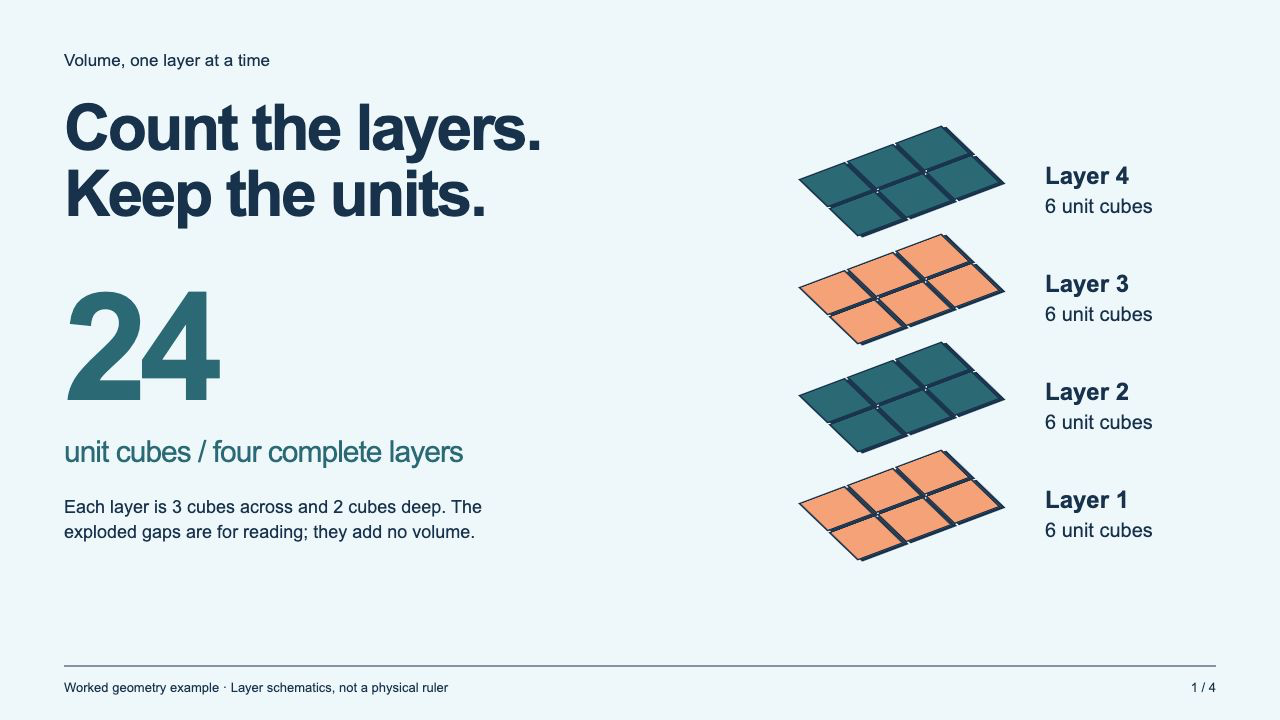
A rectangular solid is built from unit cubes, each1unit×1unit×1unit. The base has3columns and2rows:6cubes in each one-unit-high layer. Four complete layers make24unit cubes, volume24cubic units. The base area is6square units; it is not the volume. Height4units. Calculation:(3units×2units)×4units=24cubic units.
Compare a second solid with the same3×2base but only3layers:18unit cubes, volume18cubic units. One extra complete layer adds6cubic units. Do not claim that rearranging the same24cubes changes total volume, or confuse visible faces with all cubes.
Visual direction: native CSS exploded layer diagrams. Show each whole layer as a3-column2-row grid, count every cell, and label layer numbers. Gaps between layers are for reading only, not extra volume. These are layer schematics, not a physical ruler or perspective measurement. No photograph or generated image is needed to establish the counts.
Four slides: complete24-cube solid via exploded layers; count a6-cube layer; compare3and4layers at samebase; explain area×height with correctunits. No extra geometry question or claim of observed learning outcomes.
Optional imagery may supply decorative context only; unavailablegeneration must not prevent exactnative counting diagrams.
Design instructions
Voxel: a spatial teaching language in ice #eff9fc, deep blue #113b56, teal #167780 and apricot #ffa780. Use countable native cells in exploded isometric layer diagrams, then flatten one layer to expose its structure. Bring depth back through equal-base comparisons and close with a dimensionally labelled equation. Large Arial display and quiet unit labels should make the counting path obvious. Perspective and exploded gaps are reading devices, never measurement evidence; keep whole layers countable and preserve exact units. This is not a generic tile grid: the visual argument moves between depth, a layer and the full solid. Adapt it to the supplied spatial relationship rather than copying these dimensions. Exact diagrams remain native/selectable. Optional generated atmosphere may support a different brief when an image tool is available, but must not replace geometric evidence. Without image generation, continue with complete native planes, counts and labels; omit decorative image slots. Preserve source assumptions and distinguish worked examples from measured results.

Use my supplied content and the format I requested. Keep its facts, numbers, denominators, uncertainty and conclusion. Do not inherit the example deck’s story, figures or recommendation. The visual direction guides design; the audience and argument determine the slide sequence.

Check the tools available in this session. When an image would improve the presentation and a suitable generation tool is available, generate an original image or use an asset I am authorized to supply. If optional generation is unavailable or fails, continue with a complete image-free composition. Reclaim the space, leave no placeholders, and do not ask me to enable a tool or delay the deck for optional imagery. Mention a failure in the handoff rather than on audience-facing slides. If I explicitly require a particular image, preserve that requirement and explain any unmet dependency.

Keep text and evidence selectable. For HTML, use one self-contained static document with embedded CSS, compressed data images and licensed embedded fonts when needed; do not add scripts, forms, remote calls or authored slide controls. Preserve font licenses and asset provenance. Label conceptual or generated imagery when it could be mistaken for real product, customer or event evidence. Never invent a product screenshot to prove a feature.

Render every slide and inspect the actual result before handing it over. Check crop, contrast, type hierarchy, labels, overflow and source fidelity. Use at least 4.5:1 contrast for body text and 3:1 for large text. Check the destination’s file/data-image limits before any separately authorized publication. If visual checking is unavailable, say so in the handoff.About this design study
Four worked lesson slides distinguish six unit cubes in a layer from twenty-four in a four-layer solid, preserving square and cubic units. Independently authored worked geometry lesson with native CSS layer schematics. Exploded gaps are reading aids, not extra volume, perspective measurements or a tested learning outcome.