The Birch Bench booking incident
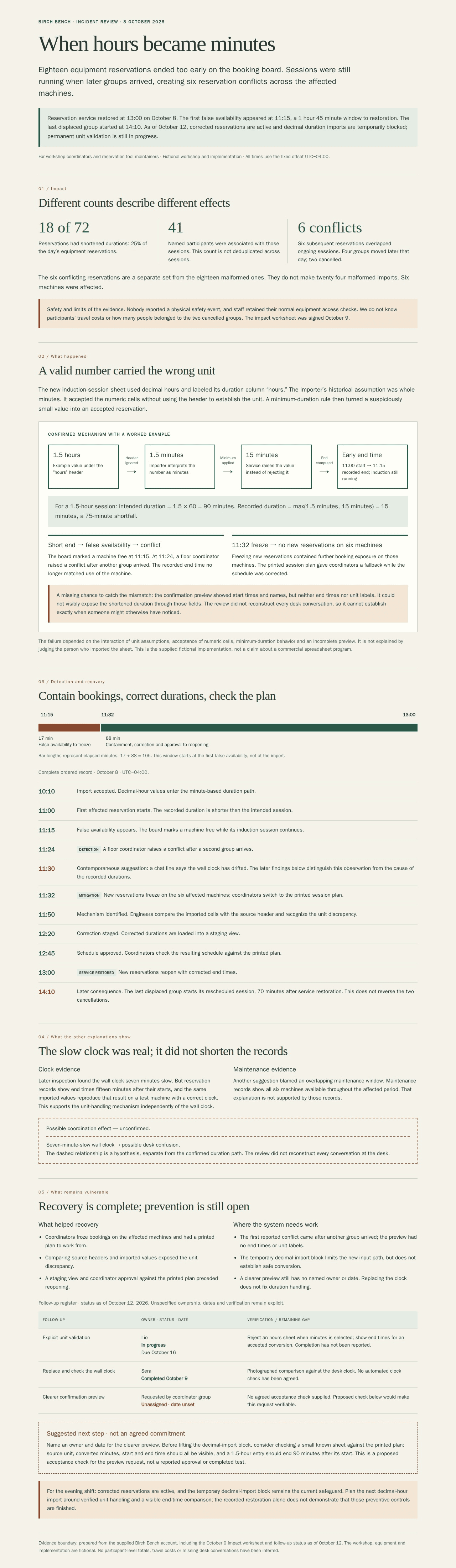
A scaled timeline shows when booking service was restored, and a worked example explains how hours became minutes.
Worked example
Source and instructions
Design instructions
Use a warm paper background and dark green type. Lead with the impact summary. Draw a timestamped timeline, use a short labeled process diagram where it explains the mechanism, and present follow-ups in an action table. Use a labeled ordered timeline and reflow the table on small screens.

Image fallback: Use native HTML and CSS for the timeline and diagram. Keep all labels and numbers selectable.Write a postmortem
Use these instructions with your incident records.
Start with customer impact, the incident interval, and the current service state. Include the timezone and mark estimates and missing evidence.

Build a timeline from the records. Distinguish observations from later interpretations. Explain the trigger and contributing system conditions. Label hypotheses and worked examples where they appear.

Distinguish mitigation and restoration from permanent preventive work. Record what went well and where detection or recovery struggled. Give follow-ups a verification criterion, owner, status, and due date when known.

Check the impact arithmetic and duration. Show a readable timeline and action table, and preserve the order and timestamps on narrow screens.Source notes
Birch Bench Workshop · reservation incident
- Fictional incident on October 8, 2026. Times use the fixed offset UTC−04:00.
- The booking board first showed false availability at 11:15. Service was restored at 13:00, and the last displaced group started at 14:10.
- The review found 18 malformed durations among 72 reservations. The notes name 41 people before deduplication.
- The packet gives 1.5 hours as an example of the input format. The diagram uses it to show how the 15-minute minimum masked the unit error.
- The Google SRE references inform the postmortem method. The incident details come from a fictional source packet.
About this example
Codex created this fictional postmortem using the postmortem skill in a blind comparison. The gallery version clarifies the worked example in the diagram.