I think HTML will eventually replace PowerPoint files, Google Slides documents, and the closed formats of AI presentation tools as the standard way we create and deliver presentations.
That is a prediction. But the reason I believe it is already visible: agents can work directly with the code that describes a presentation. Once that becomes the normal way decks are made, a lot of the assumptions behind slide software stop making sense.
We have spent years building interfaces for people to arrange boxes. Now we have agents that can generate the layout, typography, diagrams, and content together. We should take that change seriously enough to reconsider the output format.
I am not saying you should hand the whole argument to an agent. I still find their articulation and copy uneven. Bring your content, decide what you want people to understand, and use the agent as a design tool. Styling guidelines and templates can keep the work consistent while leaving room for your own choices.
The editor is becoming optional
A traditional slide editor gives a human handles to move objects around. That makes sense when the human is doing the construction.
With an agent, I can describe the relationship I want the audience to see: show these two approaches side by side; make the bottleneck obvious; turn this explanation into a sequence; keep the visual language consistent across the deck.
HTML and CSS give the agent direct access to the structure and appearance of the result. The layout itself is editable text. The same conversation can change the argument, rearrange the visual, and refine the styling.
PowerPoint and Google Slides can also be automated. The strategic question is whether we still need their document models at the centre of this workflow. If the agent creates the presentation and a browser can show it, the deck no longer has to belong to a particular editor.
That changes what a presentation product needs to be.
Your idea gets its own visual form
This is the benefit I keep coming back to. A template is a useful starting point. It becomes a constraint when every idea has to fit the same handful of compositions.
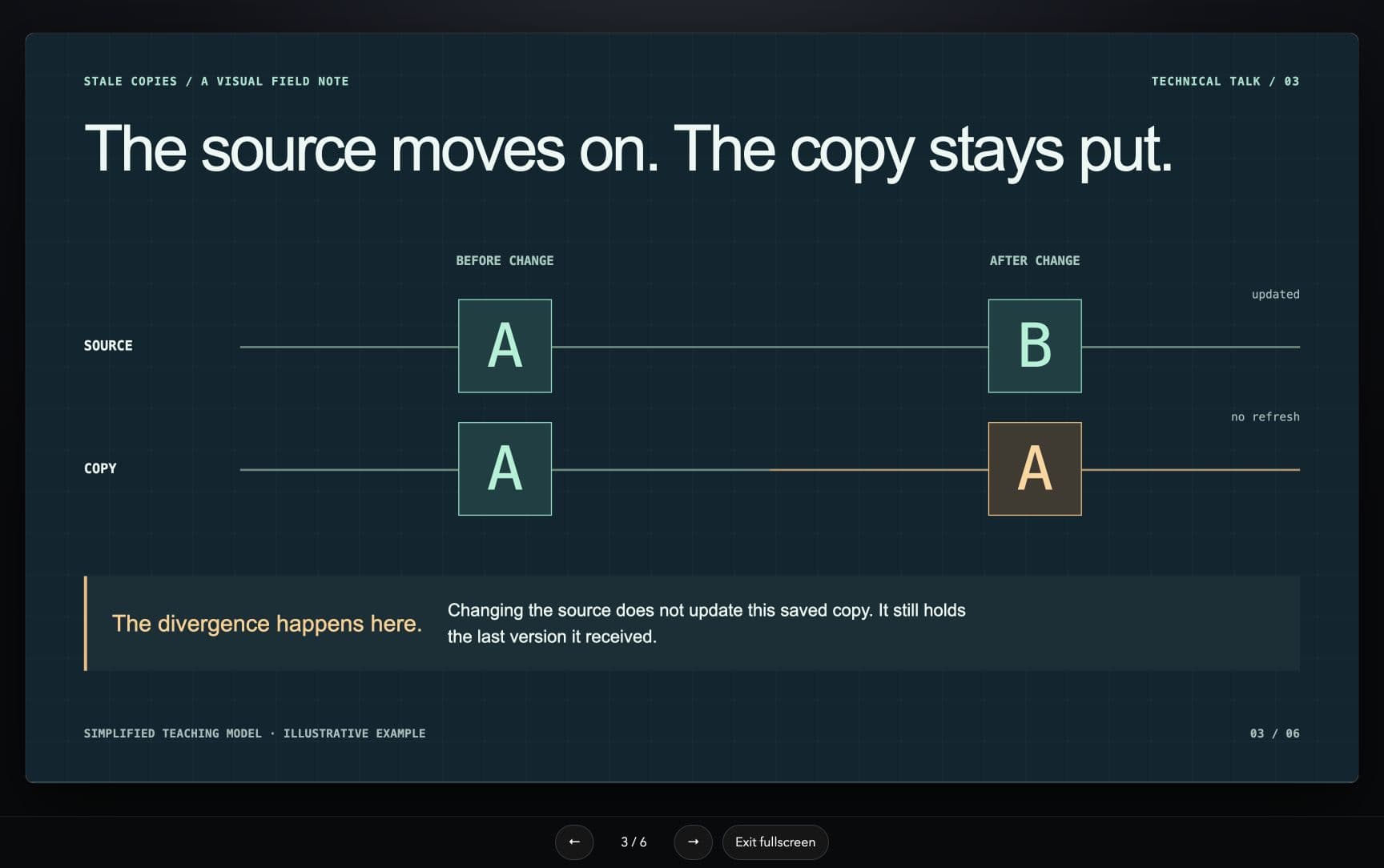
One slide might need a huge statement with almost nothing else. Another needs a precisely aligned comparison. A third needs a chart with the explanation beside the relevant data. A technical slide might need two timelines that diverge at one specific moment.
These are different visual problems. HTML lets an agent construct each one while keeping the same type, colour, spacing, and overall character across the deck.
Look at the examples here: a bold product pitch, an editorial review with a unit-count chart, and a technical explanation of a source and a saved copy. Their content is illustrative. What matters is how differently the slides communicate.
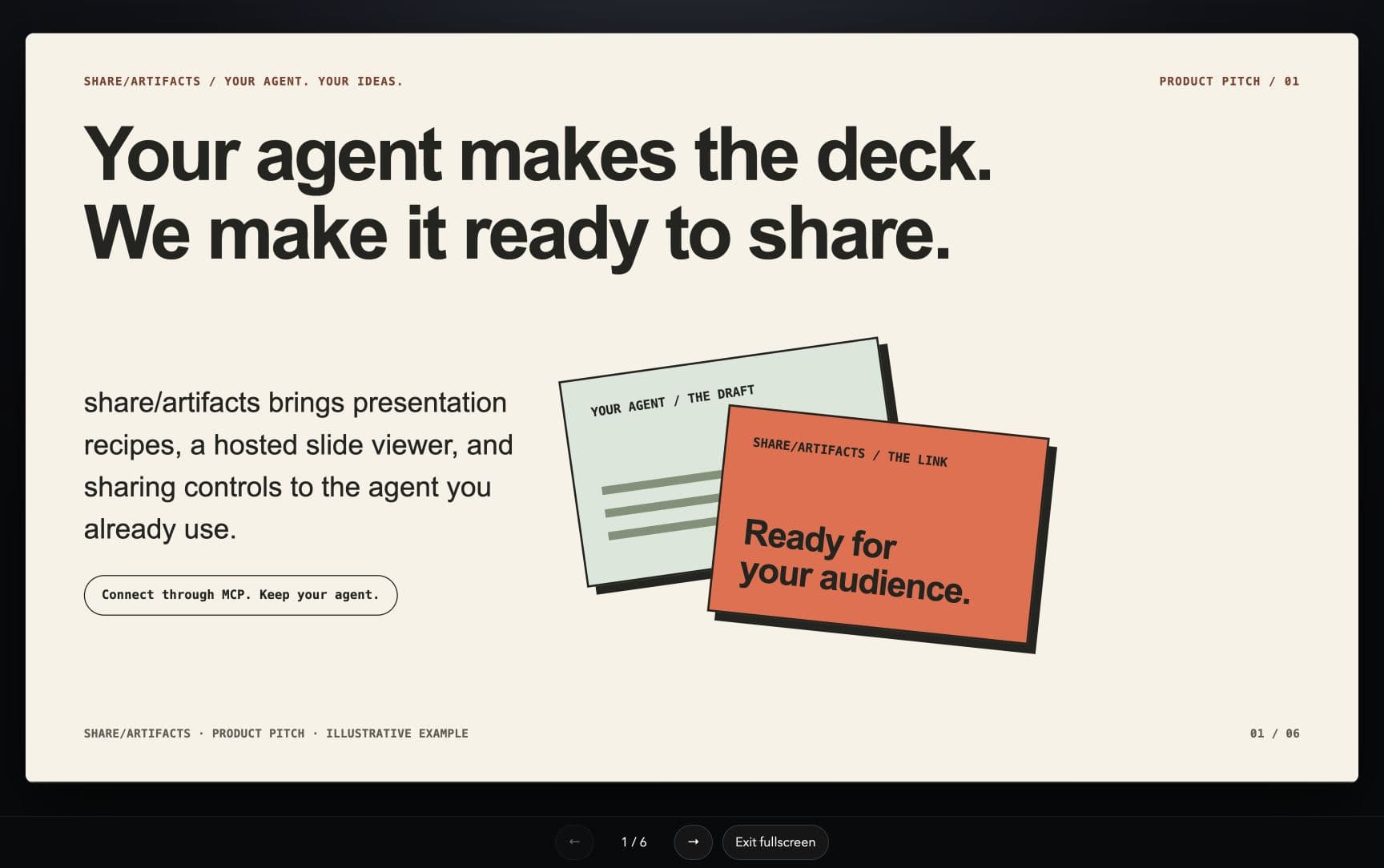
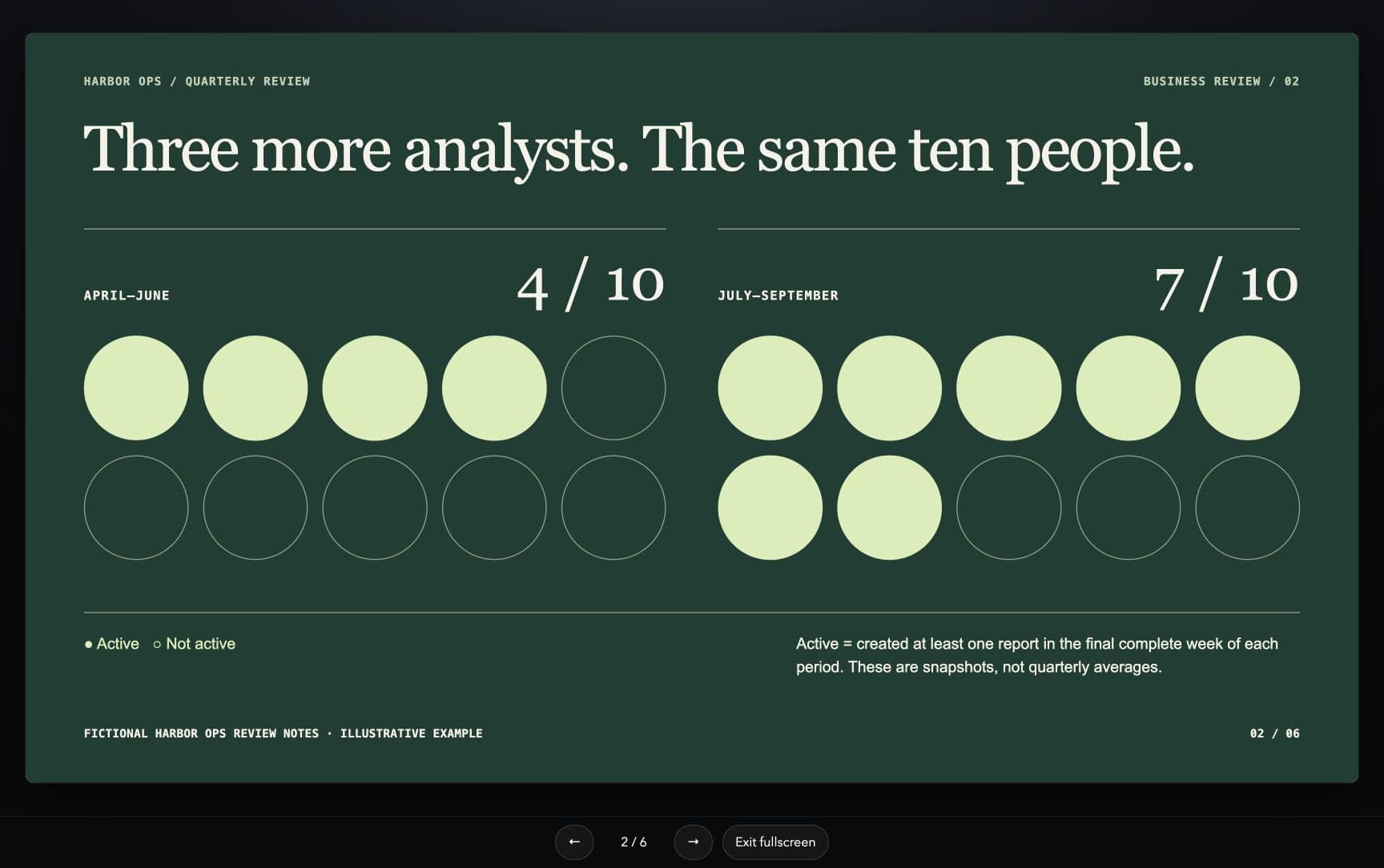
The design can follow the idea all the way down to the details. A shared style can also change across the whole deck without rebuilding each slide separately. That is a much bigger opportunity than generating another set of attractive template pages.
The work can stay with the agent
By the time I need a presentation, the useful context may already be in an agent conversation: research, notes, alternatives, diagrams, and the reasons behind a decision.
I want to keep working with that context. Ask for a narrative. Inspect a first draft. Challenge a weak slide. Change the visual treatment. Ask the agent to explain where a number came from.
A reusable skill can carry the presentation method: how to establish the story, choose visual forms, apply a style, and review the result. The next deck can use that method with different content. The method becomes something I can own and improve.
HTML makes this attractive because the agent can read and revise the actual artifact. I do not need to accept the initial generation as a finished design, or move into a separate editor to make every meaningful change.
The value is the continuity from thinking to making to refining.
There is a bigger possibility here too: the presentation becomes one expression of the underlying work. The same source material could become a deck for a meeting and a fuller explanation for someone reading later. I expect agents to make those different views easier to create and maintain together.
The browser is already a presentation surface
A deck needs a small set of things at presentation time: a clear stage, reliable navigation, fullscreen, and a way to move through the story.
The screenshot below shows the presenter I was building around HTML decks in September 2026. The content takes the space. The controls stay small.
That separation matters. Creation can happen with an agent. Delivery can happen through a focused viewer. The audience does not need the authoring environment.
HTML also gives us the ability to design for two real reading situations: the room where somebody is presenting, and the person opening the material later on a smaller screen. Responsive layouts have to be authored properly, but the format gives us that choice. We do not have to assume every reader should receive a shrunken copy of a projector slide.
PDF can remain a useful export when someone needs a fixed document. The editable source can still be HTML. The handoff format and the creation format do not have to be the same thing.
The economics move with the workflow
When someone already uses an agent for research and writing, deck creation can become another task in that environment. A separate AI slide subscription has to earn its place.
There are still costs: model usage, review, assets, hosting, and product development. My argument is that the value moves toward better instructions, visual quality, reliable presentation, and sharing. Access to an editor becomes a weaker reason to pay.
I expect the strongest products to compete on how well they help people communicate. A product that merely wraps a prompt around a rigid slide workflow will face pressure from an agent that can work directly on the artifact.
The format can change before every workflow does
Some teams require an editable PowerPoint handoff. Others depend on established review processes, specialist charts, or a familiar editor. Those are real reasons to keep using existing tools today.
They are also the workflows an HTML ecosystem has to earn. Reliable output, easy review, shared styles, and good collaboration will matter more than a spectacular first demo.
And HTML does not make an agent factually correct. A beautifully rendered chart can still be wrong. The advantage is control over the representation; the numbers and argument still need scrutiny.
None of that changes my long-term bet. As agents do more of the construction, I expect the presentation to become an open web artifact and the editor to become one of several ways to work on it. Existing companies may adapt. The conventional slide file loses its central role.
What I am building toward
I am building share/artifacts around this direction: let your agent create the HTML, then make the result easy to present and share. The current presentation experience is static; the viewer provides navigation and fullscreen around the content.
You can explore the complete presentation examples and see how a saved design carries into a new deck.
My bet is that HTML eventually becomes the presentation format, with agents as the main way we create it. The interesting work now is making that experience good enough that people choose it without caring what format is underneath.
What would have to work well enough for you to stop asking for the slide file?
The screenshots come from the September 2026 examples. This website edition adapts the original article and includes its distinction between the human’s argument and the agent’s design work; it is not an exact transcript of the X version.