The result: we gave Claude Code and Codex the same 24 deck requests, with the notes to work from, and each made every deck twice. On their own, 65 of the 96 decks stated something the notes never said: a number, a cause, a deadline, a plan. With a tested set of deck rules, 5 of 96 did. A blind reviewer would send 87 of those 96 decks as they are, against 16 before.
Most of the made-up lines weren’t wild. They were plausible: a true fact the teacher didn’t ask for, a likely reason a number moved, a sensible-sounding deadline. That’s what makes them dangerous on a slide. The person presenting has to stand behind every line, and nobody can tell which ones came from the notes.
How often do AI slides make things up?
Often, and it isn’t one agent’s problem. We ran four kinds of deck that people make every week: a product decision, a product update for leadership, a roadmap, and a talk or lesson. Each agent made every deck twice on its own and twice with the rules. A reviewer that didn’t know which was which read every slide and flagged any deck that stated something the notes didn’t contain.
| Kind of deck | Claude on its own | Claude with the rules | Codex on its own | Codex with the rules |
|---|---|---|---|---|
| Product decision | 8 of 12 | 3 of 12 | 8 of 12 | 2 of 12 |
| Product update | 11 of 12 | 0 of 12 | 5 of 12 | 0 of 12 |
| Roadmap | 12 of 12 | 0 of 12 | 5 of 12 | 0 of 12 |
| Talk or lesson | 8 of 12 | 0 of 12 | 8 of 12 | 0 of 12 |
| All four | 39 of 48 | 3 of 48 | 26 of 48 | 2 of 48 |
The agents were Claude Code with Claude Opus 5.5 and Codex with GPT-6.1 Sol. Half of the requests were held out: the rules were never tuned on them.
On those held-out requests, a separate checker read the text of every deck line by line against the notes. On their own, Claude’s talk and lesson decks presented 39 facts as real that the teacher or speaker never gave; with the rules, 0. Codex went from 9 to 1. In product updates, made-up plans, owners, deadlines and recommendations went from 18 to 0 for Claude and from 20 to 0 for Codex.
What does a made-up fact look like on a slide?
Here is one request a teacher might send: a fun, friendly deck for an 8th grade class on why the moon has phases, with the notes on what to cover.
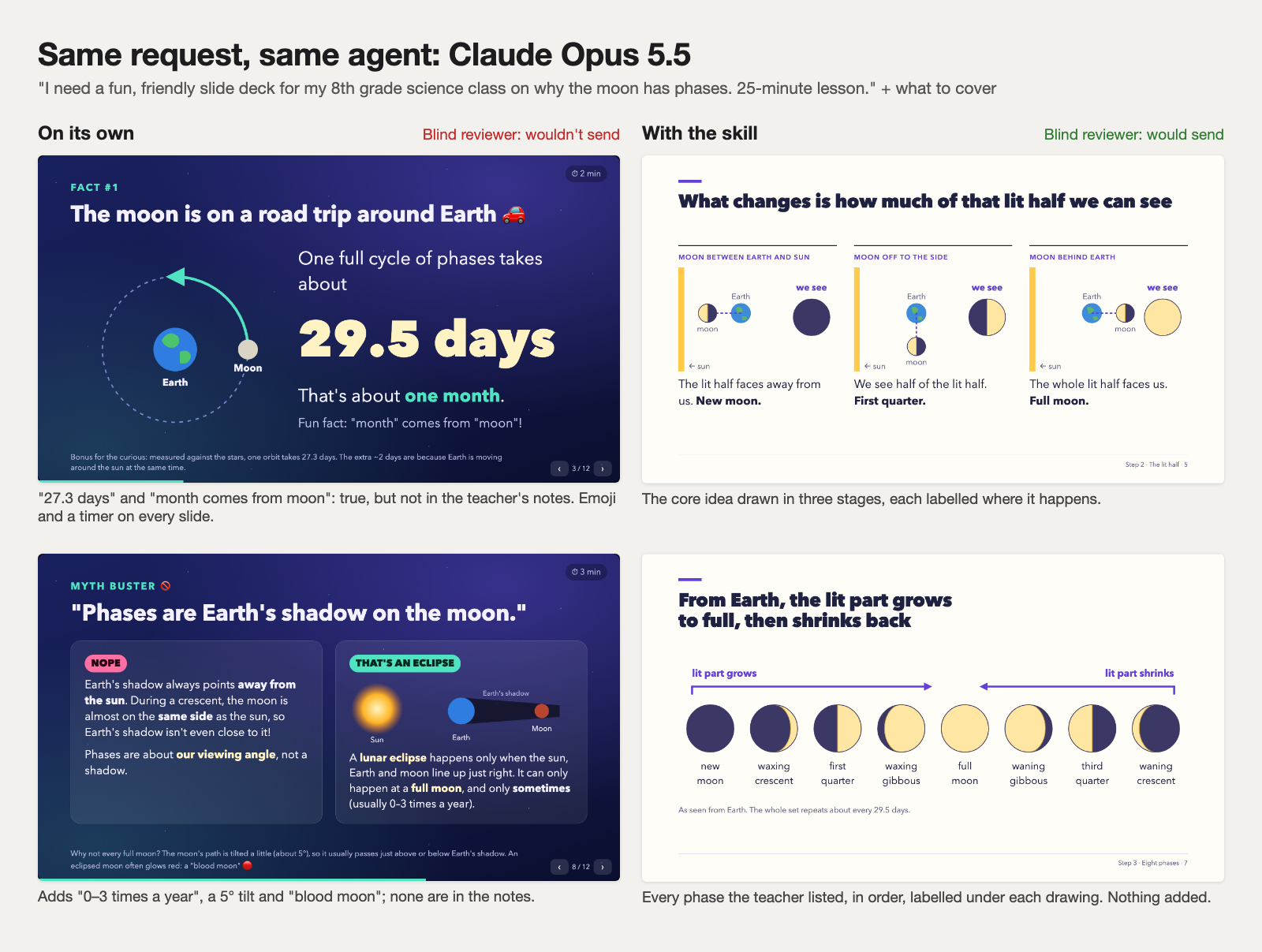
Nothing on the left is absurd. That’s the point. A teacher who skims it before class would have to fact-check four extra claims they never planned to teach, and explain a blood moon if a student asks.
Work decks show the same pattern in a different form. Four kinds of addition kept coming up:
- Causes. A CEO update where the notes say nobody knows yet why subscriptions jumped. On its own, the deck says “the October beat came from more people coming in, not from better conversion”.
- Plans nobody made. Owners, 48-hour checkpoints, 90-day plans and “decision needed today” added to roadmaps and updates. Every one of 24 roadmap decks made before the rules existed added at least one.
- Recommendations nobody made. Asked to let leadership decide whether to build something, 3 of 4 decks made on their own recommended building it.
- Evidence made bigger. “The biggest churn driver” for a reason 31% of exit surveys gave.
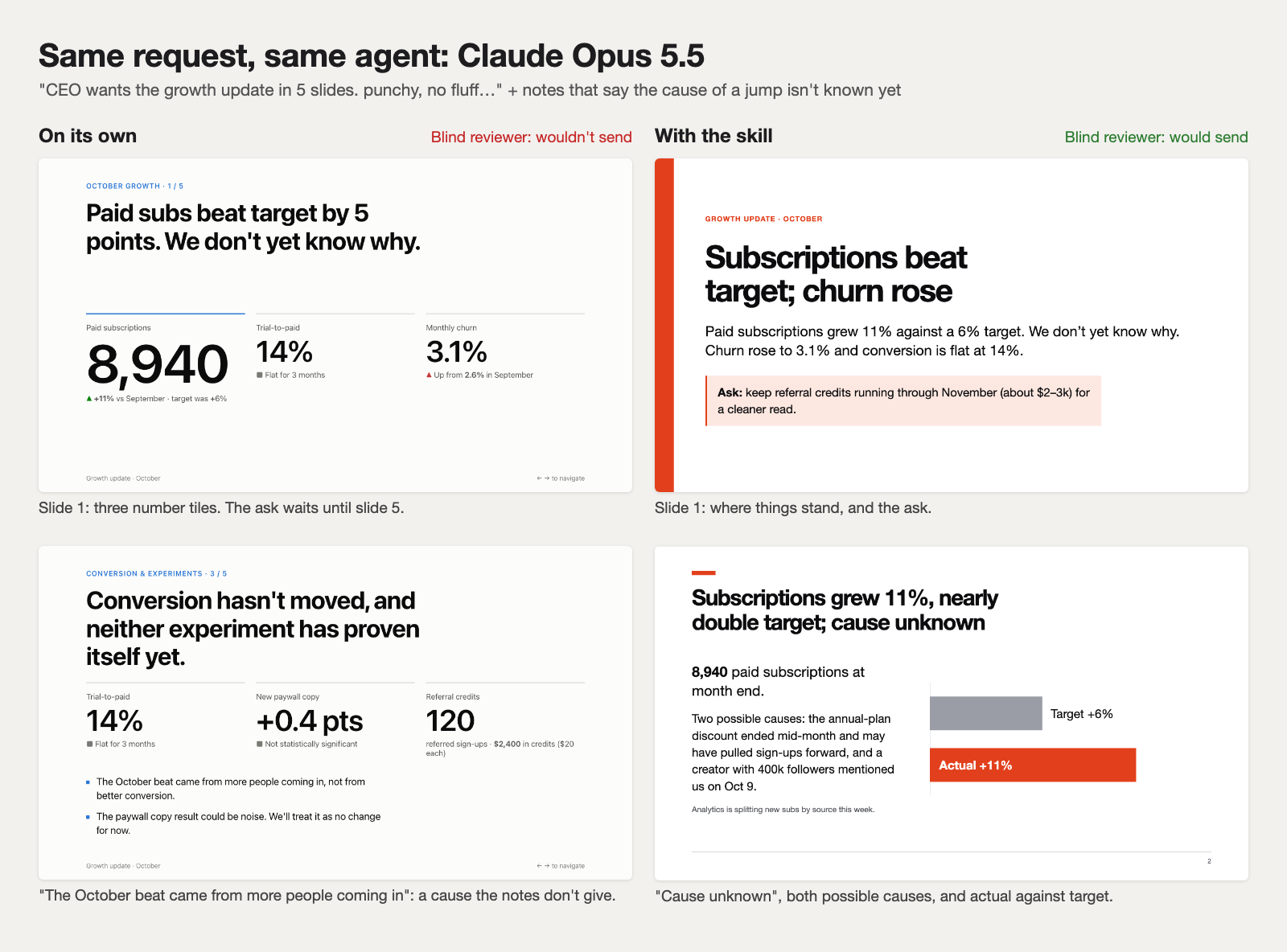
Why do AI agents add facts you didn’t give them?
Because a deck has slots, and an agent fills them. A decision deck “should” have risks and next steps. A roadmap “should” have owners and dates. A lesson “should” have a fun fact. When your notes don’t supply one, a capable model writes the most plausible thing it knows. The more polished the slide, the less anyone questions it.
We saw this in our own early rules, too. A rule asked for the decision criteria and what would change the recommendation. Given a finished memo that didn’t state them, Claude and Codex wrote their own in every test deck. The fix wasn’t a stronger warning. It was changing what the rules ask for when the material doesn’t have it.
We’re not the only ones measuring this. One AI slide maker fact-checked six AI presentation tools on the same prompt and found the best one got 44% of its claims right (LayerProof). The usual advice is to treat every AI statistic as a placeholder. That works, but it moves the work to you.
What stops an AI agent making up facts in a deck?
Not a longer “don’t hallucinate” line. What worked was a few specific rules, each aimed at one of the slots above:
- Only your facts. Every number, example, story, cause, plan, owner and date comes from the notes, or it isn’t on the slide.
- Unknown stays unknown. If the notes don’t give a cause, the slide says it’s unknown and names the possibilities the notes mention, never as the title.
- Gaps become questions, not filler. A choice only the reader can make goes on the slide as a question. A fact only you know goes in the agent’s reply, asking you. Never “TBD” on a slide.
- No recommendation you didn’t make. When the reader has to choose, the options are set out alike, with the same numbers. Your lean appears only if you gave one.
- From a document, keep the document. When you start from a memo, a section the deck usually has but the memo doesn’t is left out, and the agent asks you about it. With our earlier rules, the reviewer would send 0 of 8 memo-to-deck requests; with this one, 8 of 8.
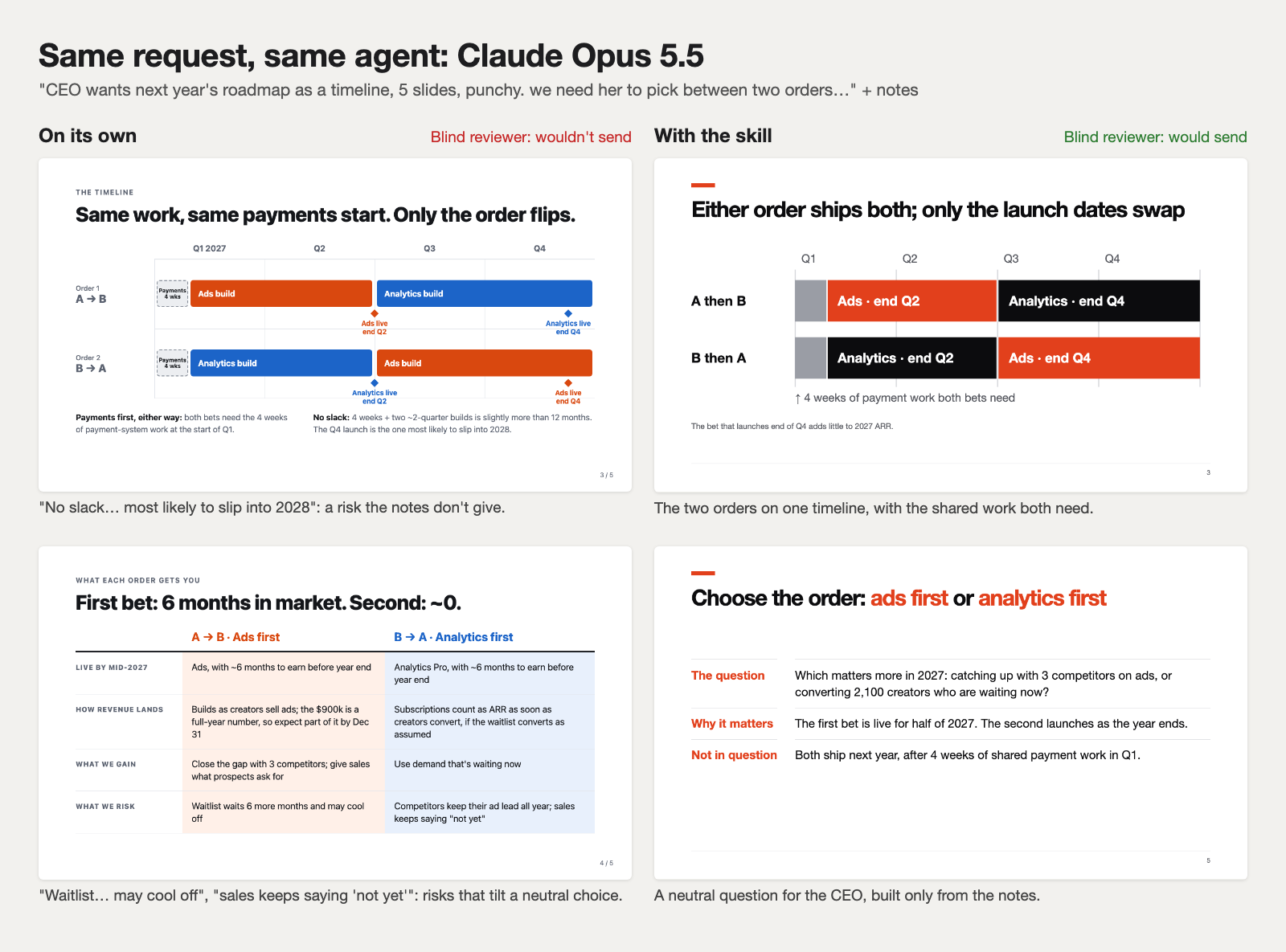
Do the decks get worse when the agent can’t add things?
No. They got better. The same blind reviewer was asked whether it would send each deck as it is: 87 of 96 with the rules, against 16 of 96 on their own. A separate checklist of what each audience needs showed nothing important dropped: on held-out talks, Claude covered 60 of 60 items with the rules against 52 of 60 on its own.
Two limits worth knowing. Decision decks still had a few lines the reviewer couldn’t trace (16 decks flagged down to 5, not 0), and Codex still adds some plans to roadmaps on new requests (25 lines down to 16). Those are next. Some decks also came out plainer, because there was less to put on each slide; making a thin slide carry a drawing of your own numbers is the next fix.
How can you check an AI deck before you send it?
Whatever tool made it, these are the questions our reviewer answered for every deck. They take about two minutes:
- Is anything stated that isn’t in my notes? Look hardest at causes, dates, owners and “fun facts”.
- Would I need to fact-check it before forwarding?
- Does slide 1 give a clear position and the ask?
- Is it about this situation, or could it be anyone’s?
- Does it look like a template or an AI default?
- Is any layout broken: tiny text, overflow, overlap?
- Is it longer than what was asked?
- Would I send it as it is?
How we tested
Each test used six requests written like real ones, with notes, for one kind of deck; three of the six were held out from tuning. Claude Code (Claude Opus 5.5) and Codex (GPT-6.1 Sol) each made every deck twice on their own and twice with the rules, 192 decks in all. The reviewer was a Claude model that read screenshots of every slide of two decks for the same request, without knowing which used the rules, answered the checklist above for each, and picked the one it would send. A second checker compared each held-out deck’s text with the notes. I checked the look of every release myself. No human panel has judged these decks yet.
Every request, number and result is published: decision decks, product updates, roadmaps, talks and lessons and decks from a document. Example decks use fictional companies and numbers. You’re welcome to cite these results, with a link.
Try the rules with your own agent
The rules are free and open source, as a skill that picks the right method for the kind of deck you ask for. In Claude Code or Codex:
npx skills add arunai30/super-document-skills --agent claude-code --skill create-html-presentation --copyFor Codex, use
--agent codex.
Using Claude in the browser or another agent that can’t install skills? Connect share/artifacts and your agent gets the same deck recipes, then publishes the finished deck as a private or shared link. The skill’s source is on GitHub.