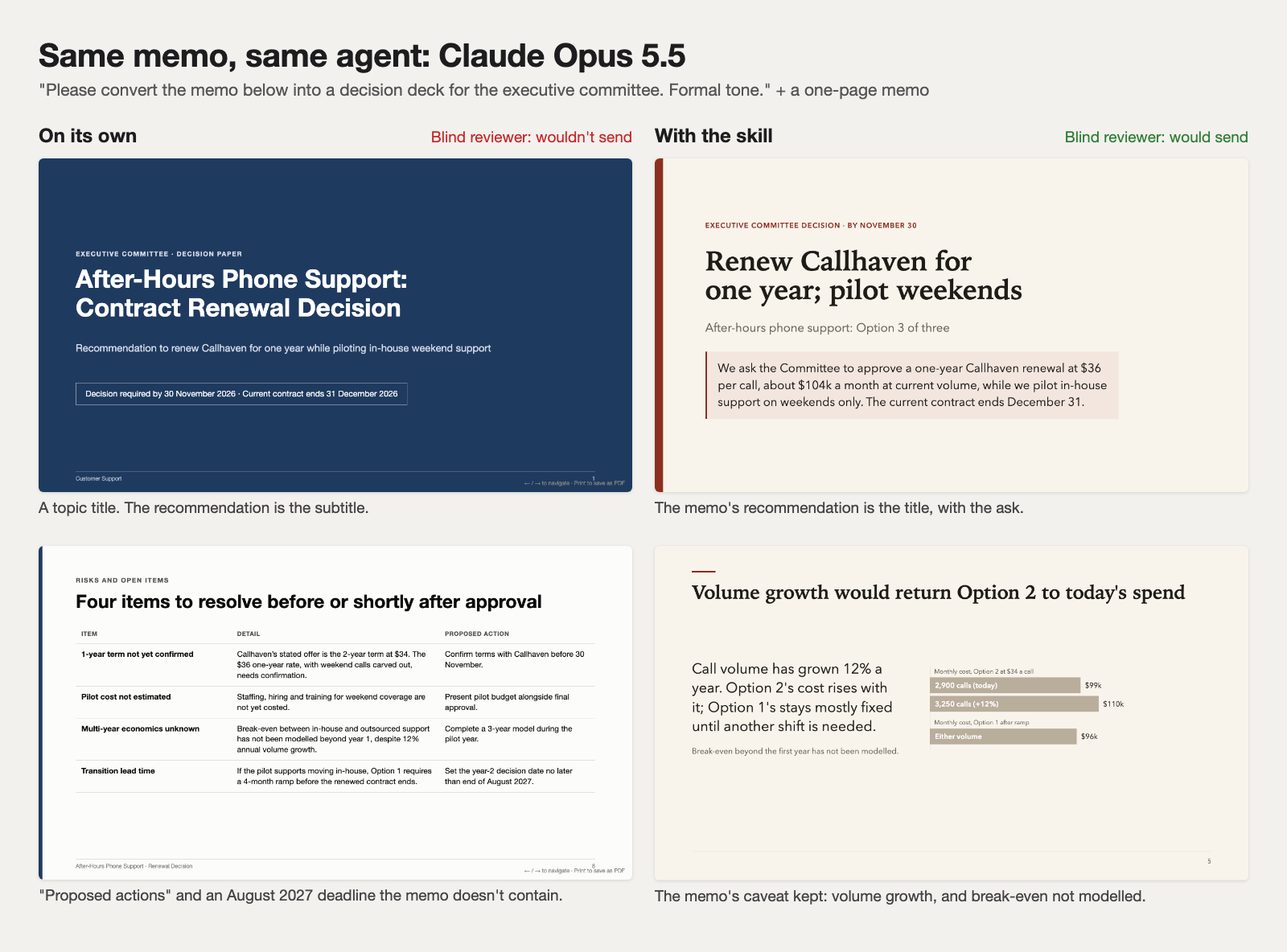
The short answer: paste the finished document and say who the deck is for, and use a method that treats your document as the argument: keep its conclusion, its order of reasoning, its evidence and its caveats, put the “because” in the titles, and add nothing the document doesn’t say. When the deck would usually have a section your document doesn’t, the agent asks you instead of writing it. In our blind test of memo-to-deck requests, a reviewer would send 7 of 8 decks made this way, against 2 of 8 made by Claude and Codex on their own.
Product managers do their thinking in a doc and then retype it into slides, and as one put it on r/ProductManagement, “something always gets flattened”. Handing the retyping to an AI saves the time but flattens it in a new way: the agent fills in what a deck usually has, whether or not you wrote it.
What goes wrong when AI turns a document into slides?
- It adds what decks usually have. Risks, next steps, owners, deadlines, a three-year model, decision criteria. Given a one-page memo for an executive committee, Claude on its own added “proposed actions” and an August 2027 deadline the memo never mentioned.
- The answer moves. The memo leads with a recommendation; the deck leads with a topic title and saves the recommendation for later.
- The caveats disappear. The line that would change the decision, such as “we have not modelled the break-even beyond year 1”, is the first thing cut.
- Working notes appear. Codex on its own left 41 lines of working notes on the slides of four memo decks.
What should a deck made from your document do?
- Keep the conclusion and the order of reasoning. The deck compresses your argument; it doesn’t re-argue it.
- Keep the “because” in the titles, so the reasoning survives the cut. Edward Tufte’s critique of slides is that they break reasoning into fragments and drop causality; full-sentence titles carry it back.
- Keep the caveats and counterpoints that would change the decision. Drop background the reader already has.
- Add nothing. No numbers, owners, dates or conclusions the document doesn’t contain. If it’s unsure or contradicts itself, the deck shows that rather than picking.
- Ask about gaps. If a deck of this kind normally has a section your document doesn’t supply, the agent leaves it out and asks you about it in its reply.
- Move detail to an appendix, not onto slides. Nancy Duarte’s rule of thumb: a slide past about 75 words has become a document.
How do you make a version of a deck for another audience?
The same rules apply when the source is a deck: an exec update recut for the sales team call, or an approved plan recut for the engineering kickoff. Say who the new audience is and what they need to do. A good recut keeps the facts and numbers, changes what leads, the depth, the vocabulary and the ask, leaves out what the new audience shouldn’t see (internal customer names, revenue, debates), and adds nothing: no cutover plans, talk tracks or acceptance criteria nobody made.
On their own, Claude added something not in the source to all 6 recut decks we tested, and Codex to 3 of 6. With the method, 0 for both. The recuts are where the method still has work to do: the reviewer found many of them plain, because keeping only the source’s facts leaves less on each slide. Making a light slide carry a drawing of the source’s own numbers is next.
How do you do it with Claude?
- Give Claude the method. In Claude Code or Codex, install the free skill:
npx skills add arunai30/super-document-skills --agent claude-code --skill create-html-presentation --copy(or--agent codex). In Claude in the browser, connect share/artifacts and Claude fetches the same recipes. - Paste the document and say who the deck is for, and the tone if it matters: “Please convert the memo below into a decision deck for the executive committee. Formal tone.” Saying it’s a finished document helps: “the memo is done, I just don’t want to retype it.”
- Read the agent’s reply for the questions about anything your document didn’t cover, and answer the ones that matter.
- Check the numbers it derived. Even with the method, an agent rounds: in one test deck, a $5.8k gap became “about $5k”.
- Share it as an HTML file, a PDF, or a private or shared link you update in place. It isn’t a PowerPoint file.
How we tested
Two memo requests written like real ones: a product decision memo for a VP’s review, and a formal memo for an executive committee, which the method was never tuned on. Claude Code (Claude Opus 5.5) and Codex (GPT-6.1 Sol) each made each deck twice on their own and twice with the method, 16 decks in all. A Claude model that didn’t know which was which read every slide; a second checker compared each deck’s text with the memo line by line.
| What we measured | Claude on its own | Claude with the method | Codex on its own | Codex with the method |
|---|---|---|---|---|
| Reviewer flagged something not in the memo | 2 of 4 | 0 of 4 | 3 of 4 | 0 of 4 |
| Lines the checker couldn’t trace to the memo | 44 | 20 | 36 | 11 |
| Working-note lines on slides | 14 | 0 | 41 | 1 |
| Memo points covered | 37 of 40 | 38 of 40 | 35 of 40 | 38 of 40 |
| Would send as it is | 2 of 4 | 3 of 4 | 0 of 4 | 4 of 4 |
The reviewer picked the deck made with the method in 7 of 8 pairs. The exception was Claude on the executive-committee memo: its deck with the method was cleaner, but it rounded a cost gap and used two informal labels, and the reviewer sent Claude’s own deck instead, after noting it had added next steps the author should check. Lines the checker couldn’t trace dropped by more than half, but not to zero; most of what remains are small inferences, such as when savings start or what an approval covers, and that’s what we’re tightening next.
An earlier version of our method made the same mistake as the agents: given a finished memo, it still asked for decision criteria and conditions the memo didn’t state, and both agents wrote their own. Changing what the method asks for when the source doesn’t have it took memo decks the reviewer would send from 0 of 8 to 8 of 8. How that was tested; recut results are in the talk and lesson results.
More on why agents add things: we counted it across 192 decks. For decisions and updates written from scratch, see the guide for product decks.