The short answer: give Claude your lesson notes, not just a topic: what you cover, the worked example with its numbers, the mistake students make, and the practice question with its answer. Then use a lesson method that keeps every step you listed, works your example in stages, shows the mistake as a mistake, puts the answer after the question, and adds no facts you didn’t give. In our blind test, a reviewer would send all 4 Claude lesson decks made this way, against 1 of 4 made without it.
Without a method, AI lesson slides tend to look lively and teach something slightly different from your plan: extra facts, a timer on every slide, a “click to reveal” that does nothing on a static slide. This guide shows what to give Claude, what a good lesson deck does and why, and how to make one.
What goes wrong when AI makes lesson slides?
We asked Claude for an 8th grade lesson on why the moon has phases, with the teacher’s notes on what to cover. On its own, the deck added “27.3 days”, “0–3 eclipses a year”, a 5° tilt and a “blood moon”. They may be true, but none were in the notes, and the teacher would have to check and explain each one in front of the class.
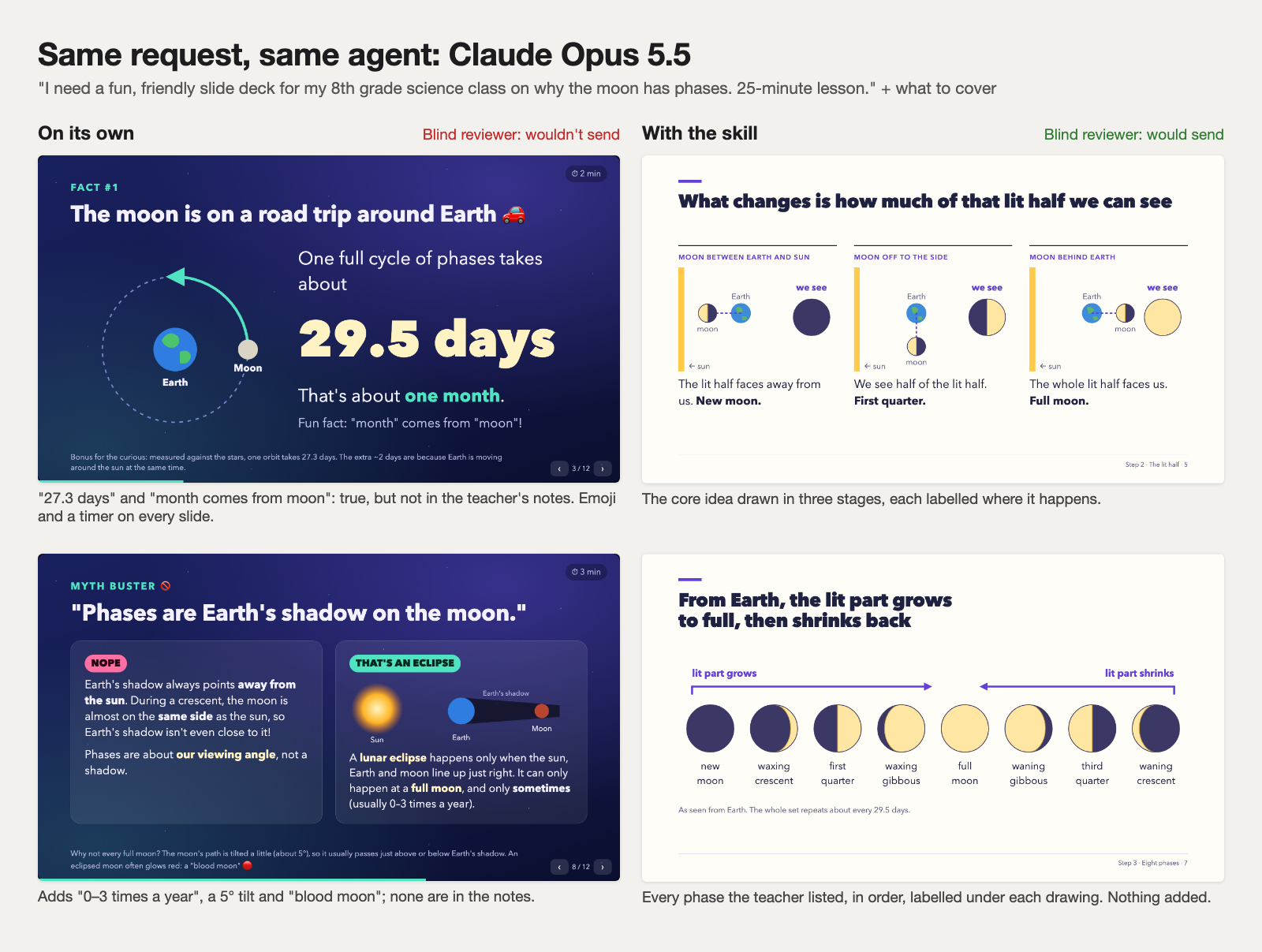
Across the talks and lessons in our test, the problems repeated:
- Facts you didn’t give. On the requests the method was never tuned on, Claude’s decks on their own presented 39 facts as real that weren’t in the notes.
- The script on the slide. Paragraphs the teacher will say anyway, timer chips, and “click a card to reveal” on a slide that can’t be clicked.
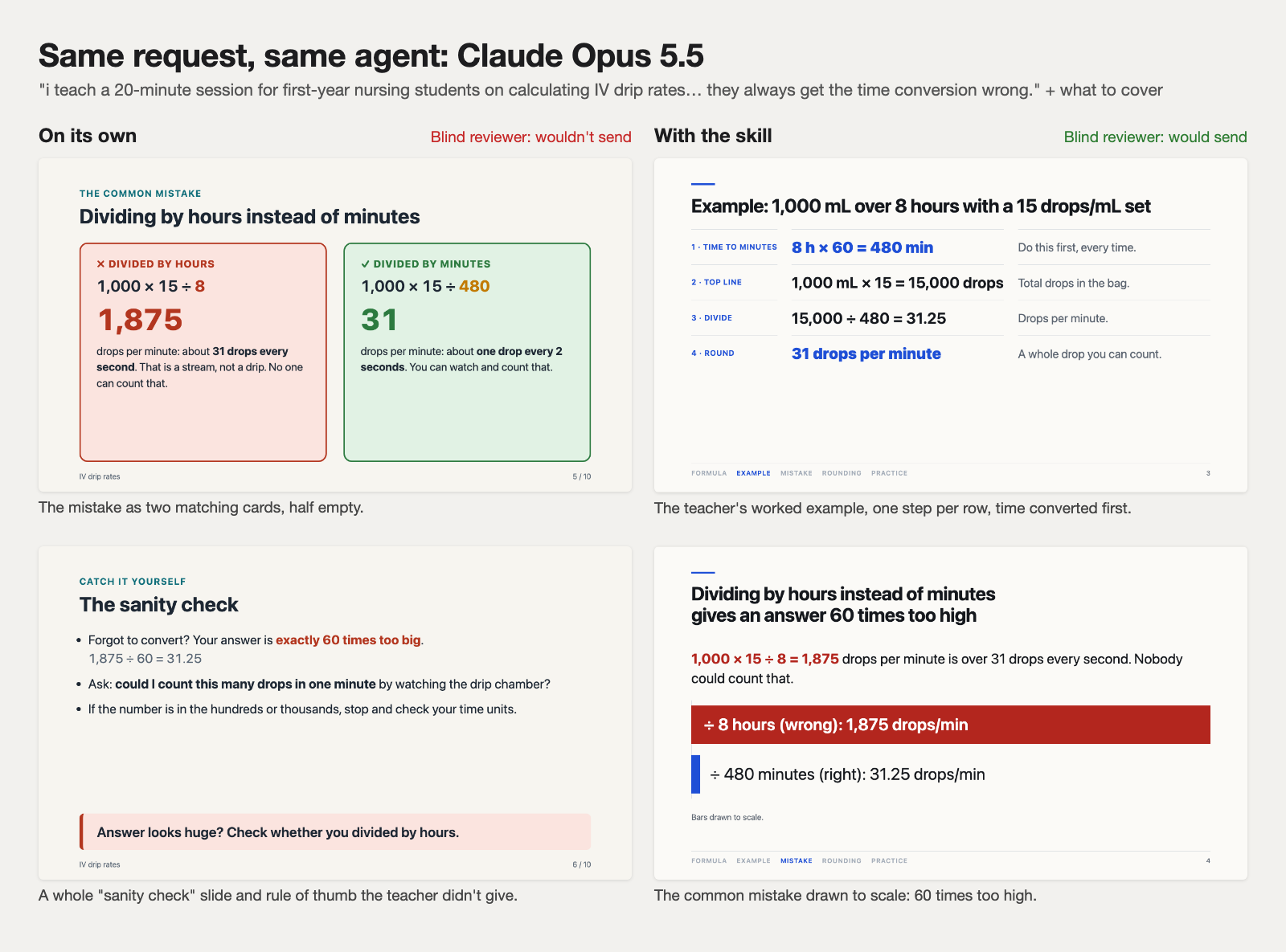
- Topic labels instead of points. “The common mistake” as a title, where “Dividing by hours instead of minutes gives an answer 60 times too high” teaches it.
- The AI look. Emoji in every title, rows of identical cards and gradients.
What should you give the AI for a lesson?
Your plan, in plain words. The more of it you give, the less the AI has to guess. This is one of our test requests, written the way a teacher would send it:
i teach a 20-minute session for first-year nursing students on calculating IV drip rates. can you make me slides? they always get the time conversion wrong.
What I cover: the formula, drops per minute = volume (mL) × drop factor (drops per mL) ÷ time (minutes). Worked example: 1,000 mL over 8 hours with a 15 drops/mL set gives 1,000 × 15 ÷ 480 = 31.25, rounded to 31 drops per minute. The common mistake: dividing by hours instead of minutes (1,000 × 15 ÷ 8 = 1,875, which is obviously wrong). Rounding: always round to a whole drop. A practice question at the end: 500 mL over 4 hours with a 20 drops/mL set (answer: about 42 drops per minute).
Notice what’s in it: who the students are, how long you have, what they get wrong, the steps in order, one worked example with real numbers, and the practice question with its answer. Add a tone if it matters (“fun, friendly” for 8th graders). If something is missing, a good method asks you rather than filling it in.
What does a good lesson deck do, and why?
The rules come from research on how people learn from slides, mostly Richard Mayer’s multimedia learning experiments and a study of 110 engineering students by Garner and Alley:
- Titles that make the point. Each title is a full sentence, so the titles read in order are the lesson. Garner and Alley found a claim headline with visual evidence beat topic-and-bullet slides on comprehension and misconceptions.
- One worked example, in stages. The example you gave, one step at a time, in the order students do it. Breaking material into steps is one of Mayer’s tested principles.
- The common mistake, shown as a mistake. Side by side with the right answer, and drawn to scale when it’s a number, so the size of the error is visible.
- Words next to the picture. Labels on the diagram, not in a legend or a separate list. In Mayer’s review, this effect held in 22 of 22 tests.
- Don’t put the script on the screen. About 30 words a slide. What you’ll say goes in speaker notes, which the agent gives you in its reply. Putting the spoken words on screen as text hurt learning in 16 of 16 tests.
- The answer after the question. The practice question on one slide, the answer on the next.
- Nothing you didn’t give. Every fact, number, example and story comes from your notes.
How do you make it with Claude?
- Give Claude the lesson method. In Claude in the browser, add share/artifacts as a connector; Claude then fetches the lesson recipe when you ask for slides. In Claude Code or Codex, install the free skill:
npx skills add arunai30/super-document-skills --agent claude-code --skill create-html-presentation --copy(or--agent codex). - Paste your notes and ask for the slides. Say the class, the length and the tone. You don’t need to name the method; the skill picks the lesson recipe for a lesson or talk.
- Let it check the slides. In Claude Code or Codex, the skill renders every slide and the agent fixes overflow and stray labels before handing over.
- Read the speaker notes in its reply and answer any question it asks about something your notes didn’t cover.
- Teach from the browser, print it, or share a link. The deck is one HTML file that opens anywhere and prints to PDF for handouts; with share/artifacts it becomes a private or shared link you can update. It isn’t a PowerPoint file, so if your school needs .pptx, use a tool that makes one.
Our tests ran in Claude Code and Codex. The connector gives Claude in the browser the same recipe.
How well does it work?
Two of our test requests were lessons: the nursing IV drip session and the moon-phases lesson, which the method was never tuned on. Each agent made each lesson twice on its own and twice with the method. A blind reviewer read every slide.
| What the reviewer found | Claude on its own | Claude with the method | Codex on its own | Codex with the method |
|---|---|---|---|---|
| Would send as it is | 1 of 4 | 4 of 4 | 3 of 4 | 4 of 4 |
| States something not in the notes | 4 of 4 | 0 of 4 | 3 of 4 | 0 of 4 |
| Picked as the one to send | 0 of 4 | 4 of 4 | 3 of 4 | 1 of 4 |
Codex’s own lessons were often good enough to send, and the reviewer preferred them in 3 of 4 pairs; what the method changed for Codex is that it stopped adding facts. Lessons are a small sample, so here is the whole talk and lesson test, six requests and 12 decks per agent each way: with the method, the reviewer would send 12 of 12 for both agents, against 2 of 12 (Claude) and 4 of 12 (Codex) on their own. Every request and number.
The reviewer was a Claude model that didn’t know which deck used the method. No teachers have judged these decks yet; a teacher review of the principles is next. Want to see how often AI slides add facts in general? We counted it across 192 decks. For other kinds of deck, see the full guide for Claude Code and Codex.