The short answer: a roadmap deck has one job, getting leadership to agree what gets built, in what order, and what that pushes out. Give your AI the work, the goals, the capacity and the dates you’ve actually committed to, ask for the format your leader wants, and use a method that adds no plans, owners or dates of its own. In our blind test, a reviewer would send 12 of 12 Claude roadmap decks made this way, against 0 of 12 made without it. For Codex it was 11 of 12, against 2.
On their own, AI agents make roadmaps that look decisive and say things nobody decided. Every one of the 24 roadmap decks Claude and Codex made on their own added at least one owner, checkpoint, deadline or rule that wasn’t in the notes. This guide shows what goes wrong, what to give the AI, what a good roadmap deck does, and how to make the customer version sales keeps asking for.
What goes wrong when AI makes a roadmap presentation?
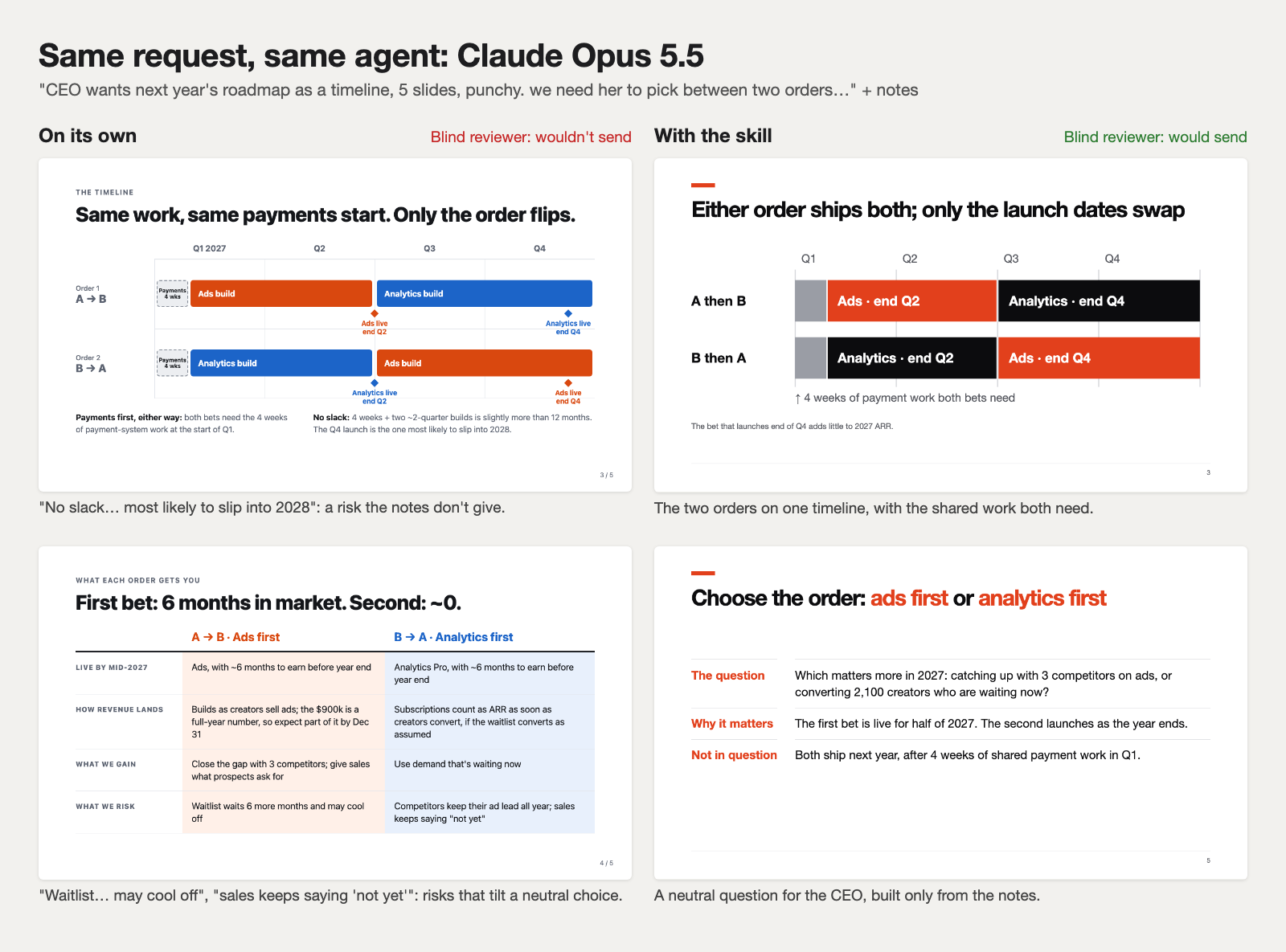
- Plans nobody made. Owners, checkpoints, “decision needed today”, and rules like “if any estimate slips, Workday is the item that moves”.
- Recommendations you didn’t make. Asked to let the reader choose between two orders, Codex recommended one anyway.
- Evidence made bigger. “The biggest churn driver” for a reason 31% of exit surveys gave.
- Risks that tilt the choice. A slip into next year, or a waitlist that “may cool off”, when the notes say neither.
- Too many items and too long. Nine of Claude’s 12 roadmap decks were longer than the request needed.
What should you give the AI for a roadmap deck?
- Who it’s for and what you need from them: agree the order, pick between two sequences, accept a delay.
- The format they want. Some leaders want quarters on a timeline; others want now / next / later. One product manager’s leadership “won’t accept Now, Next, Later columns”; the top reply: “Plan for one year. Commit to next quarter.”
- The items and the goal each serves, with the evidence that put it there: customer demand, a number, a dependency.
- Capacity and estimates, if you have them, and which dates are real commitments (a contract, a regulation).
- What you’re not doing and what each order would push out.
If something’s missing, a good method asks you in its reply instead of filling it in.
What does a good roadmap deck do?
The method draws on Marty Cagan’s case for outcomes over feature lists, ProdPad’s now-next-later guide, Aha!’s advice on presenting roadmaps to executives, and product managers’ threads on roadmap reviews:
- Slide 1 says what you’ll focus on and what you need agreed.
- Items sit under the goal they serve, not grouped by team or ticket.
- Confidence falls with distance, and the slide shows it. The near term is specific; later is themes. A contract or regulatory date is marked as a commitment.
- The reader’s format, without adding precision the plan doesn’t have.
- Evidence at its real size for each priority.
- Tradeoffs on their own slides: what each order delays, and a short “not now” list, so the roadmap picture stays clean.
- About ten themes or fewer; long idea lists fold into themes.
- Options set out alike, with your lean only if you gave one.
- Nothing you didn’t give: no estimates, dates, owners, revenue or customer names of its own.
How do you make a customer-facing roadmap from internal notes?
Sales wants a roadmap to show prospects, and your notes are full of things prospects mustn’t see: a big customer threatening to leave, a partner deal legal is still reviewing, a three-week slip. Ask for a customer version and say so. The method treats it as a different document: confirmed items and themes only, quarters at most, nothing uncertain promised, no customer names, revenue, estimates or slips, each item described in your own words, and a plain line that plans can change.
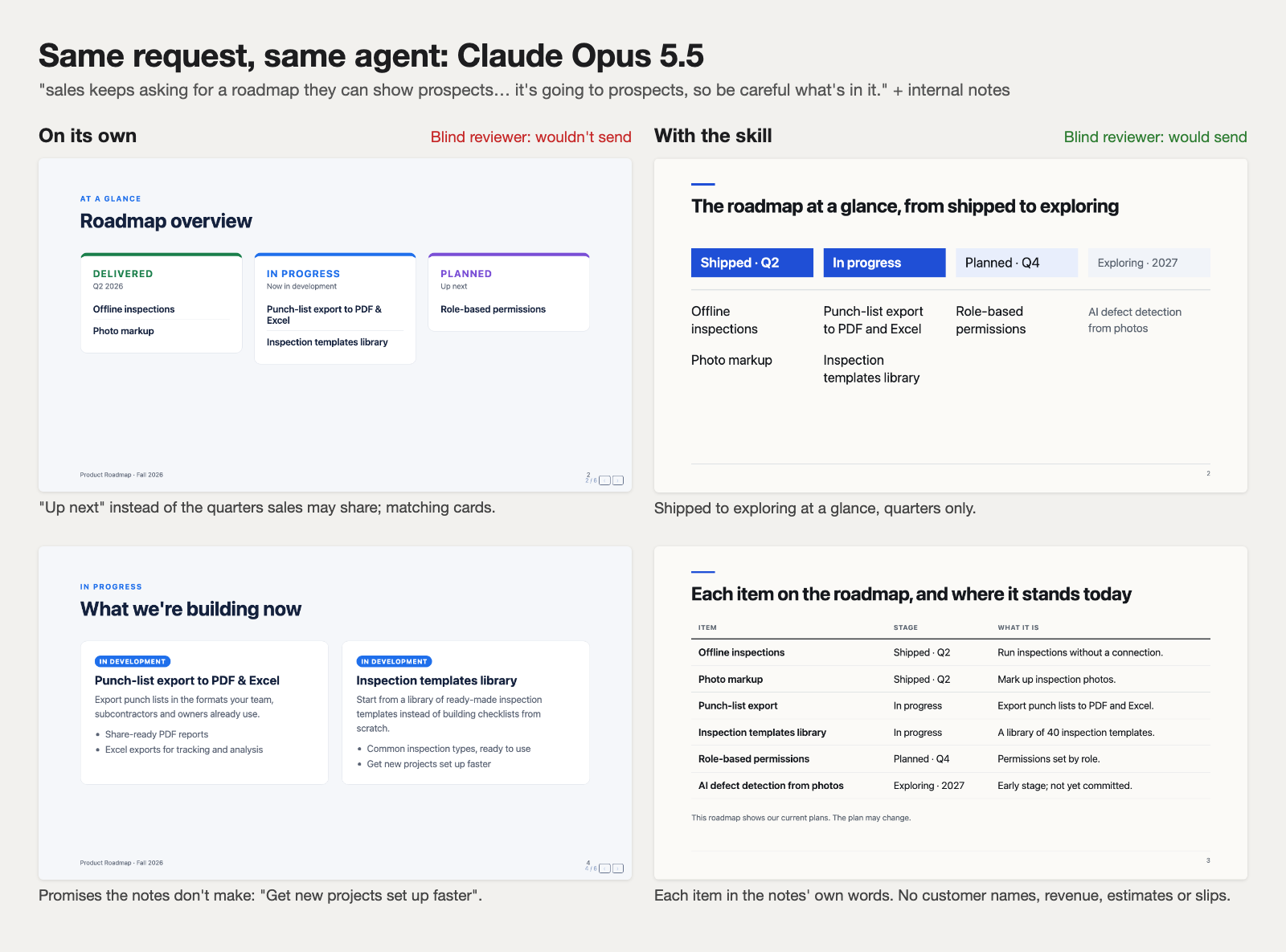
On their own, Claude added marketing claims and legal wording to its customer roadmaps, and Codex promised features the notes called uncertain.
How do you make it with your AI agent?
- Give your agent the method. In Claude Code or Codex, install the free skill:
npx skills add arunai30/super-document-skills --agent claude-code --skill create-html-presentation --copy(or--agent codex). In Claude in the browser, connect share/artifacts and Claude fetches the same roadmap recipe. - Paste your notes and ask for the roadmap. Say who it’s for, the format and the slide count if you have one. The skill picks the roadmap recipe when you ask for a roadmap.
- Let it check every slide and answer what it asks you.
- Share it. The deck is one HTML file that opens in any browser and prints to PDF; with share/artifacts it becomes a private or shared link you update in place. It isn’t a PowerPoint file.
For other kinds of deck, see the full guide for Claude Code and Codex.
How we tested
Six roadmap requests written like real ones, with notes: an H1 roadmap for a CPO who wants quarters, 12 engineer-weeks over capacity with one contract date; 14 unsized ideas into now / next / later; the customer version above; an annual plan with a regulatory deadline; the CEO choosing between two orders; and a re-plan if the team takes its biggest customer’s request. The last three were held out, so the method was never tuned on them. Claude Code (Claude Opus 5.5) and Codex (GPT-6.1 Sol) each made every deck twice on their own and twice with the method, and a Claude model that didn’t know which was which reviewed every slide.
| What the reviewer found | Claude on its own | Claude with the method | Codex on its own | Codex with the method |
|---|---|---|---|---|
| States something not in the notes | 12 | 0 | 5 | 0 |
| Broken layout | 7 | 0 | 8 | 0 |
| Too long for what was asked | 9 | 0 | 5 | 0 |
| Looks like a template or AI default | 6 | 0 | 0 | 0 |
| Would send as it is | 0 | 12 | 2 | 11 |
On the held-out requests, a separate checker read every deck line by line against the notes. Invented dates, estimates, owners, next steps and recommendations fell from 20 to 1 for Claude. Codex still adds some plans of its own on new requests, 25 down to 16, and that’s the next thing we’re fixing. The method is also still learning where a re-plan framed as “approve or decline” belongs: Codex sent it to our decision-deck method both times, and both decks were ones the reviewer would send. Every request and number.